




The Australian Dollar slips against the New Zealand Dollar as confidence sinks
- AUD/NZD slips back toward 1.2400 as Australian consumer sentiment falls to 80.4.
- Sentiment among those surveyed after the RBA hike fell to 67.2.
- The RBA's 4.60% cash rate sits 1.85 points above the RBNZ's 2.75%.
Australian consumer sentiment fell 4.7% to 80.4 in October, and the Reserve Bank of Australia (RBA) hike on September 29 did most of the damage. AUD/NZD trades just above 1.2400 on its first down day after a three-session climb from near 1.2300.
Westpac, which runs the survey, found sentiment of 86.9 among people asked before the decision and 67.2 among those asked after it, a level previously seen only during the early-1990s recession. The same bank still expects the RBA to hike again on November 3.
The RBNZ can narrow the gap six days before the RBA can widen it
The RBA's 4.60% cash rate, after its fourth hike of 2026, is the highest since 2011 and sits 1.85 points above the Reserve Bank of New Zealand's (RBNZ) 2.75%. That gap took AUD/NZD to just under 1.2500 on September 22, its highest since early 2013, and the Kiwi lost about 3% to the Aussie between late August and late September.
Money markets fully price an RBNZ hike by December, and the RBNZ decides on October 28, six days before the RBA meets on November 3. One RBNZ hike would cancel one of the RBA's four 2026 hikes in the gap until the RBA meets.
Australians expect 4.9% inflation, above the top of the RBA's 2%-3% band
The Australian Industry Group (AiG) index for August is out on Tuesday at 22:00 GMT, last at -3.5, and October consumer inflation expectations follow on Thursday at 00:00 GMT, last at 4.9%. RBNZ Governor Breman speaks the same day.
A reading above 4.9% would support a November 3 hike in the same week households told Westpac the last one hurt, and would push AUD/NZD back toward 1.2450. A softer one would leave the cross leaning on the RBNZ alone.
Aussie-Kiwi levels under 1.2500
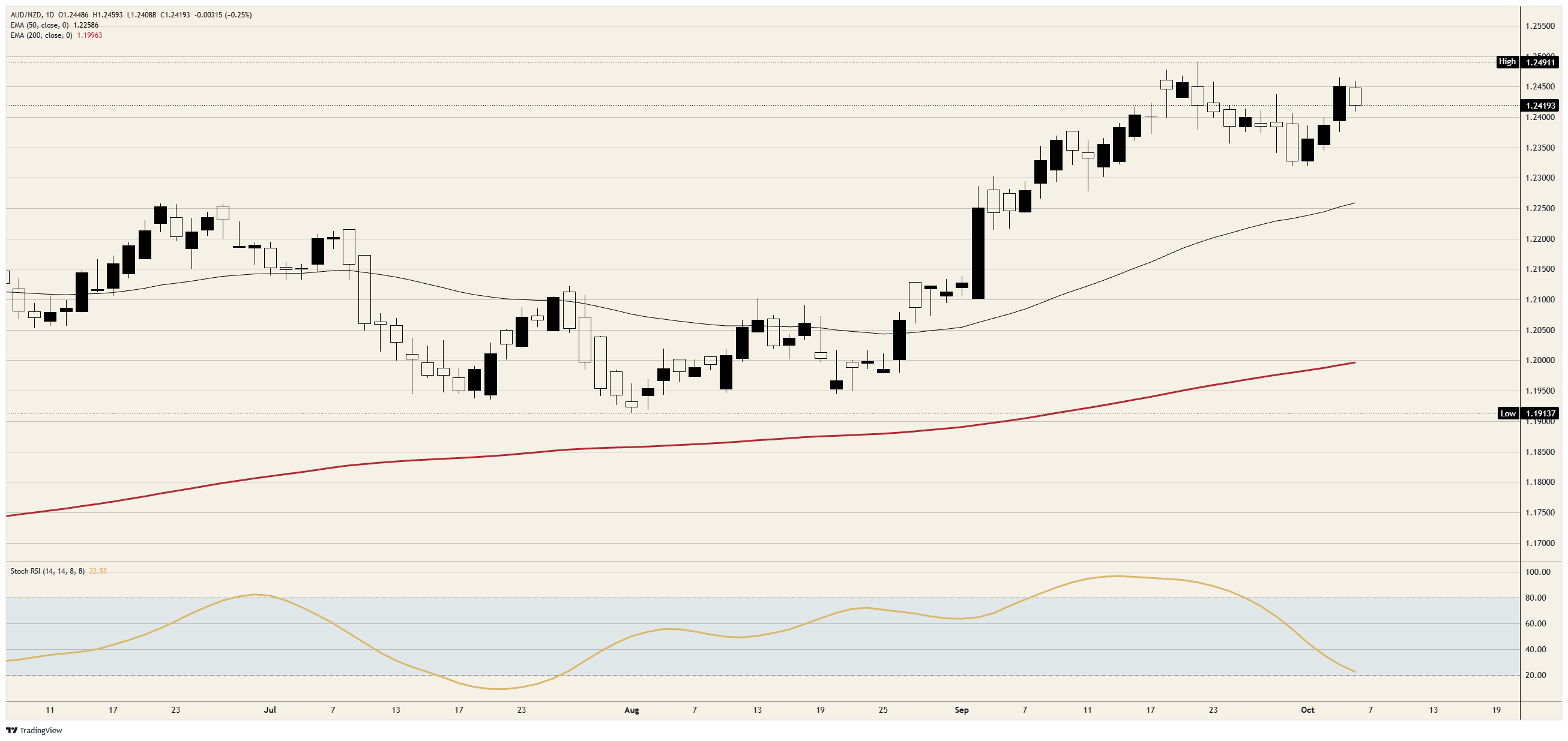
Resistance: Monday's high, just above 1.2450, ended the three-session climb, and Tuesday's high came in just under it. 1.2500 hasn't traded since early 2013, and the September 22 peak sits just under it.
Support: 1.2400 held Tuesday's low. Below it, 1.2350, then 1.2300, where September 30 and October 1 both bottomed just above it.
Bias: The lean is lower below 1.2450, with 1.2350 the first objective and 1.2300 the second. The daily Stochastic Relative Strength Index (Stoch RSI) is near 23 and still falling from above 90 in mid-September, so momentum still points down. A daily close above 1.2500 ends the call.
AUD/NZD daily chart
Australian Dollar FAQs
One of the most significant factors for the Australian Dollar (AUD) is the level of interest rates set by the Reserve Bank of Australia (RBA). Because Australia is a resource-rich country another key driver is the price of its biggest export, Iron Ore. The health of the Chinese economy, its largest trading partner, is a factor, as well as inflation in Australia, its growth rate and Trade Balance. Market sentiment – whether investors are taking on more risky assets (risk-on) or seeking safe-havens (risk-off) – is also a factor, with risk-on positive for AUD.
The Reserve Bank of Australia (RBA) influences the Australian Dollar (AUD) by setting the level of interest rates that Australian banks can lend to each other. This influences the level of interest rates in the economy as a whole. The main goal of the RBA is to maintain a stable inflation rate of 2-3% by adjusting interest rates up or down. Relatively high interest rates compared to other major central banks support the AUD, and the opposite for relatively low. The RBA can also use quantitative easing and tightening to influence credit conditions, with the former AUD-negative and the latter AUD-positive.
China is Australia’s largest trading partner so the health of the Chinese economy is a major influence on the value of the Australian Dollar (AUD). When the Chinese economy is doing well it purchases more raw materials, goods and services from Australia, lifting demand for the AUD, and pushing up its value. The opposite is the case when the Chinese economy is not growing as fast as expected. Positive or negative surprises in Chinese growth data, therefore, often have a direct impact on the Australian Dollar and its pairs.
Iron Ore is Australia’s largest export, accounting for $118 billion a year according to data from 2021, with China as its primary destination. The price of Iron Ore, therefore, can be a driver of the Australian Dollar. Generally, if the price of Iron Ore rises, AUD also goes up, as aggregate demand for the currency increases. The opposite is the case if the price of Iron Ore falls. Higher Iron Ore prices also tend to result in a greater likelihood of a positive Trade Balance for Australia, which is also positive of the AUD.
The Trade Balance, which is the difference between what a country earns from its exports versus what it pays for its imports, is another factor that can influence the value of the Australian Dollar. If Australia produces highly sought after exports, then its currency will gain in value purely from the surplus demand created from foreign buyers seeking to purchase its exports versus what it spends to purchase imports. Therefore, a positive net Trade Balance strengthens the AUD, with the opposite effect if the Trade Balance is negative.
Recommended Articles


