




AUD/NZD surges to fresh highs as Dovish RBNZ gives Aussie the win
- Dovish RBNZ hold versus hawkish RBA hike drives the cross to the top of its range.
- The RBNZ's dovish hold at 2.25% with a delayed rate hike outlook stands in sharp contrast to the RBA's 25 basis point hike to 3.85% and hawkish forward guidance, creating a clear monetary policy divergence.
- Thursday's Australian employment data and RBNZ Governor Breman's speech will test whether the divergence theme can push the cross further into new highs.
The AUD/NZD cross spiked higher on Wednesday as the Reserve Bank of New Zealand's (RBNZ) dovish hold triggered a broad New Zealand Dollar (NZD) sell-off, while the Australian Dollar (AUD) remained supported by the Reserve Bank of Australia's (RBA) recent hawkish posturing. The policy gap between the two central banks has widened meaningfully: the RBA is at 3.85% and signalling more if needed, while the RBNZ at 2.25% has pushed potential tightening out to late 2026 at the earliest. Australia's Q4 Wage Price Index at 0.8% MoM released early Wednesday added further weight to the RBA's inflation concerns. Thursday's Australian jobs data is the next risk for the Aussie side of the cross, while Governor Breman's speech could provide further guidance on the RBNZ's thinking and either reinforce or temper Wednesday's dovish signal.
Australian Dollar hits decade-plus highs against battered Kiwi
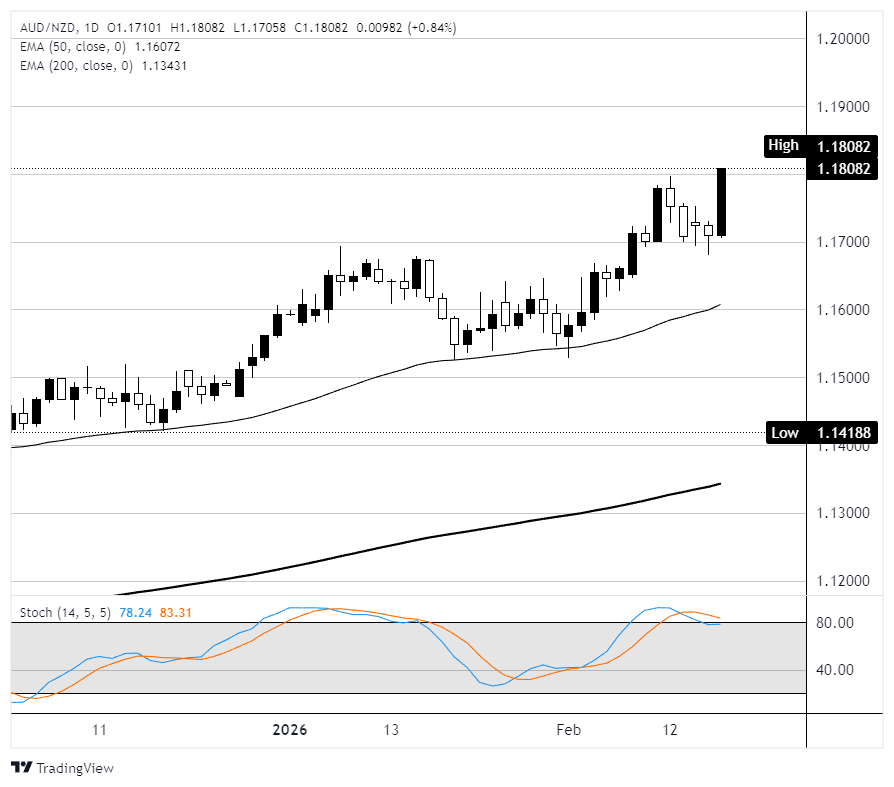
On the daily chart, AUD/NZD climbed 0.8% on Wednesday, reaching a high of 1.1807 for the first time in twelve and a half years. The session produced a strong bullish candle that extended the rally from the early February base near 1.1550. Price action is trending well above the 200-day EMA near 1.1340, confirming the dominant uptrend. The Stochastic Oscillator is now sitting in the overbought zone, suggesting the rally is becoming extended and the pair may need to consolidate before pushing higher. Support sits at 1.1710 (today's open and prior resistance), with the 50-day EMA at 1.1607 below. A sustained hold above 1.1800 would confirm the breakout and open the path toward 1.1900.
AUD/NZD daily chart
New Zealand Dollar FAQs
The New Zealand Dollar (NZD), also known as the Kiwi, is a well-known traded currency among investors. Its value is broadly determined by the health of the New Zealand economy and the country’s central bank policy. Still, there are some unique particularities that also can make NZD move. The performance of the Chinese economy tends to move the Kiwi because China is New Zealand’s biggest trading partner. Bad news for the Chinese economy likely means less New Zealand exports to the country, hitting the economy and thus its currency. Another factor moving NZD is dairy prices as the dairy industry is New Zealand’s main export. High dairy prices boost export income, contributing positively to the economy and thus to the NZD.
The Reserve Bank of New Zealand (RBNZ) aims to achieve and maintain an inflation rate between 1% and 3% over the medium term, with a focus to keep it near the 2% mid-point. To this end, the bank sets an appropriate level of interest rates. When inflation is too high, the RBNZ will increase interest rates to cool the economy, but the move will also make bond yields higher, increasing investors’ appeal to invest in the country and thus boosting NZD. On the contrary, lower interest rates tend to weaken NZD. The so-called rate differential, or how rates in New Zealand are or are expected to be compared to the ones set by the US Federal Reserve, can also play a key role in moving the NZD/USD pair.
Macroeconomic data releases in New Zealand are key to assess the state of the economy and can impact the New Zealand Dollar’s (NZD) valuation. A strong economy, based on high economic growth, low unemployment and high confidence is good for NZD. High economic growth attracts foreign investment and may encourage the Reserve Bank of New Zealand to increase interest rates, if this economic strength comes together with elevated inflation. Conversely, if economic data is weak, NZD is likely to depreciate.
The New Zealand Dollar (NZD) tends to strengthen during risk-on periods, or when investors perceive that broader market risks are low and are optimistic about growth. This tends to lead to a more favorable outlook for commodities and so-called ‘commodity currencies’ such as the Kiwi. Conversely, NZD tends to weaken at times of market turbulence or economic uncertainty as investors tend to sell higher-risk assets and flee to the more-stable safe havens.
Recommended Articles


