




USD/MXN (USDMXN) Drops 0.65% on Oct 2: What You Need to Watch
USD/MXN (USDMXN) is down 0.65% at Oct 2 09:00(ET), now at $18.16669, with a 7-day up of 2.71%.
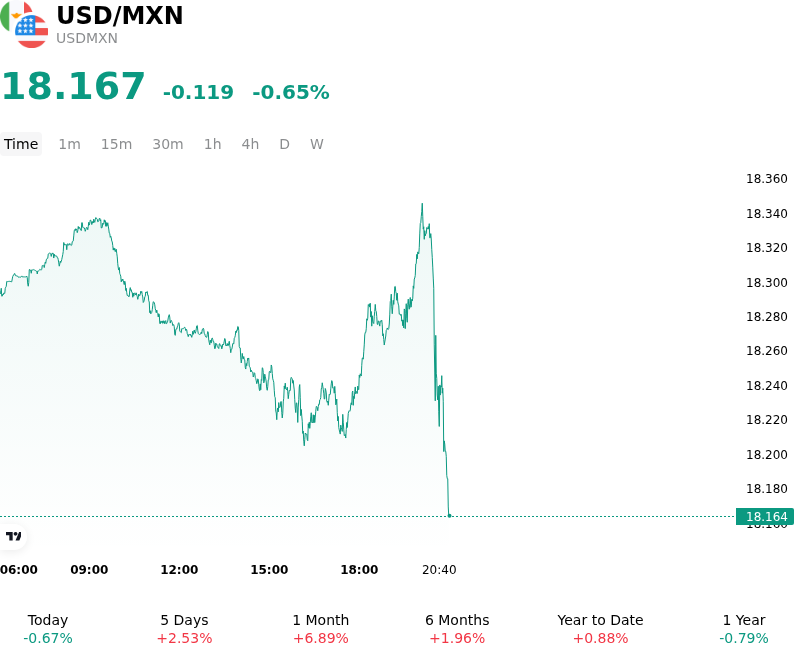
What is driving USD/MXN (USDMXN)’s stock price down today?
The downside movement in USDMXN reflects a combination of renewed appetite for high-yielding Latin American assets and broader U.S. dollar consolidation following recent volatility across global fixed-income markets. Investors digested the latest Banco de México expectations survey, which upgraded Mexico's economic growth outlook while modestly trimming inflation projections. This update reinforced confidence in domestic macroeconomic resilience and supported expectations that Banxico will keep its benchmark interest rate steady at elevated levels, anchoring local yields and attracting capital flows back into the peso.
From a relative monetary policy standpoint, interest-rate differentials continue to serve as a primary anchor for the pair. Banxico held its target interest rate at 6.50%, confirming a data-dependent approach centered on local disinflation and economic slack rather than automatically mirroring policy actions by the U.S. Federal Reserve. The substantial yield premium offered by Mexican sovereign assets continues to incentivize carry-trade strategies, particularly as fixed-income volatility subsides and global risk sentiment stabilizes.
Market positioning dynamics also contributed to the intraday decline in USDMXN. Following a sharp upward adjustment in the exchange rate driven by elevated rate volatility and leverage unwinding in previous sessions, the greenback encountered profit-taking as short-term dollar demand faded. Looking ahead, institutional investors will continue monitoring U.S. labor and inflation data alongside Banxico's policy communications to gauge the sustainability of the rate differential and the medium-term direction of Latin American currency flows.
Technical Analysis of USD/MXN (USDMXN)
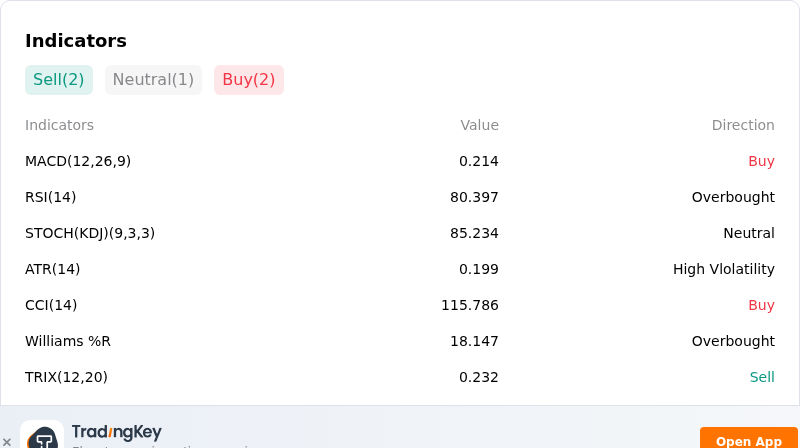
Technically, USD/MXN (USDMXN) shows a MACD (12,26,9) value of 0.214, indicating a buy signal. The RSI at 80.397 suggests overbought condition and the Williams %R at 18.147 suggests overbought condition. Please monitor closely.
More details about USD/MXN (USDMXN)
Recent Events and Risks:
- Unwinding of Crowded Carry Trades and Positioning Squeeze: A sharp spike in fixed-income market volatility and a rapid rise in one-month USDMXN implied volatility have triggered an aggressive unwind of Latin American carry trades. Leveraged funds holding large net long Mexican peso positions face forced liquidations, amplifying upside pressure and volatility in USDMXN.
- Narrowing Yield Differential and Elevated U.S. Rates: Sustained momentum in U.S. Treasury yields has tightened global dollar funding conditions and narrowed Mexico's relative interest rate advantage. This compressed carry cushion reduces the appeal of local Mexican bonds for foreign portfolio investors, leaving the peso vulnerable to further depreciation.
- Banxico Policy Decoupling and Growth Slack: The Bank of Mexico (Banxico) maintained its benchmark policy rate at 6.50% and affirmed that its monetary policy will not react mechanically to Federal Reserve rate adjustments. The central bank's acknowledgment of economic slack and its policy decoupling limit potential interest-rate support for the peso amidst sticky core inflation risks.
- USMCA Trade Frictions and Global Risk Aversion: Emerging market sentiment has deteriorated due to renewed trade uncertainty surrounding USMCA negotiations and elevated geopolitical tensions. As global risk appetite wanes, capital shifts away from high-beta Latin American currencies toward safe-haven U.S. dollar assets.
Recommended Articles


