


Here's How Much a $10,000 Investment Could Get You When SpaceX Goes Public on June 12
Key Points
SpaceX is gearing up for the largest IPO in history this week.
Retail investors can access SpaceX IPO shares through select brokerages.
While SpaceX's IPO price of $135 looks accessible, smart investors understand there's more than meets the eye with this offering.
- 10 stocks we like better than Space Exploration Technologies ›
SpaceX's (NASDAQ: SPCX) long-awaited initial public offering (IPO) has ignited investor excitement unlike anything seen in years. Last week, news broke that the company set a fixed offering price of $135 per share. For an everyday investor armed with some capital, this price tag appears accessible -- opening the door to a stake in Elon Musk's space exploration and AI empire.
Smart investors understand that IPO stocks come with far more sobering realities, however. Let's explore the harsh mechanics of IPO stocks before retail investors pile into SpaceX's upcoming offering.
Will AI create the world's first trillionaire? Our team just released a report on the one little-known company, called an "Indispensable Monopoly" providing the critical technology Nvidia and Intel both need. Continue »

Image source: Getty Images.
How much does a $10,000 investment buy in the SpaceX IPO?
Let's start with the cold math. A $10,000 initial investment at the $135 offering price will buy you roughly 74 shares. Here's the catch: IPO shares are not allocated on a first-come, first-served basis.
Brokerage firms receive a limited pool of shares from the IPO underwriters. This means that retail investors are competing against demand from institutional companies and high-net-worth clients. In other words, a $10,000 deposit doesn't guarantee 74 shares. While SpaceX's offering price is fixed, your actual execution price boils down to how brokerages rotate their allotments.
What brokerage firms have access to the SpaceX IPO?
Participating in an IPO requires having an account with one of the major brokerages that have secured access to the SpaceX offering. These platforms include Charles Schwab, Fidelity, Robinhood Markets, and SoFi Technologies.
These platforms offer online applications that take just a few minutes to complete. For the SpaceX IPO in particular, account minimums are zero for Robinhood and SoFi. Charles Schwab requires investors to have a minimum balance of $100,000, while Fidelity lowered its threshold to just $2,000.
Eligibility for IPO investing can be stricter than simply having available cash. Brokerages generally check your account tenure and trading history, and they may assess your total assets (or available liquidity).
Are IPOs smart opportunities for retail investors?
The overwhelming likelihood for a $10,000 order is a partial fill or, more commonly, no fill at all. When SpaceX stock actually lists on the Nasdaq on Friday, the shares that retail investors missed at the $135 offering price will trade in the open market.
Stock market history is filled with examples of newly public high-profile companies that pop on the first day of trading, fueled by pent-up demand. These dynamics were on full display during the Cerebras Systems IPO, and in offerings from Figma, Snowflake, and Palantir Technologies in recent years.
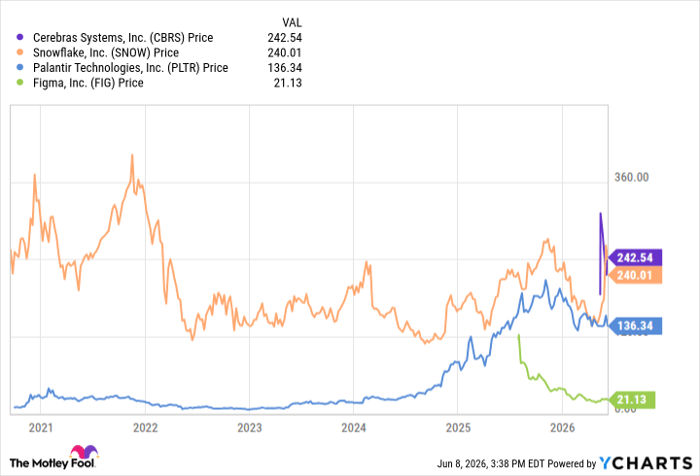
Data by YCharts.
Suddenly, the offering price climbs much higher in an otherwise short window. More often than not, chasing the premium after missing the offering price turns disciplined investments into emotional gambles. Moreover, if the stock later corrects -- which is common for hot IPOs -- investors who paid frothy prices end up holding the bag.
At the end of the day, a $10,000 investment in the SpaceX IPO will likely deliver far less ownership and far more frustration than headlines currently suggest. While straightforward math promises 74 shares at a $135 cost basis, the underlying process comes with a high degree of uncertainty and slim odds of an allocation. For most retail investors, the more prudent path to investing in SpaceX is to watch from the sidelines rather than following the crowd for now.
Should you buy stock in Space Exploration Technologies right now?
Before you buy stock in Space Exploration Technologies, consider this:
The Motley Fool Stock Advisor analyst team just identified what they believe are the 10 best stocks for investors to buy now… and Space Exploration Technologies wasn’t one of them. The 10 stocks that made the cut could produce monster returns in the coming years.
Consider when Netflix made this list on December 17, 2004... if you invested $1,000 at the time of our recommendation, you’d have $439,038!* Or when Nvidia made this list on April 15, 2005... if you invested $1,000 at the time of our recommendation, you’d have $1,277,804!*
Now, it’s worth noting Stock Advisor’s total average return is 942% — a market-crushing outperformance compared to 206% for the S&P 500. Don't miss the latest top 10 list, available with Stock Advisor, and join an investing community built by individual investors for individual investors.
See the 10 stocks »
*Stock Advisor returns as of June 10, 2026.
Charles Schwab is an advertising partner of Motley Fool Money. Adam Spatacco has positions in Palantir Technologies and SoFi Technologies. The Motley Fool has positions in and recommends Figma, Palantir Technologies, and Snowflake. The Motley Fool recommends Charles Schwab and recommends the following options: short June 2026 $97.50 calls on Charles Schwab. The Motley Fool has a disclosure policy.
Recommended Articles


