


If the AI Bubble Bursts, the S&P 500 Could Drop 20% -- These 2 ETFs Could Protect Your Money
Key Points
The Vanguard Total Bond Market ETF outperformed the S&P 500 index for several years after the 2008 global financial crisis.
During the most recent bear market in 2022, the Vanguard International High Dividend Yield ETF outperformed the S&P 500.
Bonds often move in opposite directions from stocks, and a downturn in the U.S. stock market would likely be good for bond prices.
- These 10 stocks could mint the next wave of millionaires ›
The artificial intelligence (AI) boom is top of mind for everyone who invests in stocks. Skyrocketing share prices for semiconductor stocks and other companies that are profiting from the build-out of AI data centers have become a huge part of the U.S. stock market.
But many investors are feeling doubtful and anxious along with the exuberance of this bull market. Are AI stocks too richly valued? What if corporate spending on AI capital expenditures slows? What if AI technology doesn't deliver the hoped-for gains in productivity? What if AI is a bubble that bursts?
Will AI create the world's first trillionaire? Our team just released a report on the one little-known company, called an "Indispensable Monopoly" providing the critical technology Nvidia and Intel both need. Continue »

Image source: Getty Images.
Bloomberg recently published research saying that if the AI bubble bursts, the S&P 500 index could drop by as much as 20%. If you feel as if your stock portfolio has gotten too tech-heavy with highly valued U.S. growth stocks, you might want to consider buying exchange-traded funds (ETFs) before the AI bubble bursts.
Let's look at two ETFs that could be good choices to diversify away from a tech-heavy portfolio.
1. Vanguard Total Bond Market ETF (BND): More than 11,000 bonds, 19 years of 3.08% annualized returns
If you're worried about a stock market downturn, you might want to buy more bonds. One of the best ways to do that is to invest in the Vanguard Total Bond Market ETF (NASDAQ: BND). This fund lets you own 11,387 bonds, with a broad mix of government bonds and investment-grade corporate bonds.
During the past three years, this Vanguard bond ETF has delivered average annual returns (by net asset value) of 3.95%, with an annualized return of 3.08% since the fund's inception in April 2007. After the 2008 stock market crash and during the recovery from the Great Recession, the Vanguard Total Bond Market ETF outperformed the S&P 500 for about five years.
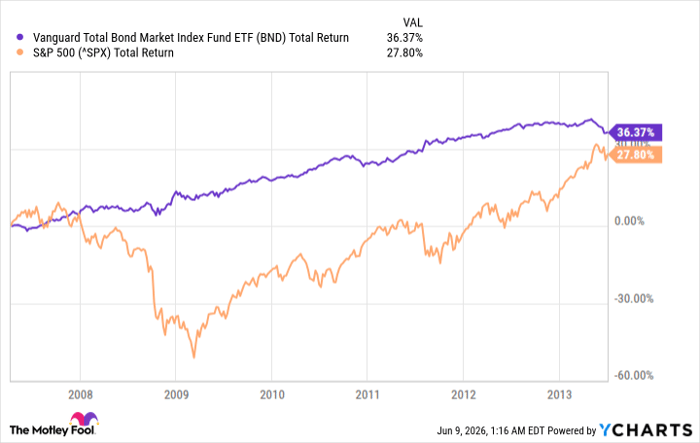
BND Total Return Level data by YCharts
Bonds don't usually outperform the S&P 500 in the long run. But a general rule of thumb in investing is that bonds tend to be negatively correlated with stocks. This means that when stock prices go down, bond prices go up and vice versa. In case of a big AI-related stock market downturn, bonds could help your portfolio stay steady and avoid excessive losses.
Bloomberg's model also forecasts that if the S&P 500 were to decline by 20%, the Fed would be likely to cut interest rates three or four times. Lower interest rates could be good news for bond prices. Buying bonds before an AI bust could be a smart move.
2. Vanguard International High Dividend Yield ETF (VYMI): 1,582 global stocks, 3.42% dividend yield
If the S&P 500 falls by 20%, that would likely be bad news for many international stocks that are riding the AI boom, such as semiconductor stocks in markets like Taiwan and South Korea. But international high-yield dividend stocks might be less exposed to the AI trade.
The Vanguard International High Dividend Yield ETF (NASDAQ: VYMI) offers a diversified portfolio of 1,582 international stocks, which are mostly far away (literally and figuratively) from the AI boom. None of the fund's top 10 stock holdings are tech stocks.
Instead, the top holdings of this ETF are mostly financial stocks and pharmaceutical stocks, along with a few big names like Toyota Motor (NYSE: TM) and Nestlé (OTC: NSRGY). This fund puts your money to work in different parts of the global stock market that might keep making steady profits and paying good dividends, no matter what happens next with AI.
For the past three years, this fund has delivered average annual returns (by net asset value) of 23.5%, with an annualized return of 11.4% since the fund's inception in February 2016. And during the past 12 months, this fund has delivered an impressive dividend yield of 3.42% -- better than most of the best dividend index funds.
If the S&P 500 drops by 20%, this ETF would probably take a hit too. But it might lose less value than the U.S. stock market as a whole in the case of an AI bust. The last time the S&P 500 was in a bear market, in 2022, the Vanguard International High Dividend Yield ETF had a negative return of -7.06% for the year, compared to -18.11% for the S&P 500.
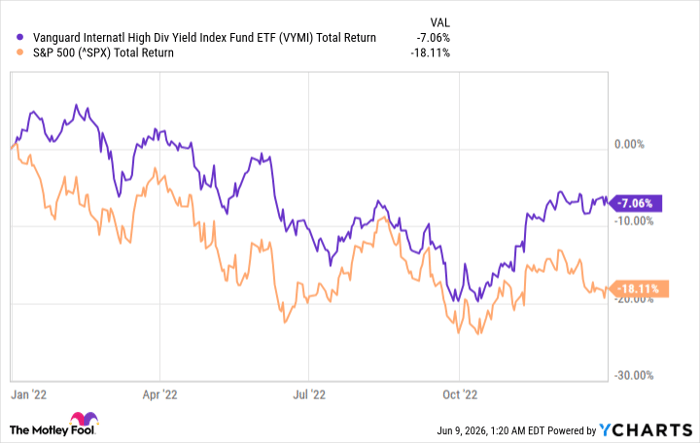
VYMI Total Return Level data by YCharts
There's no guarantee that any investment will be a safe place to hide in the event of a big tech-sector meltdown. But buying bonds and high-yield dividend stocks in international markets might help protect your money in case the AI bubble bursts.
Where to invest $1,000 right now
When our analyst team has a stock tip, it can pay to listen. After all, Stock Advisor’s total average return is 948%* — a market-crushing outperformance compared to 206% for the S&P 500.
They just revealed what they believe are the 10 best stocks for investors to buy right now, available when you join Stock Advisor.
See the stocks »
*Stock Advisor returns as of June 10, 2026.
Ben Gran has positions in Vanguard Total Bond Market ETF. The Motley Fool has positions in and recommends Vanguard Total Bond Market ETF. The Motley Fool recommends Nestlé. The Motley Fool has a disclosure policy.
Recommended Articles


