


WTI Crude Oil Falls to $90 Level. Iran Situation Cools Suddenly, Strait of Hormuz June Opening Seen Unlikely
Tradingkey - On June 8, tensions in the Iran conflict cooled abruptly, and both major crude oil futures fell. WTI crude futures briefly retreated to around the $90 level. As of press time, it was up 0.86% at $91.32, while Brent crude futures rose 1.65% to $94.63.
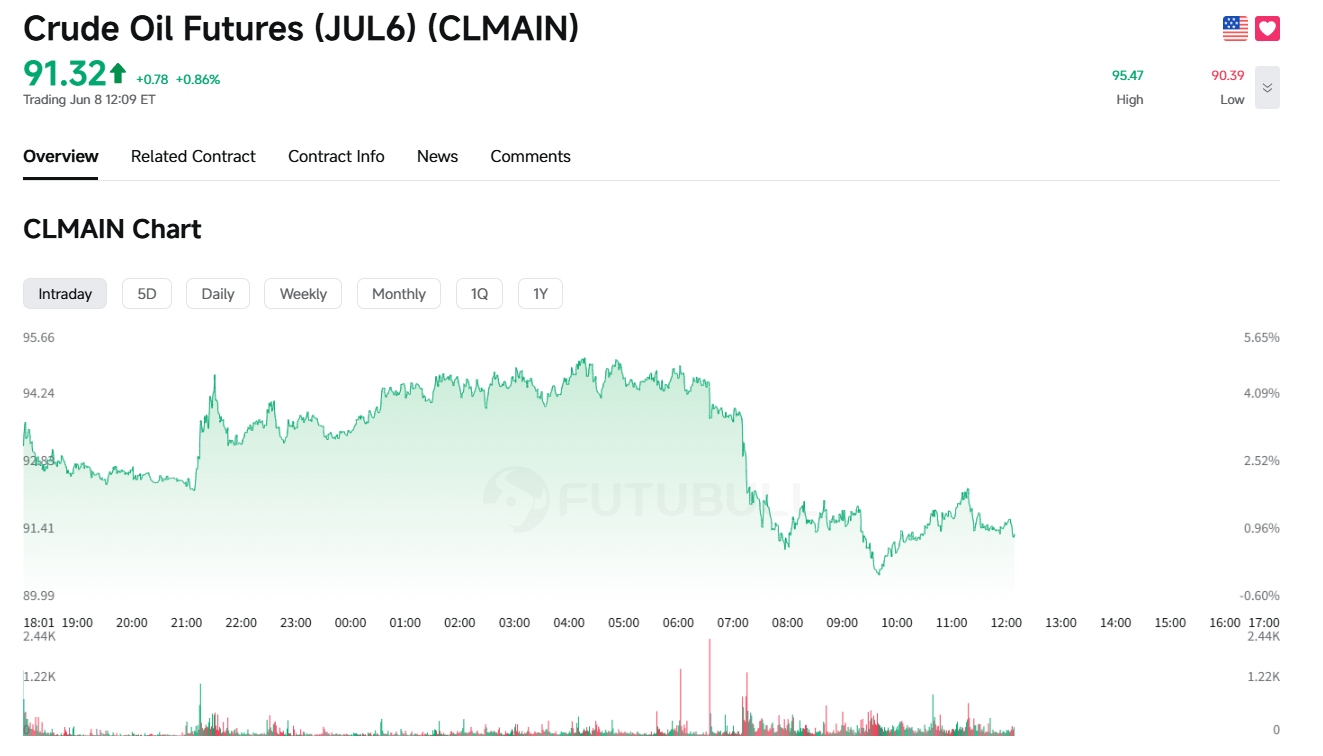
【Source: Futubull】
On the news front, the Iranian Ministry of Foreign Affairs confirmed that the Iranian military has ceased its strikes against Israel, but warned that hostilities would resume if the Israel Defense Forces continue military operations in Lebanon.
Iran and Israel launched strikes against each other on Sunday night, marking the first conflict since a ceasefire agreement was reached between the U.S. and Iran in April.
Iran accused Israel of multiple violations of the ceasefire agreement, including an attack on the southern suburbs of Beirut, and subsequently fired missiles at northern Israel; Israel stated it carried out a large-scale counterattack against Iran's strategic defense systems.
Trump stated on social media platform Truth Social: "Both Israel and Iran want an immediate ceasefire! Final negotiations regarding 'peace' are underway, unless hindered by ignorant or stupid acts. Until a 'final deal' is reached, the blockade will remain in place and in full effect."
It should be noted that while current geopolitical conflicts are a key variable affecting oil prices, supply risks beyond these factors continue to grow.
In the short term, the conflict in the Middle East has caused a dual decline in crude oil supply and demand, however, supply is falling much faster than demand, leaving upside risks for oil prices. Markets previously expected a de-escalation, causing a dip in oil prices, but it now appears that negotiations for the Iran nuclear deal are nowhere in sight. Unless countries impose mandatory oil restrictions, the supply shortage remains unresolved.
The IEA originally expected the strait to open in early June, with crude oil supply returning to normal 2-3 months after sea mines were cleared. However, given the current situation, the likelihood of the Strait of Hormuz opening in June seems low.
From a long-term perspective, the reopening of the Strait of Hormuz remains a high-probability event, at which point the oil market may shift back toward an oversupply.
Fitch Ratings believes that the closure of the Strait of Hormuz caused a temporary logistical shock and has not changed the long-term fundamentals of the crude oil market. The rapid recovery of production capacity in the Middle East, strong supply growth from non-OPEC countries, and a potentially more aggressive production increase policy from OPEC could recreate an oversupply situation in the fourth quarter of 2026. Once the strait reopens for navigation, oil prices are expected to pull back.
Fitch expects the Strait of Hormuz could reopen around the end of July, with Brent crude prices averaging $87 per barrel for the full year of 2026. However, the exact timing of the strait's opening remains highly uncertain, and oil prices face distinct multi-risk characteristics.
Recommended Articles


