


XRP grinds lower despite Ripple securing final OCC approval for National Trust Bank
- XRP trades sideways around $1.30 amid broader crypto market macro uncertainty.
- Ripple receives final US OCC approval for its National Trust Bank, aiming to manage RLUSD reserves and provide crypto custody services.
- XRP remains in lockstep, trading near $1.30 and largely constrained by a weak technical structure.
Ripple (XRP) is trading at $1.30 on Tuesday, largely constrained by technical hurdles. The token is down roughly 16% from its October high of $1.56, and 21% from the September peak of $1.66, reflecting weeks of persistent headwinds and risk-off sentiment.
Macro headwinds weigh ahead of Fed decision
Market focus has largely remained on the Federal Reserve (Fed) rate decision on Wednesday. Although the central bank is widely expected to keep interest rates unchanged in the 3.75-4.00% range, broader macro concerns remain due to elevated Oil and energy prices and sticky inflation.
Inflation in the United States (US) sits above the long-term 2% target, which the regulator is determined to achieve amid a resilient economic environment. CME’s FedWatch Tool shows 90% odds that the Federal Open Market Committee (FOMC) will hold interest rates in October, followed by a December hike. Crypto Finance foresees two further rate hikes by the end of 2027 as part of a broader outlook to bring inflation down.
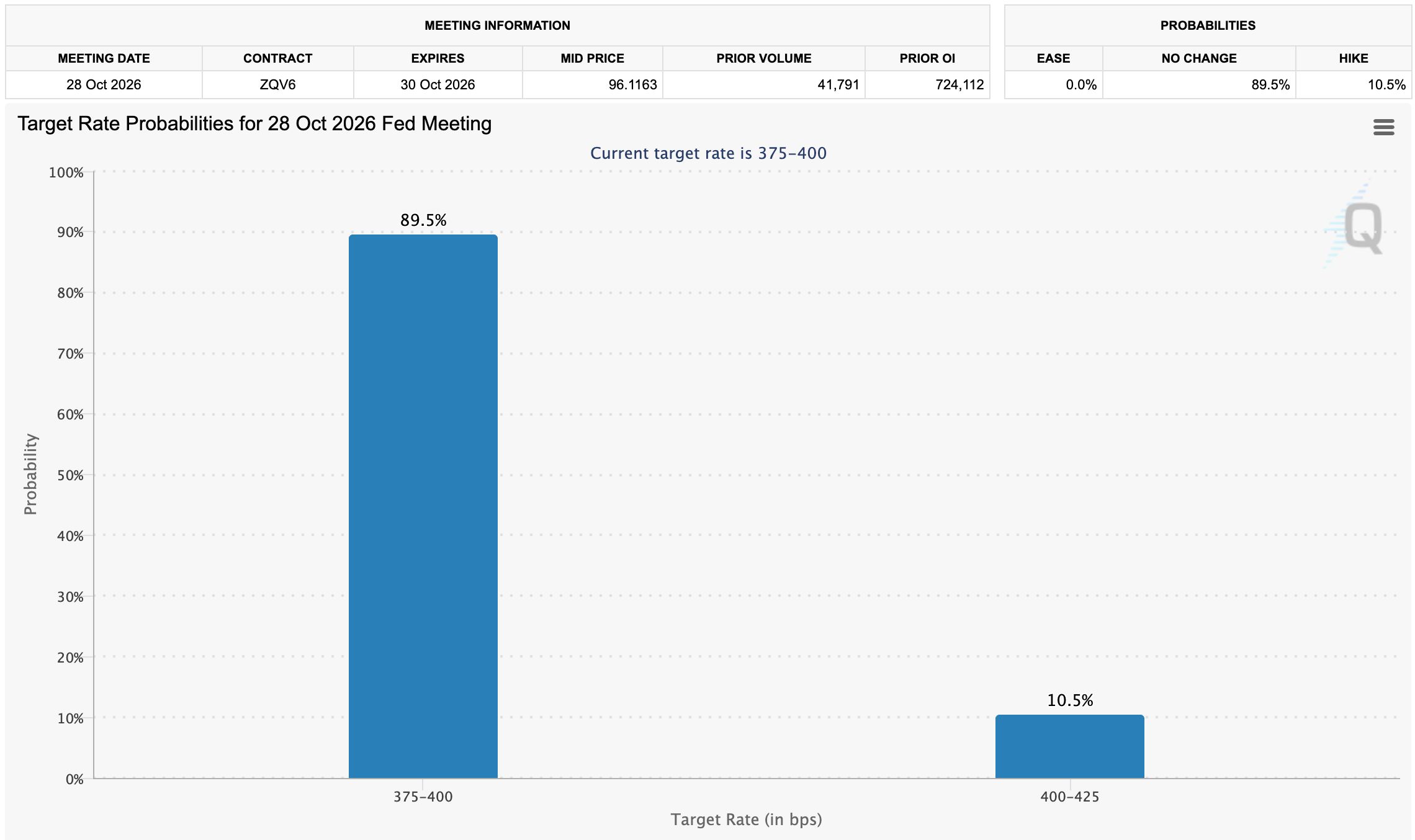
“Wednesday's Fed meeting is the key macro event. We expect rates to remain unchanged, so the focus will be on the dot plot and any shift in the forward path. Markets currently price a 90% probability of a skip, followed by a December hike and two further hikes by year-end 2027, taking the target range to 4.50–4.75%,” Crypto Finance said in an emailed analysis report.
OCC grants final approval for Ripple National Trust Bank
The US Office of the Comptroller of the Currency (OCC) has granted final approval to Ripple National Trust Bank, giving the blockchain company federal supervision to manage RLUSD stablecoin reserves. The OCC’s conditional approval was issued in December. Ripple will also provide enterprise-grade crypto custody services under the same license.
Brad Garlinghouse, Ripple’s CEO, said on X that “We’ve always said crypto and banks work better together, this is what that looks like. Real innovation, real accountability, federal oversight.”
Technical analysis: XRP holds key support
XRP trades at $1.30 as bulls push to defend the short-term psychological support level before making another recovery attempt. Despite the ongoing sideways trading, the token maintains a bearish near‑term bias as price holds below the key Exponential Moving Averages (EMAs).
The 100‑day EMA at $1.33, the 50‑day EMA at $1.36 and the 200‑day EMA at $1.37 all sit overhead, suggesting the pair remains capped within a broader corrective phase, while the SuperTrend line at $1.45 reinforces the notion of persistent supply on rallies.
Momentum is subdued, with the Relative Strength Index (RSI) hovering near 41 and the Moving Average Convergence Divergence (MACD) narrowing slightly in negative territory, hinting at weak but stabilizing downside pressure.
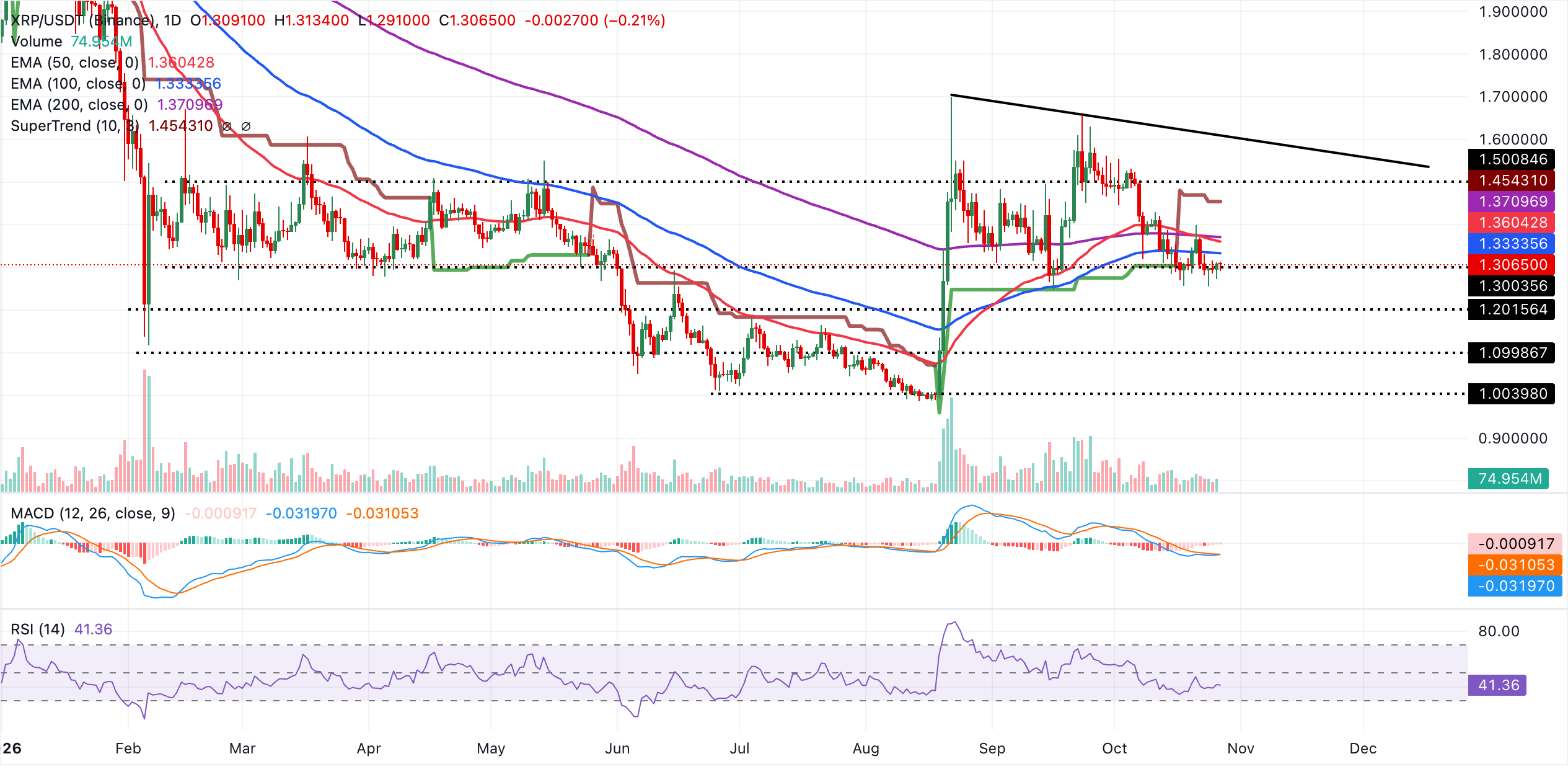
Initial resistance lies at the 100‑day EMA near $1.33, followed by the 50‑day EMA at $1.36 and the 200‑day EMA around $1.37, which together define a dense technical barrier that bulls would need to reclaim to shift the bias away from bearish.
Above these, the SuperTrend line at $1.45 marks a higher resistance zone before the longer‑term bearish trend structure at $1.61 and $1.70 comes into view. With no clear technical support below $1.30 on the daily chart, any drop would leave XRP searching for fresh demand, while sustained trading beneath the clustered EMAs favors continued range‑to‑lower price action in the short term.
(The technical analysis of this story was written with the help of an AI tool. Know more.)
Ripple FAQs
Ripple is a payments company that specializes in cross-border remittance. The company does this by leveraging blockchain technology. RippleNet is a network used for payments transfer created by Ripple Labs Inc. and is open to financial institutions worldwide. The company also leverages the XRP token.
XRP is the native token of the decentralized blockchain XRPLedger. The token is used by Ripple Labs to facilitate transactions on the XRPLedger, helping financial institutions transfer value in a borderless manner. XRP therefore facilitates trustless and instant payments on the XRPLedger chain, helping financial firms save on the cost of transacting worldwide.
XRPLedger is based on a distributed ledger technology and the blockchain using XRP to power transactions. The ledger is different from other blockchains as it has a built-in inflammatory protocol that helps fight spam and distributed denial-of-service (DDOS) attacks. The XRPL is maintained by a peer-to-peer network known as the global XRP Ledger community.
XRP uses the interledger standard. This is a blockchain protocol that aids payments across different networks. For instance, XRP’s blockchain can connect the ledgers of two or more banks. This effectively removes intermediaries and the need for centralization in the system. XRP acts as the native token of the XRPLedger blockchain engineered by Jed McCaleb, Arthur Britto and David Schwartz.
บทความแนะนำ


