


Mexican Peso rallies as weak US Retail Sales crush the US Dollar
- Mexican Peso set for over 1% weekly gain as USD tumbles.
- The US Dollar Index falls to YTD lows as Fed rate-cut bets increase
- US Retail Sales drop fuels slowdown fears, boosting Fed easing expectations to 43.5 bps.
- Banxico minutes, Mexico GDP, and Retail Sales are in focus next week.
The Mexican Peso (MXN) extended its rally on Friday, set to end the week with gains of over 1% against the Greenback. A worse-than-expected Retail Sales report tumbled the US Dollar (USD) to new year-to-date (YTD) lows as depicted by the US Dollar Index (DXY). The USD/MXN pair trades at 20.32, down 0.39%.
United States (US) economic data revealed earlier was the main driver of the session after investors shrugged off reciprocal tariffs not yet enacted by US President Donald Trump. Nevertheless, a dismal January Retail Sales report could increase the chances of a deeper economic slowdown in the United States.
This highlights that Americans are cutting spending due to high interest rates. Henceforth, investors had begun to price in 43.5 basis points of easing by the Federal Reserve (Fed), according to data from the Chicago Board of Trade (CBOT).
The Federal Reserve revealed that Industrial Production improved in January yet failed to halt the Greenback’s plunge during the North American session.
In Mexico, the docket was empty yet. Next week, USD/MXN traders will be watching the release of Retail Sales, Banco de Mexico (Banxico) monetary policy meeting minutes, and Gross Domestic Product (GDP) figures for Q4 2024.
Daily digest market movers: Mexican Peso soars as the Greenback gets battered
- The deterioration in Mexico's automobile industry and the possibility that the US applies tariffs on cars could weigh on the Mexican economy, which is expected to show a contraction in the last quarter of 2024.
- Monetary policy divergence between Banxico and the Fed favors further USD/MXN upside, as the Fed would likely hold rates unchanged. At the same time, Banxico targets another 50-basis point rate cut in the next meeting.
- The US Dollar Index (DXY), which tracks the performance of the buck against a basket of currencies, edged from 107.12 to 106.68, another reason for USD/MXN's downside.
- On Thursday, US President Donald Trump tasked his economic team with devising plans for reciprocal tariffs on every country taxing US imports.
- US Retail Sales fell sharply by -0.9% MoM in January, significantly missing expectations of -0.1% and disappointing investors. However, December’s figure was revised higher to a 0.7% increase.
- Meanwhile, Industrial Production expanded by 0.5% MoM in January, down from December’s 1% growth but surpassing economists’ forecasts of 0.3%.
- Trade disputes between the US and Mexico remain in the boiler room. Although the countries found common ground previously, USD/MXN traders should know that there is a 30-day pause and that tensions could arise toward the end of February.
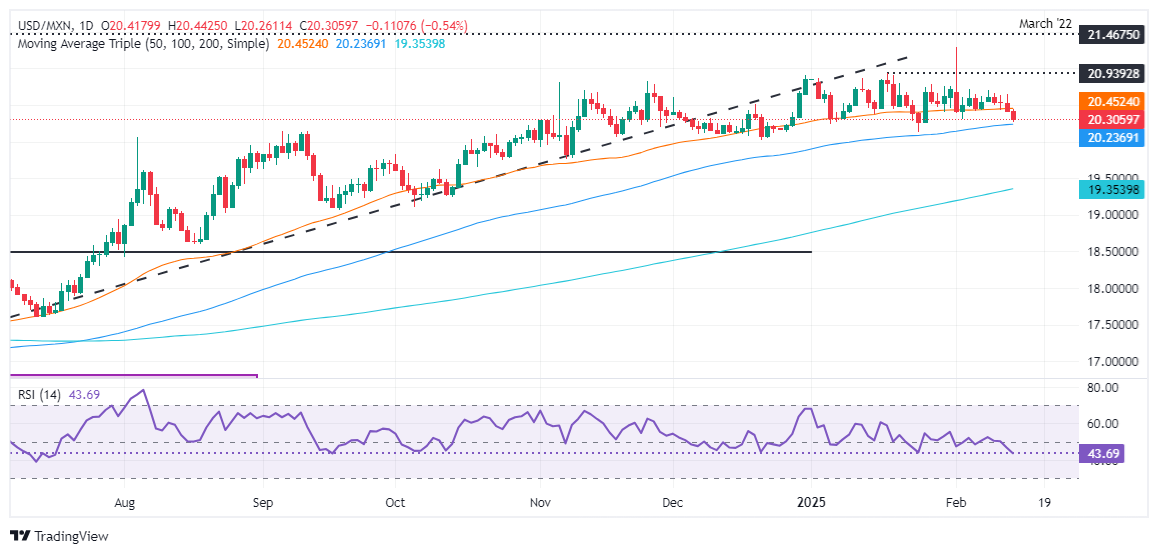
USD/MXN technical outlook: Mexican Peso surges as USD/MXN drops below 20.50
USD/MXN has fallen below the 50-day Simple Moving Average (SMA) of 20.45, which cleared the path to test the 20.25 area ahead of the 100-day SMA at 20.23. Further downside lies once sellers surpass those levels, with the 20.00 psychological figure. It is worth noting that the losses could drive the exotic pair toward the 200-day SMA at 19.35.
Conversely, if buyers want to regain control, they must clear key resistance levels such as the January 17 high of 20.90, the 21.00 figure, and the year-to-date (YTD) high of 21.29.
Mexican Peso FAQs
The Mexican Peso (MXN) is the most traded currency among its Latin American peers. Its value is broadly determined by the performance of the Mexican economy, the country’s central bank’s policy, the amount of foreign investment in the country and even the levels of remittances sent by Mexicans who live abroad, particularly in the United States. Geopolitical trends can also move MXN: for example, the process of nearshoring – or the decision by some firms to relocate manufacturing capacity and supply chains closer to their home countries – is also seen as a catalyst for the Mexican currency as the country is considered a key manufacturing hub in the American continent. Another catalyst for MXN is Oil prices as Mexico is a key exporter of the commodity.
The main objective of Mexico’s central bank, also known as Banxico, is to maintain inflation at low and stable levels (at or close to its target of 3%, the midpoint in a tolerance band of between 2% and 4%). To this end, the bank sets an appropriate level of interest rates. When inflation is too high, Banxico will attempt to tame it by raising interest rates, making it more expensive for households and businesses to borrow money, thus cooling demand and the overall economy. Higher interest rates are generally positive for the Mexican Peso (MXN) as they lead to higher yields, making the country a more attractive place for investors. On the contrary, lower interest rates tend to weaken MXN.
Macroeconomic data releases are key to assess the state of the economy and can have an impact on the Mexican Peso (MXN) valuation. A strong Mexican economy, based on high economic growth, low unemployment and high confidence is good for MXN. Not only does it attract more foreign investment but it may encourage the Bank of Mexico (Banxico) to increase interest rates, particularly if this strength comes together with elevated inflation. However, if economic data is weak, MXN is likely to depreciate.
As an emerging-market currency, the Mexican Peso (MXN) tends to strive during risk-on periods, or when investors perceive that broader market risks are low and thus are eager to engage with investments that carry a higher risk. Conversely, MXN tends to weaken at times of market turbulence or economic uncertainty as investors tend to sell higher-risk assets and flee to the more-stable safe havens.
Artigos Recomendados


