


Ripple Price Forecast: XRP lags recovery despite rising network activity, mild ETF inflows
- XRP consolidates near $1.37 as modest buy-the-dip interest emerges.
- Active addresses on the XRP Ledger approach 24,000 on Thursday, signaling a sustained uptick in speculative activity.
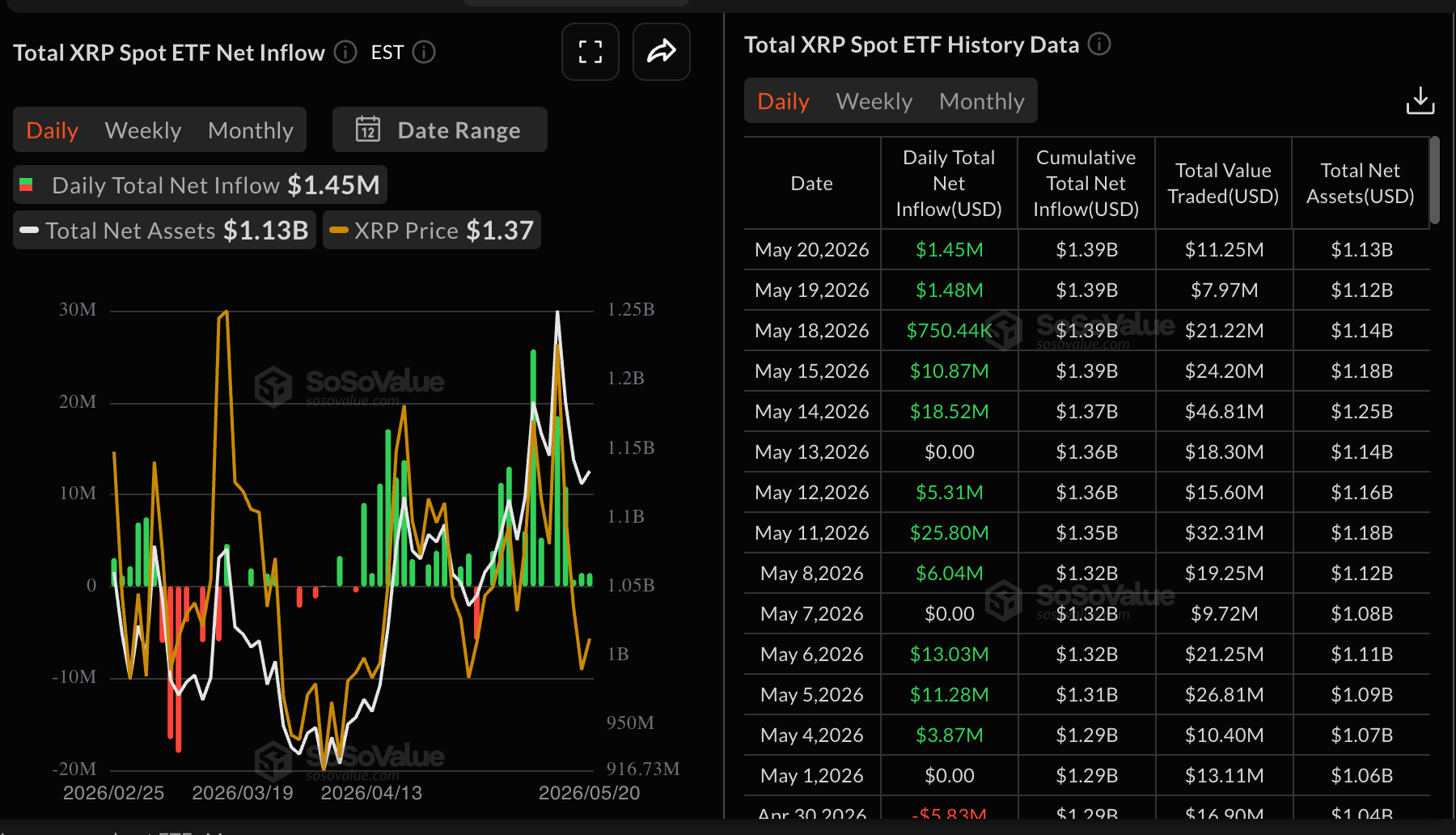
- XRP ETFs recorded steady but mild inflows of $1.45 million on Wednesday.
Ripple (XRP) remains calm, trading around $1.37 at the time of writing on Thursday. The current sideways action follows a subtle recovery from support at $1.35, and reflects broader optimism for a US-Iran peace deal.
Iran is reportedly reviewing a peace proposal from the US, delivered through Pakistan, the mediator. US President Donald Trump said on Wednesday that the two countries are in the final stages of peace negotiations. However, Trump added that the situation could escalate if Iran does not make a deal, prompting caution across global markets.
Network activity builds on the XRP Ledger
The number of active addresses on the XRP Ledger (XRPL) has gained traction since Monday, nearing 24,000 on Thursday, according to Santiment data. Active addresses track wallets that interact with the network by sending or receiving assets over a given period.
A steady increase suggests growing user engagement and speculative interest. At the same time, investor confidence tends to improve when on-chain activity affirms price strength and reduces bearish conviction.
 [13-1779364220143.44.17, 21 May, 2026].png)
Institutions are showing mild speculative interest, as XRP spot Exchange-Traded Funds (ETFs) extended their bullish streak with inflows totaling $1.45 billion on Wednesday. According to SoSoValue, cumulative XRP ETF inflows have stabilized at $1.39 billion, with average net assets under management at $1.13 billion. Sustained ETF growth will be crucial to bolstering bullish sentiment and underpinning XRP’s near-term rebound.
Price analysis: XRP consolidation persists
XRP trades around $1.37, keeping a bearish near-term bias as price holds below all its major Exponential Moving Averages (EMAs) and a recently broken rising trendline. The 50-day EMA at $1.41, backed by the ascending trendline around $1.40, acts as immediate overhead supply, while the 100-day and 200-day EMAs, at $1.48 and $1.70 respectively, reinforce the broader topping tone.
Momentum supports this cautious view, with the Relative Strength Index (RSI) hovering near 43 and the Moving Average Convergence Divergence (MACD) histogram in negative territory, hinting that rallies are likely to face selling pressure.
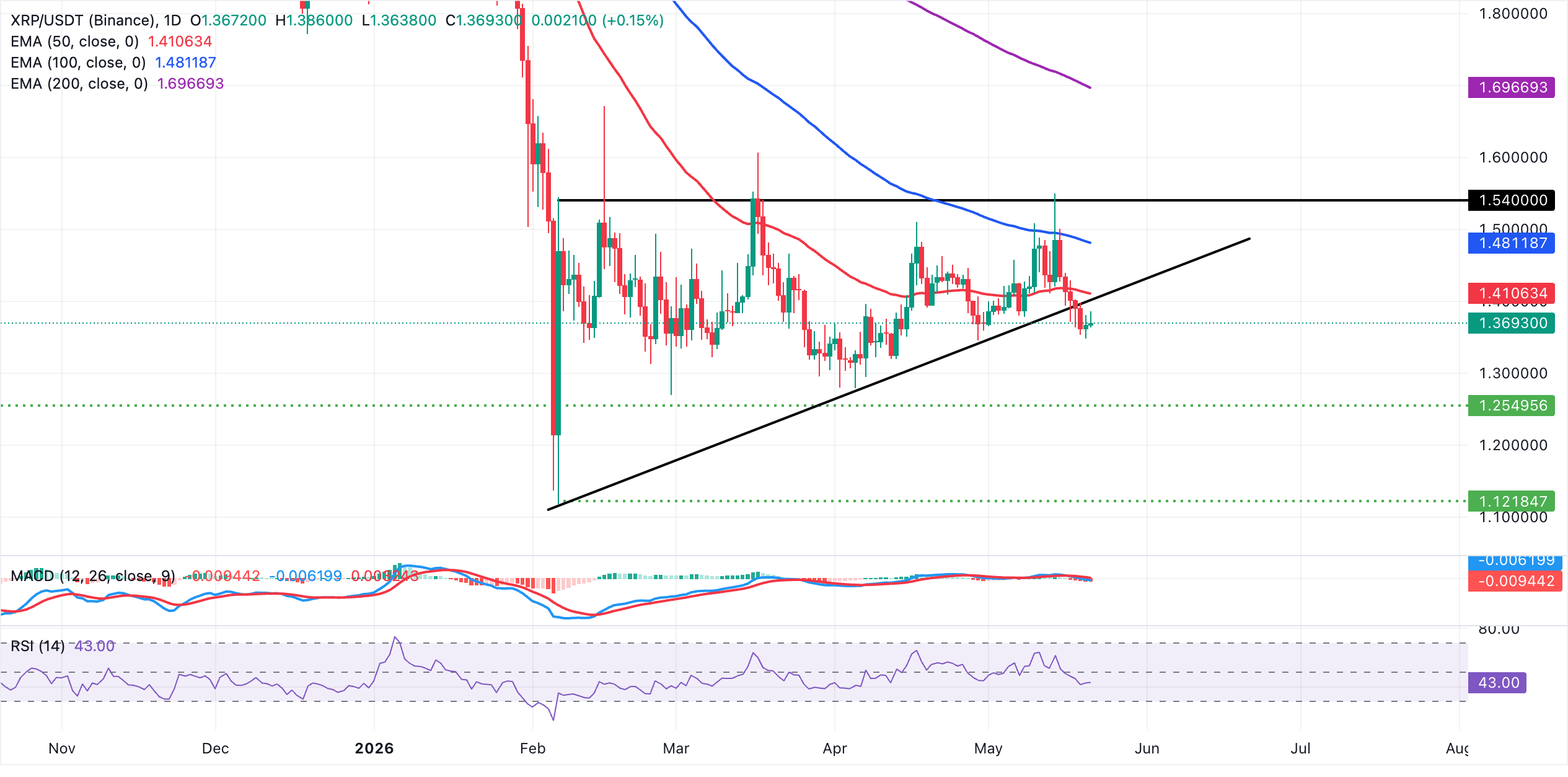
On the topside, initial resistance emerges at the former trendline support turned barrier near $1.40, followed closely by the 50-day EMA at $1.41, forming a nearby cap that bulls would need to reclaim to ease immediate downside pressure. Above that, the 100-day EMA at $1.48 and the 200-day EMA near $1.70 define progressively stronger resistance zones that currently frame the broader bearish structure. If selling activity overwhelms demand, XRP may drop to retest support at $1.35, with a deeper correction likely to extend toward $1.30.
(The technical analysis of this story was written with the help of an AI tool.)
Ripple FAQs
Ripple is a payments company that specializes in cross-border remittance. The company does this by leveraging blockchain technology. RippleNet is a network used for payments transfer created by Ripple Labs Inc. and is open to financial institutions worldwide. The company also leverages the XRP token.
XRP is the native token of the decentralized blockchain XRPLedger. The token is used by Ripple Labs to facilitate transactions on the XRPLedger, helping financial institutions transfer value in a borderless manner. XRP therefore facilitates trustless and instant payments on the XRPLedger chain, helping financial firms save on the cost of transacting worldwide.
XRPLedger is based on a distributed ledger technology and the blockchain using XRP to power transactions. The ledger is different from other blockchains as it has a built-in inflammatory protocol that helps fight spam and distributed denial-of-service (DDOS) attacks. The XRPL is maintained by a peer-to-peer network known as the global XRP Ledger community.
XRP uses the interledger standard. This is a blockchain protocol that aids payments across different networks. For instance, XRP’s blockchain can connect the ledgers of two or more banks. This effectively removes intermediaries and the need for centralization in the system. XRP acts as the native token of the XRPLedger blockchain engineered by Jed McCaleb, Arthur Britto and David Schwartz.
Artigos Recomendados


