


Dow Jones Industrial Average falls below 48,000 as tech stocks slide and shutdown ends
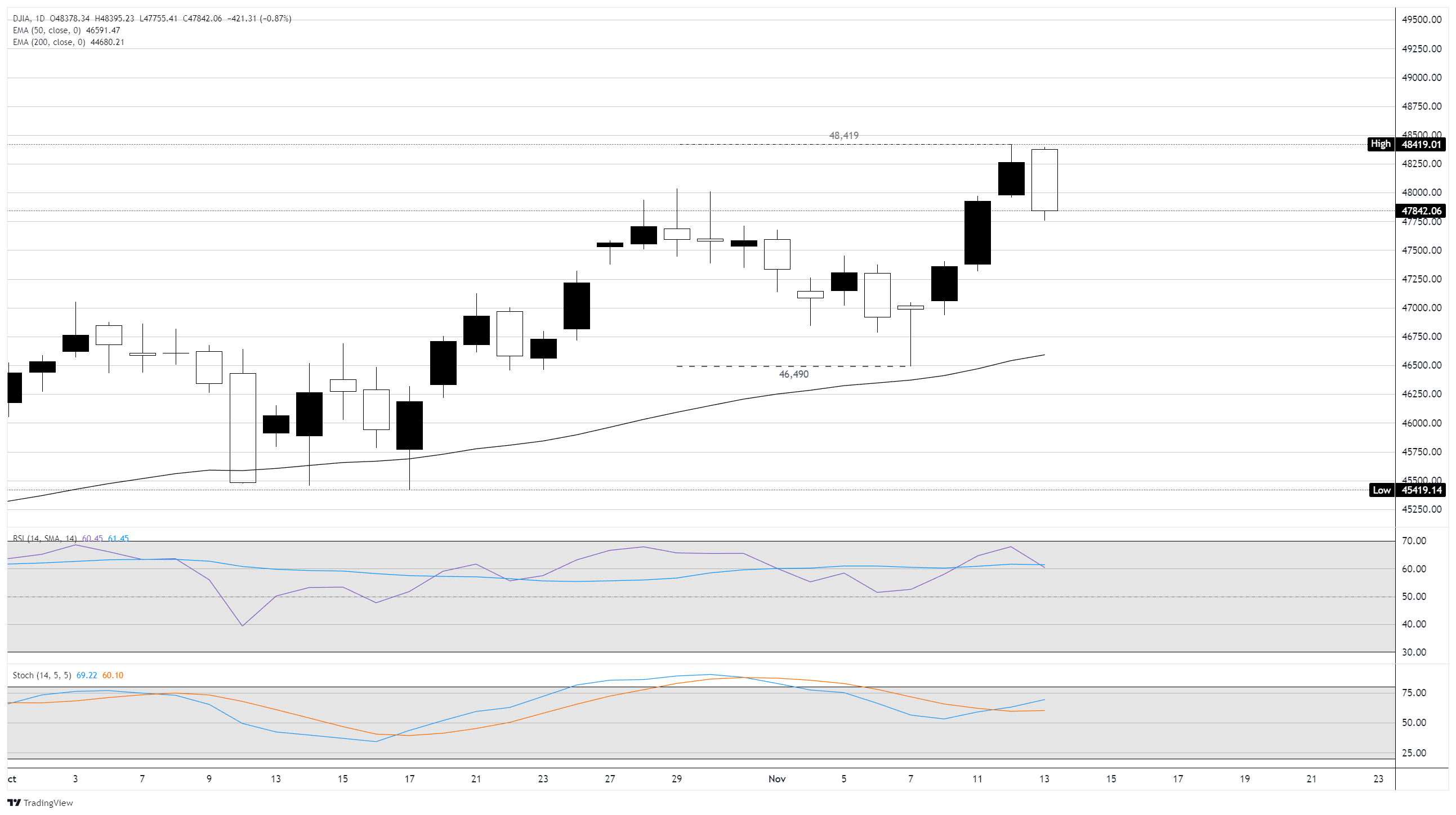
- The Dow Jones pulled back from all-time highs on Thursday, falling back below 48,000.
- With an end to the US government shutdown now in sight, investor apprehension is back on the rise.
- The AI trade is losing steam as tech stocks continue to backslide.
The Dow Jones Industrial Average (DJIA) took a sharp step back on Thursday, declining around 500 points at its lowest and falling away from record highs posted during the midweek market session. US President Donald Trump signed off his formal presidential approval of a short-term funding solution to get the federal government reopened. The temporary funding bill will see federal operations restart until the end of January, and brings an end to what has become the longest US government shutdown in American history.
Healthcare stocks and energies saw scattered gains on Thursday, but an ongoing tilt back into more traditional investment segments is doing little to stave off a spreading decline in the tech sector. The AI and tech trades continue to bleed on the floor, with Tesla (TSLA) declining 6.6% and ambiguously AI-connected Palantir (PLTR) shedding over 5% on Thursday.
Disney also fell over 9% on Thursday, slipping to $106.00 per share after missing on overall revenue expectations despite beating earnings estimates. Mixed segment results combined to generate overall revenue of $94.4 billion for the fiscal year, up 3% from 2024’s $91.4 billion.
Lack of data almost fixed?
With the US government set to reopen, at least temporarily, markets are now looking ahead to the resumption of critical economic dataset releases. US White House officials toyed with the idea of declaring entire batches of inflation and growth data as “lost” during the government closure, specifically the October inflation and employment figures, which could never be released. A critical gap in key inflation and labor information is a prospect that is likely sitting poorly with investors who are eager to try and draw a bead on the chances of a third straight interest rate cut from the Federal Reserve (Fed) on December 10.
Despite a potential gap in the October data, September’s Nonfarm Payrolls (NFP) jobs report is rumored to be getting prepared for a late release next week, and will serve as one of the last chances for the Fed to take a dipstick measurement of the US economy before its next interest rate decision. According to the CME’s FedWatch Tool, rate traders are pricing in slightly less than 50% odds of a quarter-point rate cut in December, with around 90% odds that the Fed will blink and wait until January 28, 2026, before giving a third 25 basis point cut.
Dow Jones daily chart
Dow Jones FAQs
The Dow Jones Industrial Average, one of the oldest stock market indices in the world, is compiled of the 30 most traded stocks in the US. The index is price-weighted rather than weighted by capitalization. It is calculated by summing the prices of the constituent stocks and dividing them by a factor, currently 0.152. The index was founded by Charles Dow, who also founded the Wall Street Journal. In later years it has been criticized for not being broadly representative enough because it only tracks 30 conglomerates, unlike broader indices such as the S&P 500.
Many different factors drive the Dow Jones Industrial Average (DJIA). The aggregate performance of the component companies revealed in quarterly company earnings reports is the main one. US and global macroeconomic data also contributes as it impacts on investor sentiment. The level of interest rates, set by the Federal Reserve (Fed), also influences the DJIA as it affects the cost of credit, on which many corporations are heavily reliant. Therefore, inflation can be a major driver as well as other metrics which impact the Fed decisions.
Dow Theory is a method for identifying the primary trend of the stock market developed by Charles Dow. A key step is to compare the direction of the Dow Jones Industrial Average (DJIA) and the Dow Jones Transportation Average (DJTA) and only follow trends where both are moving in the same direction. Volume is a confirmatory criteria. The theory uses elements of peak and trough analysis. Dow’s theory posits three trend phases: accumulation, when smart money starts buying or selling; public participation, when the wider public joins in; and distribution, when the smart money exits.
There are a number of ways to trade the DJIA. One is to use ETFs which allow investors to trade the DJIA as a single security, rather than having to buy shares in all 30 constituent companies. A leading example is the SPDR Dow Jones Industrial Average ETF (DIA). DJIA futures contracts enable traders to speculate on the future value of the index and Options provide the right, but not the obligation, to buy or sell the index at a predetermined price in the future. Mutual funds enable investors to buy a share of a diversified portfolio of DJIA stocks thus providing exposure to the overall index.
Artigos Recomendados


