


Gold price consolidates amid strong US Dollar, robust PPI data
- XAU/USD remains subdued under the weight of a strengthening Dollar and recent US inflation data.
- Producer Price Index exceeds expectations, suggesting Fed easing cycle might be reconsidered.
- Investors recalibrate expectations for December Fed rate cut amid ongoing inflation concerns.
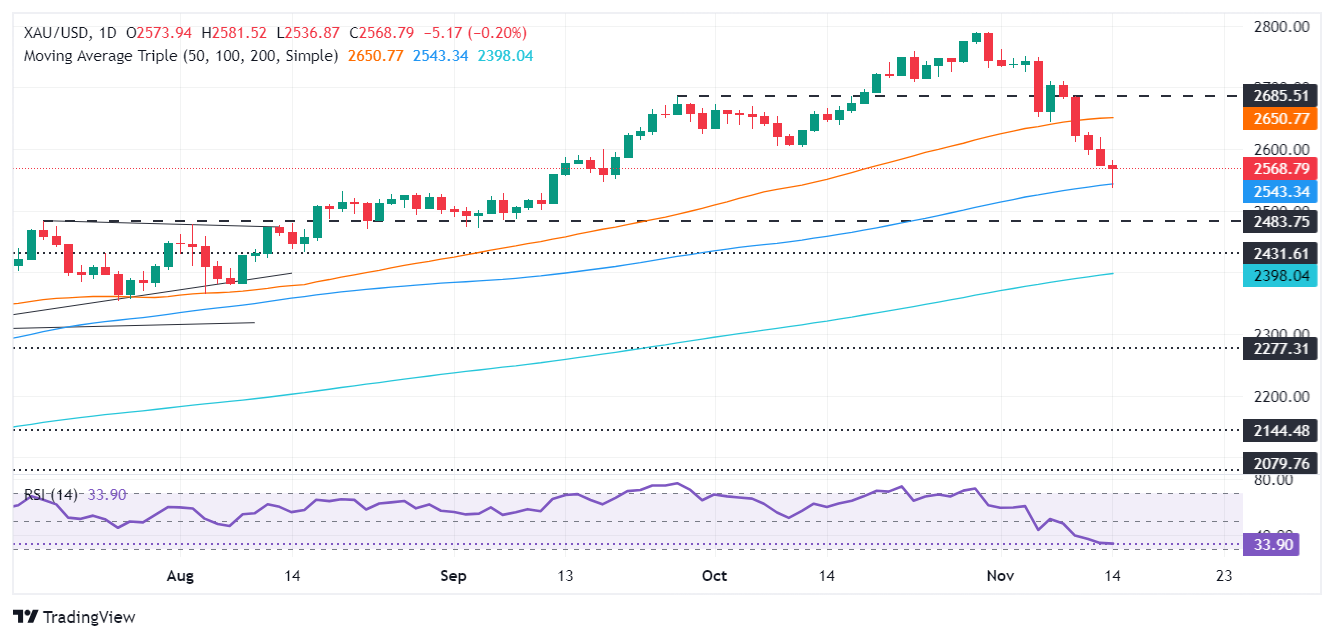
Gold recovers some ground on Thursday yet remains trading below its opening price for the fifth consecutive day, undermined by the Greenback’s advance for its own fifth consecutive day. A slightly hot inflation report in the US and solid jobs data sponsored XAU/USD’s leg down toward the 100-day Simple Moving Average (SMA). At the time of writing, Bullion trades at $2,568.
The market mood shifted negatively yet failed to boost Gold’s prices and underpin the US Dollar. The US Bureau of Labor Statistics revealed that the Producer Price Index (PPI) rose in October, exceeding estimates and September’s figures.
This indicates that the Federal Reserve's (Fed) job is far from done, even though the central bank embarked on an easing cycle that has seen the Fed lower its primary interest rate instrument by 75 basis points since September 2024.
At the same time, the US Department of Labor revealed that unemployment claims filled by Americans diminished compared to the previous reading
Fed officials have recently underscored the delicate act of balancing inflation control with employment goals. Governor Adriana Kugler stressed the importance of addressing both mandates, pointing out that while strides have been made toward reducing inflation, hitting the 2% target remains challenging.
Likewise, Richmond Fed President Thomas Barkin acknowledged the progress in curbing inflation but warned against premature optimism. He sees risks like substantial union wage settlements and potential tariff hikes, which could spark inflationary pressure.
Gold has been undermined by investor fears that US President-elect Donald Trump’s proposed tariffs and tax reductions are likely to increase inflation, which could prompt the Fed to pause its easing cycle.
Market participants see a 72% chance of a quarter percentage rate cut by the Fed in the upcoming December meeting, down from 82% a day ago.
Investors are awaiting remarks from Fed Chair Jerome Powell later on Thursday along with Friday's US Retail Sales data.
Daily digest market movers: Gold steadies alongside strong US Dollar
- Gold prices recover as US real yields, which inversely correlate against Bullion, fall three basis points to 2.068%. The DXY registers gains of 0.18% to 106.67.
- Fed Chair Jerome Powell, commented the US economy is not sending signals that US central bank needs to be in a hurry to lower interest rates, and he expect inflation to “come down toward the 2% goal.” Powell reassured the Fed’s commitment on inflation.
- The US PPI surpassed expectations with the headline increasing by 2.4% YoY, beating the 2.3% forecast and up from 1.9% in September. The Core PPI, often influencing the core Personal Consumption Expenditures (PCE) Price Index, rose by 3.1% YoY, higher than the prior 2.9% and above the expected 3%.
- Initial Jobless Claims for the week ending November 9 came in at 217K, a decrease from the previous week's 221K and below the forecast of 223K.
- According to the December fed funds futures contract data from the Chicago Board of Trade, investors are projecting a 25 bps Fed rate cut in December.
XAU/USD Technical Outlook: Gold price holds firm, but downside risks remain
Gold (XAU/USD) has recently declined below the October 10 swing low of $2,603, exacerbating further losses below $2,600 and opening the door to a new two-month low of $2,536, briefly below the 100-day Simple Moving Average (SMA) at $2,547. Nevertheless, sellers’ failure to push Bullion prices toward $2,500 paved the way for a leg-up.
XAU/USD’s first resistance is seen at $2,600. If buyers reclaim that level, they could test the 50-day SMA at $2,650, with subsequent resistance around $2,700. Surpassing this could open the path to the November 7 high of $2,710.
The Relative Strength Index (RSI) has moved away from its neutral line, suggesting a bearish momentum that could lead to further declines in XAU/USD.
Gold FAQs
Gold has played a key role in human’s history as it has been widely used as a store of value and medium of exchange. Currently, apart from its shine and usage for jewelry, the precious metal is widely seen as a safe-haven asset, meaning that it is considered a good investment during turbulent times. Gold is also widely seen as a hedge against inflation and against depreciating currencies as it doesn’t rely on any specific issuer or government.
Central banks are the biggest Gold holders. In their aim to support their currencies in turbulent times, central banks tend to diversify their reserves and buy Gold to improve the perceived strength of the economy and the currency. High Gold reserves can be a source of trust for a country’s solvency. Central banks added 1,136 tonnes of Gold worth around $70 billion to their reserves in 2022, according to data from the World Gold Council. This is the highest yearly purchase since records began. Central banks from emerging economies such as China, India and Turkey are quickly increasing their Gold reserves.
Gold has an inverse correlation with the US Dollar and US Treasuries, which are both major reserve and safe-haven assets. When the Dollar depreciates, Gold tends to rise, enabling investors and central banks to diversify their assets in turbulent times. Gold is also inversely correlated with risk assets. A rally in the stock market tends to weaken Gold price, while sell-offs in riskier markets tend to favor the precious metal.
The price can move due to a wide range of factors. Geopolitical instability or fears of a deep recession can quickly make Gold price escalate due to its safe-haven status. As a yield-less asset, Gold tends to rise with lower interest rates, while higher cost of money usually weighs down on the yellow metal. Still, most moves depend on how the US Dollar (USD) behaves as the asset is priced in dollars (XAU/USD). A strong Dollar tends to keep the price of Gold controlled, whereas a weaker Dollar is likely to push Gold prices up.
Artigos Recomendados


