


GBP/JPY Price Forecast: Rebounds from four-month low of 188.00
- GBP/JPY recovers strongly to near 189.50 as investors digest BoE’s dovish policy outlook.
- The BoE halved UK GDP growth for the year to 0.75%.
- BoJ Tamura sees interest rates rising to at least 1% by April 2026.
The GBP/JPY pair bounces back to near 189.50 in Friday’s North American session after posting a fresh four-month low of 188.00 earlier in the day. The cross recovers strongly as the Pound Sterling (GBP) outperforms across the board, with investors starting to digest Bank of England’s (BoE) dovish communication on the monetary policy outlook and downwardly revised Gross Domestic Product (GDP) forecasts for the year to 0.75% from 1.5% projected in November.
British Pound PRICE Today
The table below shows the percentage change of British Pound (GBP) against listed major currencies today. British Pound was the strongest against the Swiss Franc.
| USD | EUR | GBP | JPY | CAD | AUD | NZD | CHF | |
|---|---|---|---|---|---|---|---|---|
| USD | 0.11% | -0.07% | 0.15% | -0.09% | 0.02% | 0.00% | 0.40% | |
| EUR | -0.11% | -0.18% | -0.02% | -0.20% | -0.09% | -0.10% | 0.28% | |
| GBP | 0.07% | 0.18% | 0.17% | -0.02% | 0.09% | 0.09% | 0.48% | |
| JPY | -0.15% | 0.02% | -0.17% | -0.25% | -0.15% | -0.18% | 0.23% | |
| CAD | 0.09% | 0.20% | 0.02% | 0.25% | 0.09% | 0.10% | 0.49% | |
| AUD | -0.02% | 0.09% | -0.09% | 0.15% | -0.09% | -0.01% | 0.39% | |
| NZD | -0.01% | 0.10% | -0.09% | 0.18% | -0.10% | 0.01% | 0.39% | |
| CHF | -0.40% | -0.28% | -0.48% | -0.23% | -0.49% | -0.39% | -0.39% |
The heat map shows percentage changes of major currencies against each other. The base currency is picked from the left column, while the quote currency is picked from the top row. For example, if you pick the British Pound from the left column and move along the horizontal line to the US Dollar, the percentage change displayed in the box will represent GBP (base)/USD (quote).
On Thursday, the BoE reduced its key borrowing rates by 25 basis points (bps) to 4.5%, as expected. However, the vote split was more dovish than what the market participants had anticipated.
Out of nine members-led-Monetary Policy Committee (MPC) committee, seven members voted in favor of an interest rate of 25 bps and two for 50 bps, including Catherine Mann, an outspoken hawk. Market participants have projected that eight members will support a reduction in interest rates, and one would vote for keeping interest rates steady.
Meanwhile, the Japanese Yen (JPY) underperforms its peers even though traders raised Bank of Japan (BoJ) hawkish bets after board member Naoki Tamura said that interest rates must increase at least 1% by the second half of the fiscal year beginning in April, Reuters reported. Tamura’s hawkish guidance was based on the assumption that there will be broad-based pay increases, which would lift price pressures.
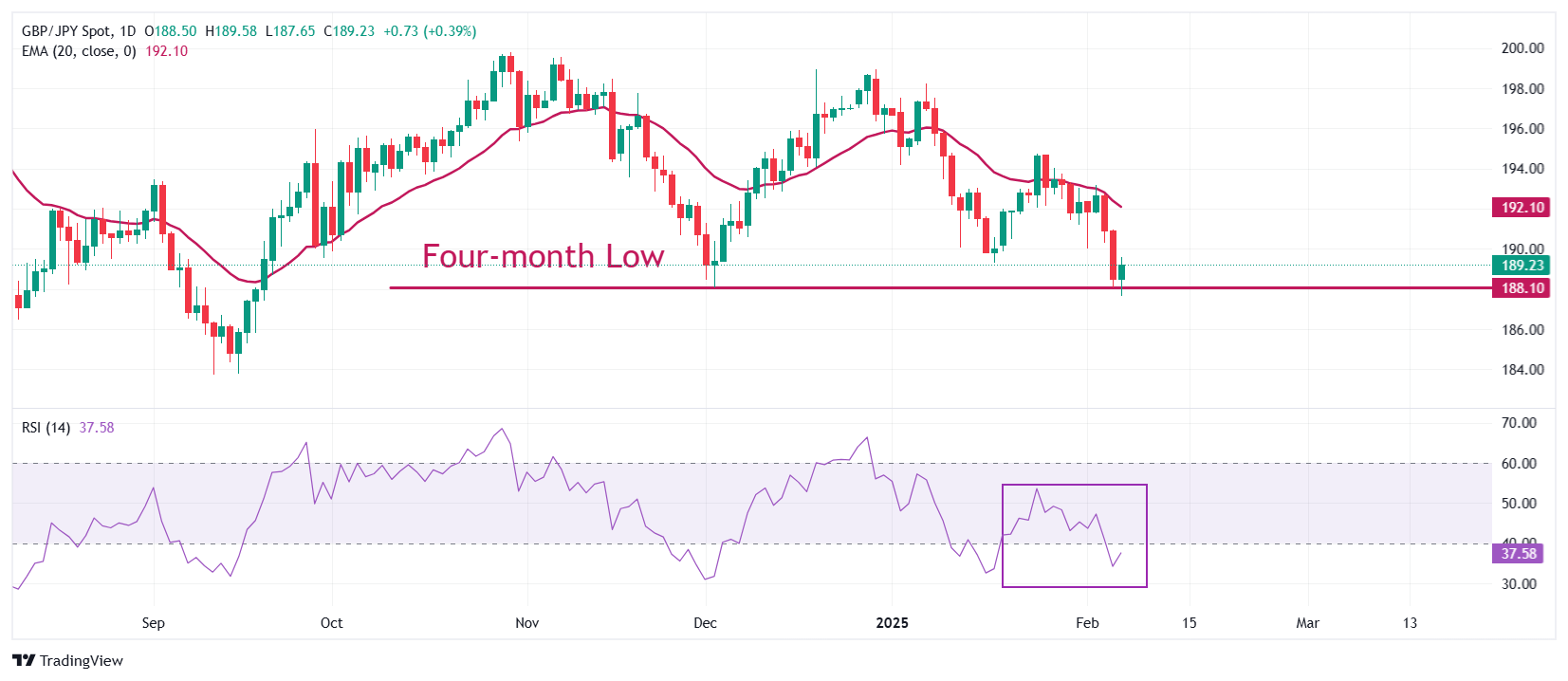
GBP/JPY discovers strong buying interest after diving to near the four-month low of 188.00. The outlook of the pair remains bearish as the 20-day Exponential Moving Average (EMA) is sloping downwards, which trades around 192.10.
The 14-day Relative Strength Index (RSI) slides into the 20.00-40.00 range, suggesting that the downside momentum is intact.
More downside would appear towards the September 18 low of 185.80 and the September 16 low of 183.77 if the pair breaks below the intraday low of 188.00.
On the flip side, a further recovery move above the February 4 high of 193.18 will drive the asset towards the January 24 high of 194.76, followed by the January 9 high of 195.90.
GBP/JPY daily chart
Pound Sterling FAQs
The Pound Sterling (GBP) is the oldest currency in the world (886 AD) and the official currency of the United Kingdom. It is the fourth most traded unit for foreign exchange (FX) in the world, accounting for 12% of all transactions, averaging $630 billion a day, according to 2022 data. Its key trading pairs are GBP/USD, also known as ‘Cable’, which accounts for 11% of FX, GBP/JPY, or the ‘Dragon’ as it is known by traders (3%), and EUR/GBP (2%). The Pound Sterling is issued by the Bank of England (BoE).
The single most important factor influencing the value of the Pound Sterling is monetary policy decided by the Bank of England. The BoE bases its decisions on whether it has achieved its primary goal of “price stability” – a steady inflation rate of around 2%. Its primary tool for achieving this is the adjustment of interest rates. When inflation is too high, the BoE will try to rein it in by raising interest rates, making it more expensive for people and businesses to access credit. This is generally positive for GBP, as higher interest rates make the UK a more attractive place for global investors to park their money. When inflation falls too low it is a sign economic growth is slowing. In this scenario, the BoE will consider lowering interest rates to cheapen credit so businesses will borrow more to invest in growth-generating projects.
Data releases gauge the health of the economy and can impact the value of the Pound Sterling. Indicators such as GDP, Manufacturing and Services PMIs, and employment can all influence the direction of the GBP. A strong economy is good for Sterling. Not only does it attract more foreign investment but it may encourage the BoE to put up interest rates, which will directly strengthen GBP. Otherwise, if economic data is weak, the Pound Sterling is likely to fall.
Another significant data release for the Pound Sterling is the Trade Balance. This indicator measures the difference between what a country earns from its exports and what it spends on imports over a given period. If a country produces highly sought-after exports, its currency will benefit purely from the extra demand created from foreign buyers seeking to purchase these goods. Therefore, a positive net Trade Balance strengthens a currency and vice versa for a negative balance.
Artigos Recomendados


