


Indian Rupee opens lower as renewed US-Iran tensions boost oil prices
- The Indian Rupee declines at open against the US Dollar as oil prices extend recovery.
- FIIs have remained net sellers in the first two trading days of June.
- Economists expect the RBI to hold the Repo Rate steady on Friday.
The Indian Rupee (INR) opens on a negative note against the US Dollar (USD) on Wednesday. The USD/INR pair jumps to near 95.67 as oil prices extend recovery due to renewed hostilities in the Middle East region, and the continuous outflow of foreign funds from the Indian stock market.
At press time, the WTI Oil price trades 1.4% higher to near $93.00, the highest level seen in over a week. Oil prices started recovering from May 29, following the announcement of revisions by United States (US) President Donald Trump in the agreement provided to Iran for a permanent ceasefire.
Currencies from economies, such as India, which rely heavily on oil imports to meet their energy needs, tend to underperform in a high oil price environment.
Meanwhile, a report from Reuters has stated that the Indian central bank likely selling US Dollars to limit Indian Rupee's losses.
US forces retaliate after Iran attacks
Late Tuesday, the US Central Command (CENTCOM) said that it had intercepted and defeated a series of Iranian missile and drone attacks targeting regional neighbors, including Kuwait and Bahrain, while also carrying out self-defense strikes on Iran’s Qeshm Island in the Strait of Hormuz, renewing fears of a war resumption in the Middle East.
This came at a time when US President Donald Trump announced, through a post on Truth Social earlier this week, that Israeli Prime Minister (PM) Benjamin Netanyahu won’t attack Lebanon, and there will be no strikes between them after several Iranian officials warned attacks on Lebanon are non-compliant with the ceasefire.
FIIs continue to pare stake in Indian stock market
Renewed uncertainty over the US-Iran deal has prompted caution among overseas investors toward the Indian stock market. On Tuesday, Foreign Institutional Investors (FIIs) sold a significant amount of shares worth Rs. 8,362.92 crore. FIIs were also net sellers on the first day of June on Monday, in which they offloaded their stake worth Rs. 3,911.68 crore.
RBI’s monetary policy awaited
The three-day Reserve Bank of India (RBI) policy meeting has started, and it will announce the monetary policy on Friday. According to a PTI poll, 11 respondents expect the RBI to maintain the repo rate at current levels in the June policy review, while four foresee a 25-basis-point (bps) increase, The Times of India (ToI) reported.
Investors will pay close attention to RBI Governor Sanjay Malhotra’s comments on the economic and the inflation outlook.
The same day, India’s Q1 Gross Domestic Product (GDP) data will also be published, which is expected to arrive lower at 7.2% from the previous reading of 7.8%.
Technical Analysis: USD/INR returns above 20-day EMA
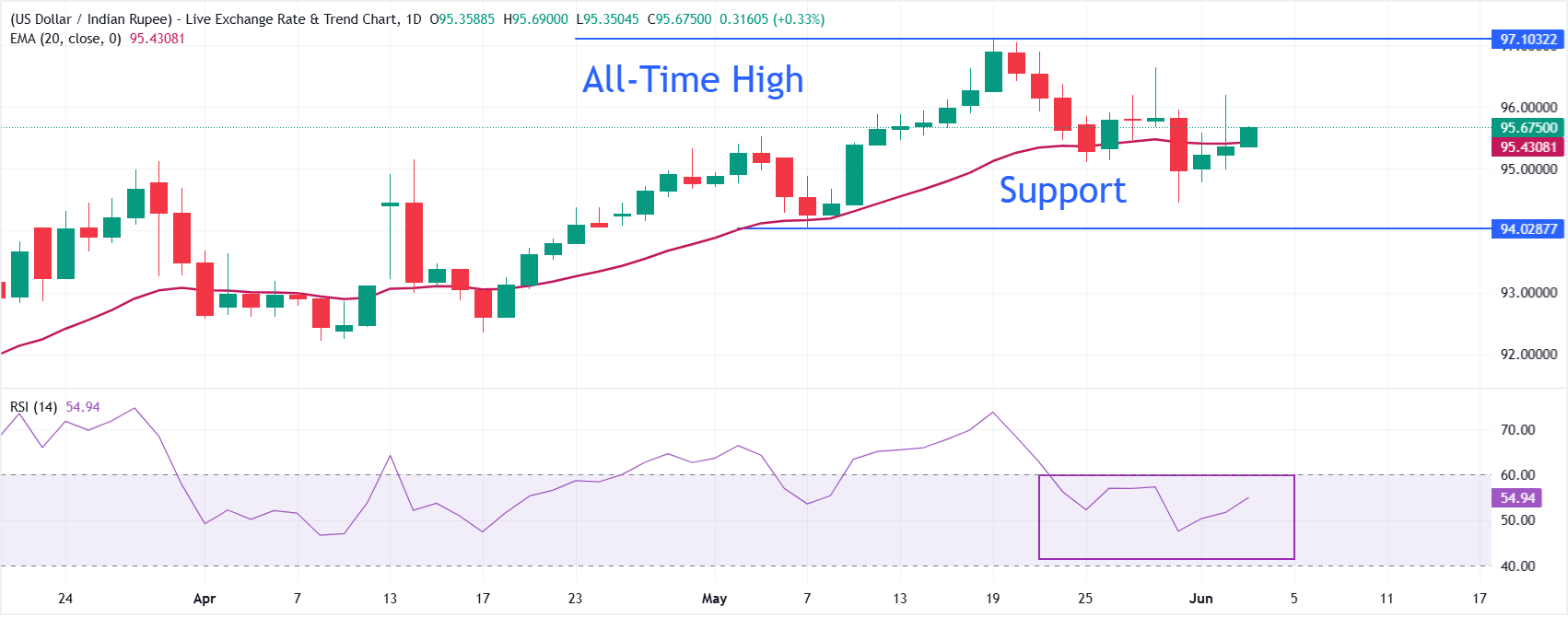
USD/INR trades higher at around 95.67 in the opening session on Wednesday. The near-term trend of the pair appears to be turning bullish as it has returned above the 20-day Exponential Moving Average (EMA), which is at 95.43. The positioning of price over this dynamic support suggests buyers retain control, while the Relative Strength Index (RSI) around 54.9 stays in neutral territory, hinting at steady rather than overheated upside momentum.
On the downside, initial support is defined by the 20-day EMA at 95.43, where a break could open the door to a deeper correction toward the May 29 low at 94.46, followed by the May 07 low at 94.03. Looking up, the pair could hope to reclaim the all-time high of 97.09 if it manages to extend its recovery above the June 2 high at 96.19.
(The technical analysis of this story was written with the help of an AI tool.)
Indian Rupee FAQs
The Indian Rupee (INR) is one of the most sensitive currencies to external factors. The price of Crude Oil (the country is highly dependent on imported Oil), the value of the US Dollar – most trade is conducted in USD – and the level of foreign investment, are all influential. Direct intervention by the Reserve Bank of India (RBI) in FX markets to keep the exchange rate stable, as well as the level of interest rates set by the RBI, are further major influencing factors on the Rupee.
The Reserve Bank of India (RBI) actively intervenes in forex markets to maintain a stable exchange rate, to help facilitate trade. In addition, the RBI tries to maintain the inflation rate at its 4% target by adjusting interest rates. Higher interest rates usually strengthen the Rupee. This is due to the role of the ‘carry trade’ in which investors borrow in countries with lower interest rates so as to place their money in countries’ offering relatively higher interest rates and profit from the difference.
Macroeconomic factors that influence the value of the Rupee include inflation, interest rates, the economic growth rate (GDP), the balance of trade, and inflows from foreign investment. A higher growth rate can lead to more overseas investment, pushing up demand for the Rupee. A less negative balance of trade will eventually lead to a stronger Rupee. Higher interest rates, especially real rates (interest rates less inflation) are also positive for the Rupee. A risk-on environment can lead to greater inflows of Foreign Direct and Indirect Investment (FDI and FII), which also benefit the Rupee.
Higher inflation, particularly, if it is comparatively higher than India’s peers, is generally negative for the currency as it reflects devaluation through oversupply. Inflation also increases the cost of exports, leading to more Rupees being sold to purchase foreign imports, which is Rupee-negative. At the same time, higher inflation usually leads to the Reserve Bank of India (RBI) raising interest rates and this can be positive for the Rupee, due to increased demand from international investors. The opposite effect is true of lower inflation.
Artigos Recomendados


