


EUR/USD falls as Middle East tensions lift USD despite hot EZ inflation
- EUR/USD loses 0.63% to 1.1618 after touching 1.1530 lows.
- DXY up 0.50% at 99.04 as Fed officials warn inflation remains elevated.
- EZ HICP rises to 1.9% YoY; core accelerates to 2.4%, yet Euro pressured by geopolitics.
EUR/USD edges down during the North American session yet it has bounced off daily lows hit at 1.1530 on heightened tensions in the Middle East, despite a jump on inflation in the Eurozone. The pair trades at 1.1618, down 0.63%.
Euro weighed by geopolitics, despite high EZ inflation
Geopolitical tensions remain high, sparking a flight to safety, boosting the US Dollar. Nevertheless, breaking news that US President Donald Trump ordered the United States Development Finance Corporation (DFC) to provide political risk insurance and guarantees for financial security of all maritime trade, especially energy traveling through the Persian Gulf, lifted the shared currency and pushed Oil prices lower.
Trump added that “if necessary, the US Navy will escort tankers through the Strait of Hormuz as soon as possible.”
Consequently, the Greenback trimmed some of its earlier gains according to the US Dollar Index (DXY). The DXY, which tracks the American’s currency value against a basket of other six, is up 0.50% at 99.04.
Fed commentary supports a higher USD
Data-wise the US economic docket was absent, yet some Federal Reserve Regional Bank Presidents crossed the wires.
New York Fed President John Williams said monetary policy is “well positioned,” adding that if inflation evolves as anticipated, additional rate cuts would eventually be appropriate.
On the other hand, Kansas City Fed’s Jeffrey Schmid was hawkish and warned that inflation remains “too hot” and must return to the 2% target. Minneapolis Fed President Neel Kashkari echoed concerns, stating that inflation is still elevated and that the economy’s resilience points to a higher neutral rate.
In the Eurozone (EZ), inflation exceeded forecasts in February, still it was below the European Central Bank’s (ECB) 2% goal. The Harmonized Index of Consumer Prices (HICP) in February rose by 1.9% YoY up from 1.7%. Underlying HICP was slightly hotter than headline inflation, jumping from 2.2% to 2.4% YoY.
The ECB Chief Economist Philip Lane expressed concerns that scarcity of oil and gas supplies, could cause a “substantial spike” in inflation and a fall in output in the EZ. Echoing his comments was Stournaras who said that should the Middle East war continues, there will be upward pressure on inflation.
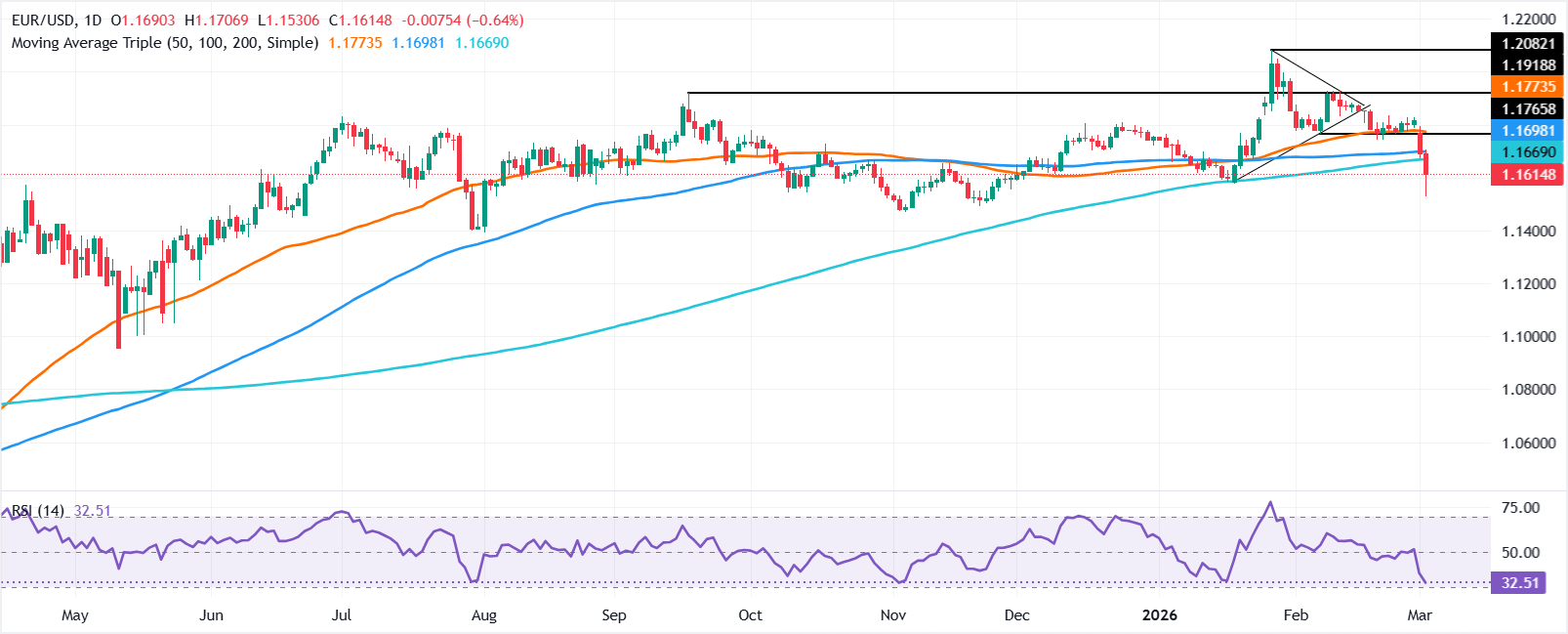
EUR/USD Price Forecast: Euro’s upside limited beneath 200-day SMA
The technical picture turned slightly negative for the EUR/USD, which tumbled below the 200-day Simple Moving Average (SMA) at 1.1664, a signal that could prompt sellers to step into the market and push prices lower. During the day, the major reached a daily low of 1.1530 before reclaiming 1.1600 and it seems poised to end the day above the January 19 swing low at 1.1576.
Momentum turns bearish as depicted in the Relative Strength Index (RSI). But Trump comment, relieved investors and pushed the Shared currency past the 1.1600 milestone.
As of writing, the EUR/USD first resistance is the 200-day SMA at 1.1664. If surpassed, traders will look at the 100-day SMA at 1.1668 followed by 1.1700. A breach of the latter clears the path for a recovery, with eyes set at the 50-day SMA at 1.1773.
On the flip side, a drop below 1.1600 opens the door to test 1.1576, followed by the day’s low 1.1530 ahead of 1.1500.
Euro FAQs
The Euro is the currency for the 20 European Union countries that belong to the Eurozone. It is the second most heavily traded currency in the world behind the US Dollar. In 2022, it accounted for 31% of all foreign exchange transactions, with an average daily turnover of over $2.2 trillion a day. EUR/USD is the most heavily traded currency pair in the world, accounting for an estimated 30% off all transactions, followed by EUR/JPY (4%), EUR/GBP (3%) and EUR/AUD (2%).
The European Central Bank (ECB) in Frankfurt, Germany, is the reserve bank for the Eurozone. The ECB sets interest rates and manages monetary policy. The ECB’s primary mandate is to maintain price stability, which means either controlling inflation or stimulating growth. Its primary tool is the raising or lowering of interest rates. Relatively high interest rates – or the expectation of higher rates – will usually benefit the Euro and vice versa. The ECB Governing Council makes monetary policy decisions at meetings held eight times a year. Decisions are made by heads of the Eurozone national banks and six permanent members, including the President of the ECB, Christine Lagarde.
Eurozone inflation data, measured by the Harmonized Index of Consumer Prices (HICP), is an important econometric for the Euro. If inflation rises more than expected, especially if above the ECB’s 2% target, it obliges the ECB to raise interest rates to bring it back under control. Relatively high interest rates compared to its counterparts will usually benefit the Euro, as it makes the region more attractive as a place for global investors to park their money.
Data releases gauge the health of the economy and can impact on the Euro. Indicators such as GDP, Manufacturing and Services PMIs, employment, and consumer sentiment surveys can all influence the direction of the single currency. A strong economy is good for the Euro. Not only does it attract more foreign investment but it may encourage the ECB to put up interest rates, which will directly strengthen the Euro. Otherwise, if economic data is weak, the Euro is likely to fall. Economic data for the four largest economies in the euro area (Germany, France, Italy and Spain) are especially significant, as they account for 75% of the Eurozone’s economy.
Another significant data release for the Euro is the Trade Balance. This indicator measures the difference between what a country earns from its exports and what it spends on imports over a given period. If a country produces highly sought after exports then its currency will gain in value purely from the extra demand created from foreign buyers seeking to purchase these goods. Therefore, a positive net Trade Balance strengthens a currency and vice versa for a negative balance.
Artigos Recomendados


