


Gold slumps over 4% as US yields surge on Middle East escalation
- XAU/USD slides briefly below $5,000 from $5,379 as the US 10-year yield climbs to 4.05%.
- DXY jumps 0.70% to 99.21 amid Strait of Hormuz closing threats and 6% Oil spike.
- Fed easing bets trimmed to 44 bps as Williams, Schmid, Kashkari sound cautious.
Gold (XAU/USD) drops more than 4% on Tuesday as high US Treasury yields weighed on the yellow metal, which usually works as a hedge amid global geopolitical uncertainty and conflicts. The escalation of hostilities between the US, Israel and Iran pushed US debt premiums higher, a tailwind for the US Dollar. At the time of writing, XAU/USD trades at $5,104 after reaching a daily low of $4,997 earlier in the day.
Risk aversion sparked by Middle East conflict fuels inflation fears
Sentiment remains sour as the conflict enters its fourth day, and the rise of Oil prices stoked inflation fears. The US Dollar Index (DXY), which measures the buck’s performance against six currencies, is rising nearly 0.70% to 99.21.
Developments in the Middle East involved explosions in Tehran and Beirut. Threats of the Iranian Revolutionary Guard to keep the Strait of Hormuz closed keep WTI prices underpinned, up so far 6.74% in the day at $75.80 per barrel.
Given the geopolitical backdrop, investors seem less confident that the Federal Reserve (Fed) will reduce borrowing costs during the year, as depicted by high US Treasury yields. The US 10-year Treasury note is yielding 4.059%, up nearly three basis points, a headwind for bullion.
Investors pricing in a less dovish Fed
New York Fed President John Williams crossed the wires and said that policy is “well positioned,” and that “if inflation follows the path I expect, further reductions in the federal funds rate will eventually be warranted.”
Kansas City Fed President Jeffrey Schmid was hawkish, saying that inflation “is too hot,” and that the Fed needs to get inflation down to 2%. Recently, Minneapolis Fed President Neel Kashkari said that “inflation is too high,” and that the “strength of the economy suggests a higher neutral rate.”
Money markets had priced in 44 basis points of Fed easingby year-end, according to Prime Market Terminal data.
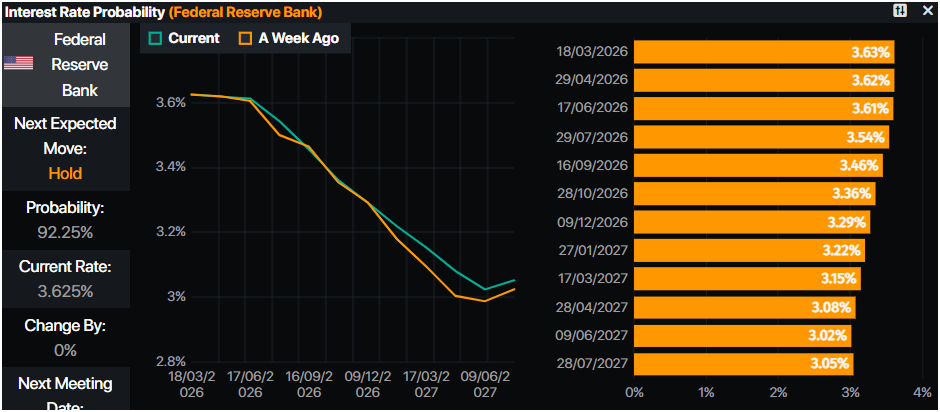
This week, the US economic docket will feature the release of the latest Nonfarm Payrolls report on Friday, the ISM Services PMI on Wednesday and jobless claims on Thursday. Nevertheless, heightened geopolitical tensions pushed macroeconomic data to the backseat.
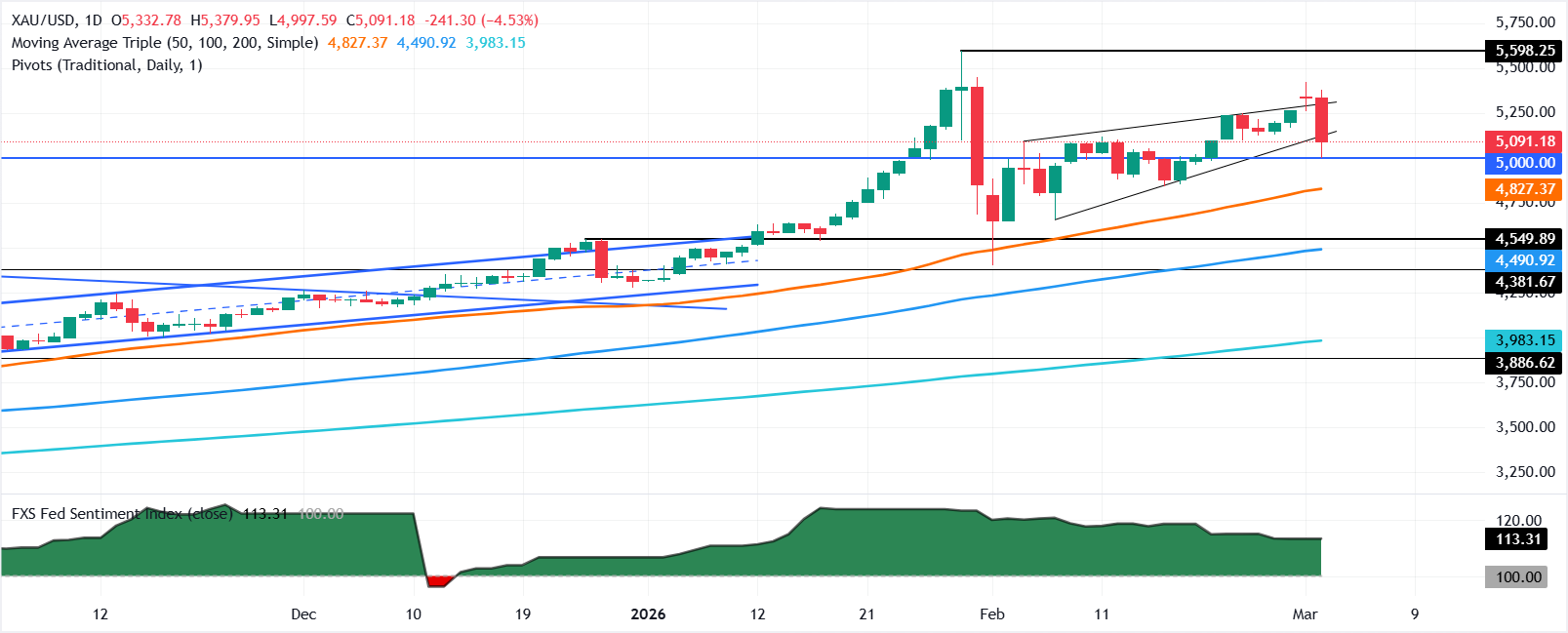
XAU/USD technical outlook: Gold remains bullish, despite testing $5,000
Gold’s technical picture supports further upside after briefly testing the $5,000 mark. The Relative Strength Index (RSI), although edging lower, remains in bullish territory, an indication that buyers have the upper hand. However, in the short term, XAU/USD might consolidate above/below $5,100, awaiting a fresh catalyst.
If XAU/USD rises past $5,100, the first resistance would be $5,200, followed by the February 24 high at $5,249, ahead of $5,300. Overhead lies the March 3 high at $5,379, ahead of $5,419.
Conversely, if Gold drops below $5,000, the first support would be $4,950, followed by the February 17 cycle low of $4,841. On further weakness, the next stop would be the 50-day SMA at $4,810.
Gold FAQs
Gold has played a key role in human’s history as it has been widely used as a store of value and medium of exchange. Currently, apart from its shine and usage for jewelry, the precious metal is widely seen as a safe-haven asset, meaning that it is considered a good investment during turbulent times. Gold is also widely seen as a hedge against inflation and against depreciating currencies as it doesn’t rely on any specific issuer or government.
Central banks are the biggest Gold holders. In their aim to support their currencies in turbulent times, central banks tend to diversify their reserves and buy Gold to improve the perceived strength of the economy and the currency. High Gold reserves can be a source of trust for a country’s solvency. Central banks added 1,136 tonnes of Gold worth around $70 billion to their reserves in 2022, according to data from the World Gold Council. This is the highest yearly purchase since records began. Central banks from emerging economies such as China, India and Turkey are quickly increasing their Gold reserves.
Gold has an inverse correlation with the US Dollar and US Treasuries, which are both major reserve and safe-haven assets. When the Dollar depreciates, Gold tends to rise, enabling investors and central banks to diversify their assets in turbulent times. Gold is also inversely correlated with risk assets. A rally in the stock market tends to weaken Gold price, while sell-offs in riskier markets tend to favor the precious metal.
The price can move due to a wide range of factors. Geopolitical instability or fears of a deep recession can quickly make Gold price escalate due to its safe-haven status. As a yield-less asset, Gold tends to rise with lower interest rates, while higher cost of money usually weighs down on the yellow metal. Still, most moves depend on how the US Dollar (USD) behaves as the asset is priced in dollars (XAU/USD). A strong Dollar tends to keep the price of Gold controlled, whereas a weaker Dollar is likely to push Gold prices up.
Artigos Recomendados


