


NZD/USD: All eyes on RBNZ guidance and new Governor Breman's debut
- Reserve Bank of New Zealand rate decision on Wednesday is the week's dominant event, with a hold at 2.25% fully priced and forward guidance under the spotlight.
- January trade balance data on Thursday, RBNZ Governor Breman's speech Thursday, and US Q4 GDP and core PCE on Friday complete a heavy back half of the week.
The Reserve Bank of New Zealand (RBNZ) delivers its first monetary policy decision of 2026 on Wednesday, with a 99% probability priced in for a hold at the 2.25% Official Cash Rate (OCR). With the decision itself largely settled, markets will focus on updated economic projections and whether the central bank shifts its guidance away from mid-2027 as the likely timing for the first rate increase. New Governor Anna Breman is fronting her first major set-piece event, and her tone will be closely parsed for hawkish or dovish leanings. Consumer Price Index (CPI) inflation at 3.1% sits above the top of the RBNZ's 1% to 3% target band, and Q1 business inflation expectations have risen, keeping roughly 40 basis points of tightening priced in by year-end. ING expects two rate hikes from Q3, taking the OCR to 2.75%. Breman is also scheduled to speak again on Thursday evening. On the data front, New Zealand January trade balance and export/import figures are due Thursday.
From the US, Federal Reserve (Fed) minutes from the January meeting (where two members dissented in favor of a cut) are released Wednesday, followed by weekly jobless claims and the Philadelphia Fed Manufacturing Survey on Thursday. Friday brings a concentrated batch of US data: preliminary Q4 Gross Domestic Product (GDP) (3.0% forecast versus 4.4% prior), core Personal Consumption Expenditures Price Index (PCE) (0.3% month-on-month), and final February University of Michigan (UoM) consumer sentiment. Fed speakers Bostic, Bowman, Kashkari, Goolsbee, and Daly are all on the calendar through Thursday and Friday.
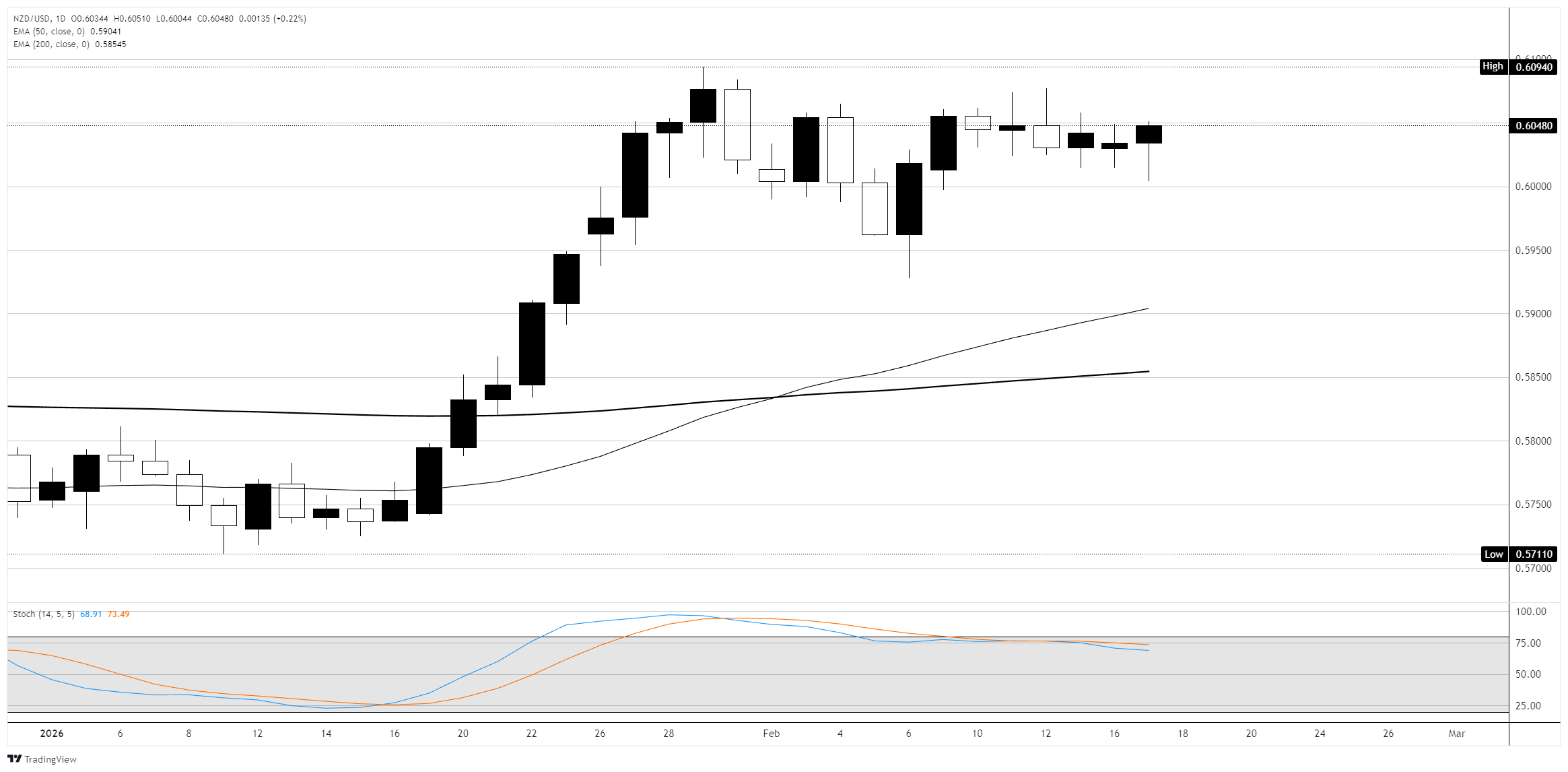
Sideways consolidation below 0.6094 as Stochastic cools from overbought
On the daily chart, NZD/USD opened Tuesday at 0.60344, reached a high of 0.60520 and a low of 0.60044, and closed at 0.60480, down 0.22%. The pair is holding well above the 50-day Exponential Moving Average (EMA) at 0.59041 and the 200-day EMA at 0.58545, with both averages rising and spaced roughly 50 pips apart, confirming the underlying bullish trend that began from the January low of 0.57110. Price action since late January has formed a sideways consolidation range between approximately 0.5990 and the year-to-date high of 0.60940, with Tuesday's candle printing another small-bodied session within this band. The Stochastic Oscillator (14,5,5) reads %K at 68.90 and %D at 73.49, with both lines rolling lower out of the overbought zone; %K has crossed below %D, suggesting near-term momentum is fading.
The candle structure over the past two weeks shows repeated tests of the 0.6040 to 0.6050 area as resistance and the 0.6000 handle as support, with several doji and spinning-top candles pointing to indecision ahead of the RBNZ decision. Immediate support sits at Tuesday's low of 0.60044, followed by the 0.5990 area and the 50-day EMA at 0.59041. On the upside, a break and close above 0.60940 would be a fresh breakout, targeting the 0.6120 to 0.6122 zone (the July 2025 high). The pair's proximity to the top of the consolidation range heading into a central bank decision creates a binary risk event; a hawkish surprise from Breman could fuel a breakout above 0.6094, while a dovish tone or downward revision to rate projections would likely push price back toward the 0.5990 to 0.6000 support zone.
NZD/USD daily chart
New Zealand Dollar FAQs
The New Zealand Dollar (NZD), also known as the Kiwi, is a well-known traded currency among investors. Its value is broadly determined by the health of the New Zealand economy and the country’s central bank policy. Still, there are some unique particularities that also can make NZD move. The performance of the Chinese economy tends to move the Kiwi because China is New Zealand’s biggest trading partner. Bad news for the Chinese economy likely means less New Zealand exports to the country, hitting the economy and thus its currency. Another factor moving NZD is dairy prices as the dairy industry is New Zealand’s main export. High dairy prices boost export income, contributing positively to the economy and thus to the NZD.
The Reserve Bank of New Zealand (RBNZ) aims to achieve and maintain an inflation rate between 1% and 3% over the medium term, with a focus to keep it near the 2% mid-point. To this end, the bank sets an appropriate level of interest rates. When inflation is too high, the RBNZ will increase interest rates to cool the economy, but the move will also make bond yields higher, increasing investors’ appeal to invest in the country and thus boosting NZD. On the contrary, lower interest rates tend to weaken NZD. The so-called rate differential, or how rates in New Zealand are or are expected to be compared to the ones set by the US Federal Reserve, can also play a key role in moving the NZD/USD pair.
Macroeconomic data releases in New Zealand are key to assess the state of the economy and can impact the New Zealand Dollar’s (NZD) valuation. A strong economy, based on high economic growth, low unemployment and high confidence is good for NZD. High economic growth attracts foreign investment and may encourage the Reserve Bank of New Zealand to increase interest rates, if this economic strength comes together with elevated inflation. Conversely, if economic data is weak, NZD is likely to depreciate.
The New Zealand Dollar (NZD) tends to strengthen during risk-on periods, or when investors perceive that broader market risks are low and are optimistic about growth. This tends to lead to a more favorable outlook for commodities and so-called ‘commodity currencies’ such as the Kiwi. Conversely, NZD tends to weaken at times of market turbulence or economic uncertainty as investors tend to sell higher-risk assets and flee to the more-stable safe havens.
Artigos Recomendados


