


The US Dollar Index stops paying for hawks who cannot vote
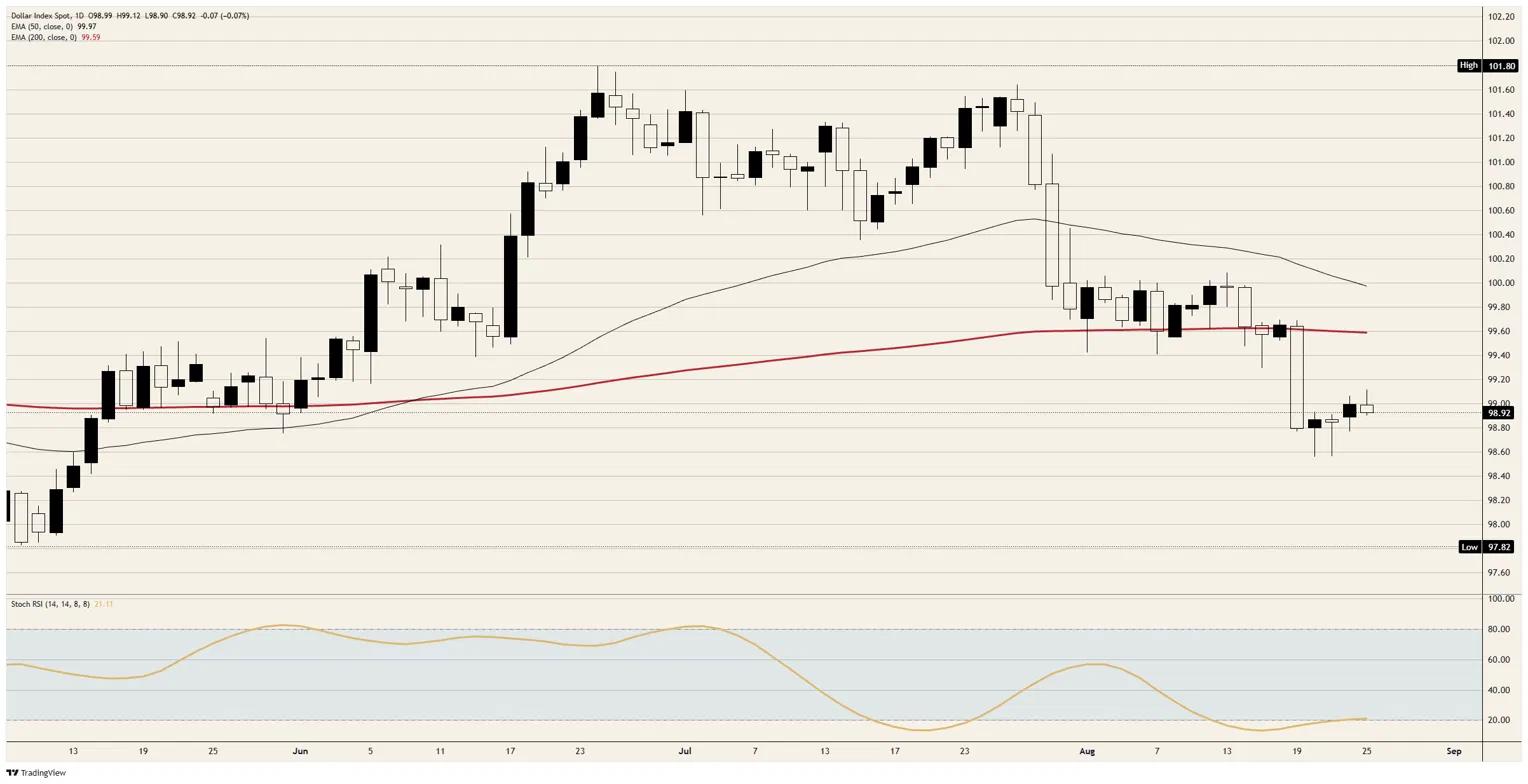
- DXY trades just under the 99.00 handle, capped by a 200-day EMA near 99.50.
- American session holds a band under a tenth of a point since 13:00 GMT.
- Fed chair keynote and the payrolls benchmark revision share 14:00 GMT on Friday.
A non-voting regional Federal Reserve president published a conditional hold on Tuesday, tying the current target range to continued evidence that inflation is actually coming down, and the Dollar Index has not moved for it. The index trades just beneath the 99.00 handle after a European morning high a shade above it, and the American session band since 13:00 GMT runs less than a tenth of a point wide. That is less a market waiting for a catalyst than a market that has stopped paying for speeches.
The hawks with microphones do not hold votes
Boston and Richmond both rotated off the Federal Open Market Committee (FOMC) in January, which makes Tuesday's remarks and the second regional address scheduled for 20:00 GMT commentary rather than count. The four regional presidents who do hold votes this year sit in Cleveland, Philadelphia, Dallas and Minneapolis, and three of the four already dissented for a quarter point on July 29.
The minutes released last week widened the chorus without widening the tally. Several participants recorded themselves ready to tighten, some doubted that financial conditions were restrictive enough to finish the job, and two presidents who held no vote in July said afterwards that they would have joined the dissent. The ladder of stated hawkishness keeps climbing while the count underneath it stays 9-3.
A market that has watched this sequence run since June now prices the gap between a stated preference and a recorded vote at close to nothing. That is the mechanism behind Tuesday's flat tape, and it is why the speaking calendar has stopped functioning as a Dollar input.
The front end has been moving the other way
Futures put a September increase near one chance in three, down from roughly two thirds in the days after the July meeting. The path down ran through a payrolls contraction, a cooler inflation print and a retail sales miss, which is to say through the data rather than through the podium. Pricing and rhetoric have been moving in opposite directions for three weeks, and the exchange rate has followed the pricing.
Tuesday's own releases pulled the same way as that pricing rather than the podium, with new home sales down 10.5% MoM in July to an annual rate near 607K and inventory rising toward 488K units. Consumer confidence eased to 89.4 in August as the expectations index dropped to 68.2, well beneath the 80 line conventionally read as a recession signal. Neither number argues for a tighter policy setting.
Long-end yields sit close to where they stood before last week's Treasury buyback announcement, the 10-year around 4.70% and the 30-year around 5.25%, so the Dollar is not being sold on a funding scare either. It is being sold because the marginal reason to own it has been repriced away, one release at a time.
An economic D-Day the Dollar declined to buy
The Treasury Secretary spent Monday unveiling what had been trailed for a week as an economic D-Day for Iran, then conceded that the package withholds the secondary measures aimed at third countries and described it as a warning shot. Tehran's state Strait authority answered by warning that vessels breaching its transit rules face fines, seizure or confiscation, and Oman's foreign minister travelled to Tehran on Tuesday to work the only channel either side still uses.
Escalation of exactly this shape bought Dollars in June, when a shut Strait read as a haven bid and a growth tax on everyone outside the United States. The formal truce mechanism has since lapsed with the 60-day window missed on both sides, Brent trades near $93.00, and the index has spent the week beneath both of its major moving averages anyway. A war premium that no longer reaches the exchange rate is not a war premium.
Wednesday's inflation test and Friday's collision
Wednesday's 12:30 GMT block carries the Personal Consumption Expenditures (PCE) price index for July, with core seen at 0.2% MoM and 3.3% YoY. An in-line print would leave core unchanged on the year and deliver none of the progress that Tuesday's conditional hold demanded. The same block brings the second cut of second-quarter Gross Domestic Product (GDP), expected to confirm 1.5% annualised growth beside a 6.3% GDP price index, and initial claims follow on Thursday with 208K forecast against 206K.
Friday is where the week actually resolves, because the chair's first Jackson Hole keynote and the preliminary annual benchmark revision to nonfarm payrolls are both scheduled for 14:00 GMT, nineteen days ahead of the September decision. Last year's preliminary revision cut 911K from the March level. A figure of that order would restate the labour market on which every hold this year has rested, in the same minute the chair is speaking about the framework.
Levels
Resistance: The 200-day Exponential Moving Average (EMA) near 99.50 has capped every attempt since last week's break and Tuesday's high did not come close to testing it. Above that the 50-day EMA sits on the 100.00 handle, which stacks two obstacles inside half a point of each other and makes the 99.50 to 100.00 band the entire bull case.
Support: The 99.00 handle is giving way intraday, leaving last week's low just above 98.50 as the first real shelf, with the daily Stochastic Relative Strength Index (Stoch RSI) near 21 and the 5-minute reading beneath 20. Oversold on both frames without a bounce is a statement about who is left to buy, and the May low just under 98.00 is the only structure below that shelf.
Bias: Bearish while the 99.50 area caps, selling rallies into it with objectives at 98.50 and then the 98.00 handle. Invalidation is a daily close back above 100.00, which would reclaim both moving averages at once and hand the September hawks a price to point at.
Dollar Index daily chart
US Dollar FAQs
The US Dollar (USD) is the official currency of the United States of America, and the ‘de facto’ currency of a significant number of other countries where it is found in circulation alongside local notes. It is the most heavily traded currency in the world, accounting for over 88% of all global foreign exchange turnover, or an average of $6.6 trillion in transactions per day, according to data from 2022. Following the second world war, the USD took over from the British Pound as the world’s reserve currency. For most of its history, the US Dollar was backed by Gold, until the Bretton Woods Agreement in 1971 when the Gold Standard went away.
The most important single factor impacting on the value of the US Dollar is monetary policy, which is shaped by the Federal Reserve (Fed). The Fed has two mandates: to achieve price stability (control inflation) and foster full employment. Its primary tool to achieve these two goals is by adjusting interest rates. When prices are rising too quickly and inflation is above the Fed’s 2% target, the Fed will raise rates, which helps the USD value. When inflation falls below 2% or the Unemployment Rate is too high, the Fed may lower interest rates, which weighs on the Greenback.
In extreme situations, the Federal Reserve can also print more Dollars and enact quantitative easing (QE). QE is the process by which the Fed substantially increases the flow of credit in a stuck financial system. It is a non-standard policy measure used when credit has dried up because banks will not lend to each other (out of the fear of counterparty default). It is a last resort when simply lowering interest rates is unlikely to achieve the necessary result. It was the Fed’s weapon of choice to combat the credit crunch that occurred during the Great Financial Crisis in 2008. It involves the Fed printing more Dollars and using them to buy US government bonds predominantly from financial institutions. QE usually leads to a weaker US Dollar.
Quantitative tightening (QT) is the reverse process whereby the Federal Reserve stops buying bonds from financial institutions and does not reinvest the principal from the bonds it holds maturing in new purchases. It is usually positive for the US Dollar.
추천 기사


