


What Tom Gardner Said About Days Like This
If you opened your portfolio today and winced, you're in good company. As of market close, the S&P 500 was down 4.36% and the Nasdaq 5.52%. If you own a lot of growth stocks, your account probably fell harder than that.
Back in September, Tom Gardner sat down to record his sixth Quarterly Call, and he spent a good chunk of it on days like this one. He didn't predict today. Tom doesn't make market calls, and he gave "a mild wrist slap" to people who make spectacular ones. Instead, he explained why a drop like this shouldn't catch a Fool off guard and what to do when one arrives. Here are five ideas from that call worth rereading before you touch the sell button.
Missed AI’s "Act 1"? Act 2 Could Be 15x Bigger. Most investors think they missed the AI boat because they didn't buy Nvidia in 2005. But according to our analysts, we’re only at the end of "Act 1"—the R&D phase. "Act 2" is the global rollout. Continue »
1. Expect a 10% to 15% drop now and then
Tom reminded us that the S&P 500 has historically fallen 10% about once a year. A pullback of 10% to 15%, he said, is "par for the course." Think of it as the toll you pay for decades of stock market returns.
He also argued the odds of a pullback were higher than usual when he recorded the call. The S&P 500 and Nasdaq were trading 10% to 30% above their typical historical valuation ranges. When stocks are priced for good news, it takes less bad news to knock them down.
And he warned that when the index falls, the high-growth, high-beta stocks many Fools own tend to fall further. High beta means a stock swings harder than the market in both directions. So if your portfolio is down more than the S&P 500 today, that's the trade-off Tom told us to expect.
2. Move in stages, never all at once
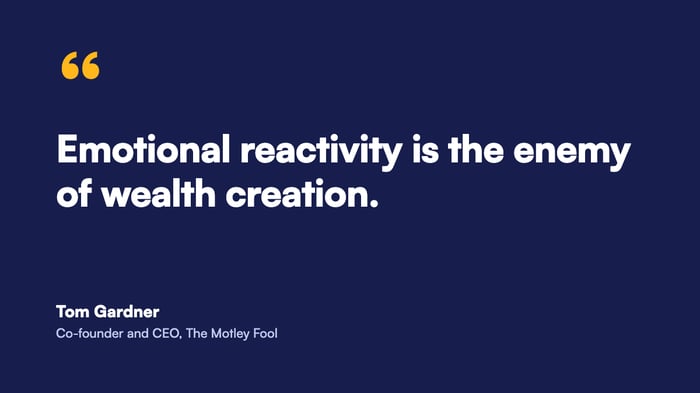
"Emotional reactivity is the enemy of wealth creation," Tom said. A red day tempts you toward the dramatic move: Sell everything, or back up the truck.
Tom's alternative is incrementalism. Buy and sell in stages and recheck your thesis at every step. His example came from Hidden Gems, which sold 15% of its CrowdStrike (NASDAQ:CRWD) position in the weeks before the call. Tom said the team didn't expect calamity for the business. The stock looked richly priced, so they took some cash off the table and kept the rest.
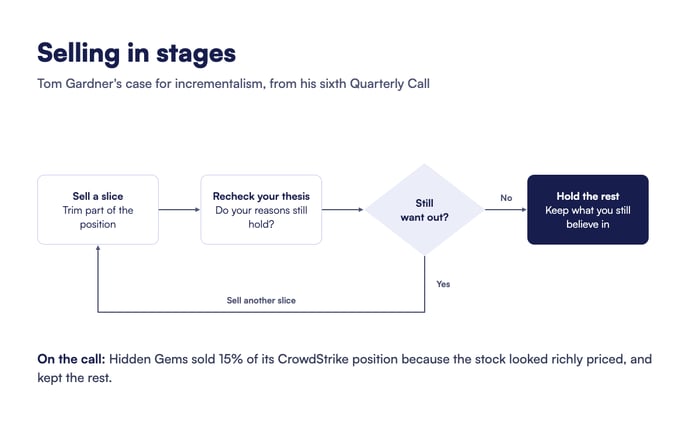
Tom argued that moving in steps builds conviction. Each partial sale makes you rethink your reasons, and that can get you out of a bad position sooner than an all-or-nothing standoff in your head. If you feel the urge to do something today, do a small something.
3. Favor quality, and lower your expectations
Tom's first recommendation for this market was to pair higher-quality companies with lower return expectations. He used Costco (NASDAQ:COST) to show what he means.
He thinks Costco could deliver about 10% a year plus a small dividend. Over a decade, that turns $10,000 into roughly $27,000. Tom admitted that sounds dull to anyone who's seen a stock do 2.7 times its money in six months. So he asked members to picture Costco handing them about 10% a year for the next decade and to decide honestly whether that would satisfy them. Your answer, he said, sets the frame for how you invest from here.
The danger runs the other way. Lower-quality companies carrying high expectations can fall 50%, 70%, or 90% "and never come back," Tom warned. If one of those becomes one of your largest positions, it can be "quite damaging to your pursuit of financial freedom," he said, noting that it's a good idea to have "solid ballast" in your portfolio. Ballast is the heavy weight in a ship's hold that keeps it steady.
4. Own enough companies that no single one can sink you
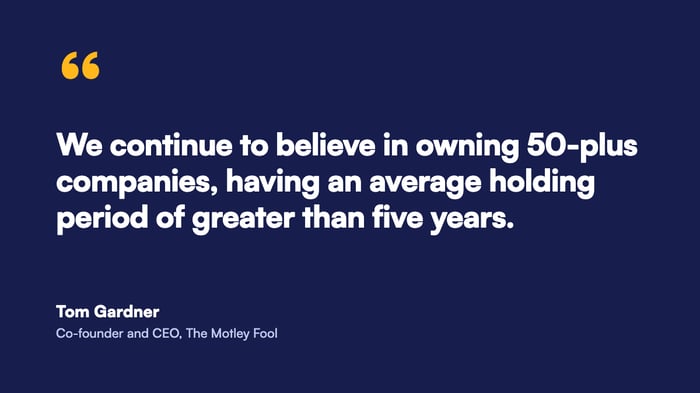
Tom reaffirmed a core Foolish principle: Own 50 or more companies and hold them for more than five years on average.
His reminder of why came from a stock he owns. Rocket Lab (NASDAQ:RKLB) had run up to $150 a share and then been cut in half by the time of the call. Tom still believes in the business, but he called that kind of swing a reminder of "the importance of having a diversified portfolio."
5. Run the fire drill before the fire
Tom's final action step was about your household, and it may matter most on a day like today. He suggested a family exercise. Figure out how cheaply you could live for a month and still enjoy your life. Then ask how big your emergency fund should be. Is six months enough? Nine? Twelve?
His goal is to simulate a recession, a market decline, or a job change before any of them shows up. "Taking the step to improve the sustainability of a high-quality life is vastly more significant and important than squeezing out extra percentage points of returns, particularly in a richly priced market," he said.
A household with its bills covered and cash in reserve can treat a falling market as a sale. Tom described investors who get through a 20% or even 40% decline "in style." They keep a cash position on the side and put it to work in their favorite companies at lower prices. In a reply to members in the call's comments section, Tom said his own cash position sits in the 10% to 15% range.
Tomorrow's another day
Tom closed the first section of his call with a line from his father, who created the Potential Growth Indicator you'll find on our site. After a long, happy day, when the Gardner kids asked to stay up late, their dad would say, "Tomorrow's another day." Tom offered that advice to investors who try to cram every win into today. It works just as well for losses. A bad day is one day, and Fools invest for decades.
Missed AI’s "Act 1"? Act 2 Could Be 14x Bigger
Most investors think they missed the AI boat because they didn't buy Nvidia in 2005.
But according to our analysts, we’re only at the end of "Act 1"—the R&D phase. "Act 2" is the global rollout, a massive technology build-out that Google’s CEO says could be more profound than fire or electricity.
While everyone watches the chip designers, one "backbone" company provides the critical technology that Nvidia and AMD literally cannot function without. We’ve detailed this under-the-radar player in our new AI Playbook.
Continue »
Tom Gardner has positions in CrowdStrike and Rocket Lab. The Motley Fool has positions in and recommends Costco Wholesale, CrowdStrike, and Rocket Lab. The Motley Fool has a disclosure policy.
Recommended Articles


