


Stellantis Stock Is Soaring. Europe Is Crashing the Party.
Key Points
Stellantis stock surged 13% after the company reported third-quarter results.
While Stellantis' North American region improved drastically, Europe drove in the opposite direction.
Investors have reasons to be optimistic, as cost improvements have made a difference.
- 10 stocks we like better than Stellantis ›
Stellantis (NYSE: STLA) investors finally had something to smile about after the automaker released third-quarter results on Wednesday. Its U.S.-listed shares jumped roughly 15% during morning trading as investors welcomed signs that the turnaround was already gaining some traction.
There was certainly reason for investor enthusiasm. Management reported €828 million in year-over-year industrial cost improvements, and adjusted operating income increased impressively. On the flip side, the company's adjusted operating margin was still just 0.7%.
Missed AI’s "Act 1"? Act 2 Could Be 15x Bigger. Most investors think they missed the AI boat because they didn't buy Nvidia in 2005. But according to our analysts, we’re only at the end of "Act 1"—the R&D phase. "Act 2" is the global rollout. Continue »
That leaves investors with a fair question: If the savings are showing up, why are profits still so ugly? A look beneath the companywide results reveals progress in one major market and a setback in another. Let's dig in.

Image source: Stellantis.
Show me the money!
Stellantis generated 256 million euros in adjusted operating income during the third quarter, up from 90 million euros a year earlier. The good news is that the automaker did this even as revenue increased by only 1% to approximately 37.6 billion euros. That tells us cost control is a critical part of the story. During the earnings call, management noted industrial cost improvement as the largest positive contributor to year-over-year adjusted operating income. Purchasing efficiencies, including initial benefits from its Value Creation Program, accounted for most of that improvement.
The 828-million-euro figure isn't additional profit shareholders can simply add to the bottom line. Other changes -- including volume, product mix, and operating expenses -- also affected the result. Still, there is evidence of progress beyond a presentation full of promises. Management expects savings from the program to accelerate in the fourth quarter, and the company remains focused on a €6 billion annual run-rate efficiency target by 2028.
Europe crashes the party
North America provided an encouraging development. The region moved from a €475 million adjusted operating loss in the third quarter of 2025 to a €64 million profit this year. Its adjusted operating margin improved from negative 3% to positive 0.4%. Investors surely won't be throwing a parade for a 0.4% margin, but returning to a small adjusted profit is a better starting point than another sizable loss. Worse yet, Stellantis's Enlarged Europe business swung from a €157 million adjusted operating profit to a €311 million loss. That sent its margin from positive 1.2% to negative 2.2%.
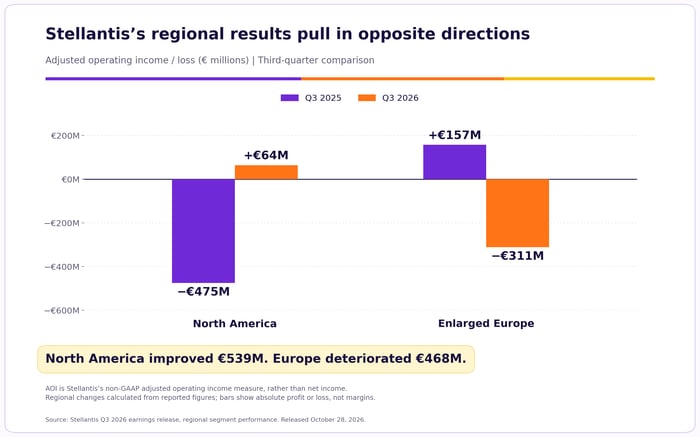
Data source: Stellantis SEC filings. Graphic source: Author using ChatGPT for editing.
The European deterioration nearly matched North America's improvement. That helps explain why progress in a crucial market hasn't produced a much stronger companywide result. European profitability faced an unfavorable mix, including higher electric vehicle (EV) sales and persistent pricing pressure. Higher volumes and continued cost savings weren't enough to offset those pressures.
That's the distinction investors should watch: selling more vehicles and keeping more of the proceeds from those sales should be a focal point over the next year's earnings reports.
What it all means
The next step is for cost improvements to translate into a recovery across more of the business. North America needs to build on its modest profitability, as it still remains the company's profit engine, while Europe needs to stop pulling in the other direction. Cash generation matters, too. Industrial free cash flow was negative €4 billion during the third quarter. Management attributed much of that pressure to seasonal working-capital movements and expects those dynamics to reverse in the fourth quarter. It also reaffirmed its expectation of positive industrial free cash flow in 2027 – a solid next step for the automaker.
Investors have reasons to welcome the progress. But a sharp stock-price bounce doesn't finish the turnaround; it's really still just beginning. Watch whether accelerating savings, healthier regional margins, and improved cash flow begin to expand the turnaround story. Stellantis is showing that it can find savings. Now it needs more of those savings to survive the rest of the income statement.
Should you buy stock in Stellantis right now?
Before you buy stock in Stellantis, consider this:
The Motley Fool Stock Advisor analyst team just identified what they believe are the 10 best stocks for investors to buy now… and Stellantis wasn’t one of them. The 10 stocks that made the cut could produce monster returns in the coming years.
Consider when Netflix made this list on December 17, 2004... if you invested $1,000 at the time of our recommendation, you’d have $334,793!* Or when Nvidia made this list on April 15, 2005... if you invested $1,000 at the time of our recommendation, you’d have $1,257,420!*
Now, it’s worth noting Stock Advisor’s total average return is 874% — a market-crushing outperformance compared to 209% for the S&P 500. Don't miss the latest top 10 list, available with Stock Advisor, and join an investing community built by individual investors for individual investors.
See the 10 stocks »
*Stock Advisor returns as of November 1, 2026.
Daniel Miller has no position in any of the stocks mentioned. The Motley Fool recommends Stellantis. The Motley Fool has a disclosure policy.
Recommended Articles


