


TSMC or Nvidia: If I Could Only Own 1 for the Next 5 Years, It Would Be This 1.
Key Points
Nvidia and TSMC are critical parts of the AI ecosystem, which is why investors have flocked to them in recent years.
Nvidia's data center segment now accounts for over 92% of its total revenue.
TSMC has a virtual monopoly on manufacturing advanced AI chips.
- 10 stocks we like better than Nvidia ›
The ongoing artificial intelligence (AI) boom has birthed many new inspiring companies, but it has also added a fresh spark to companies that have been around for decades.
Many stocks have soared in recent years as investors pour money into AI stocks, but two of the main beneficiaries have been Nvidia (NASDAQ: NVDA) and Taiwan Semiconductor Manufacturing (NYSE: TSM) (TSMC). In the past five years, Nvidia and TSMC are up 874% and 266%, respectively, far outperforming any major index.
Missed Nvidia in 2009? This Rare Signal Is Flashing Again. In 2009, a "Double Down" signal flashed for a little-known chipmaker called Nvidia. For the first time in years, that same "Total Conviction" signal is flashing for a company 1/100th the size of Nvidia. Continue »
Both stocks are great options, but if you had to choose one, which should it be? Let's take a look.
Image source: The Motley Fool.
What Nvidia has working in its favor
Nvidia is the poster child of the current AI boom, with its hardware (especially its GPUs) powering the most advanced AI models around. Nvidia's GPUs were initially used for video games, but they're also great at the processing required to train and run AI models.
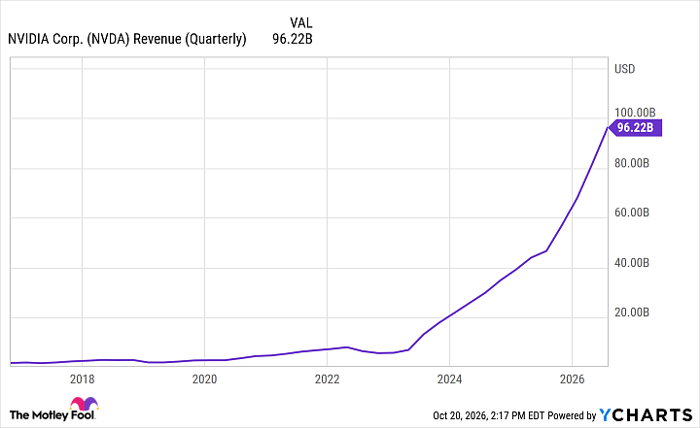
In its fiscal second quarter (ended July 26), Nvidia reported $96.2 billion in revenue (up 106% year over year), with $89 billion from its data center segment (up 117% year over year).
NVDA Revenue (Quarterly) data by YCharts
Nvidia is more than just its advanced chips. It's done a great job of building a hardware-software ecosystem that essentially traps customers in because it's the de facto coding language used in AI development (called CUDA), and switching to a different chipmaker would be too costly and time-consuming for companies.
This stronghold in enterprise AI is how Nvidia has become the world's most valuable public company, with a market cap of over $5.2 trillion (as of market open on Oct. 21).
What TSMC has working in its favor
TSMC is the world's premier semiconductor (chip) foundry and is also extremely important to the AI ecosystem, but for a different reason. While companies like Nvidia design the chips they sell, TSMC manufactures them and brings them to life.
None of TSMC's competitors can match its scale or capabilities, which is why it has long been the go-to for some of the world's top tech giants -- including Nvidia. When it comes to manufacturing advanced AI chips, TSMC has a monopoly, and that's putting it lightly.
Being the go-to option has given TSMC significant pricing power, which it has used to its advantage. Its revenue growth is solid, but its margins are where its pricing power really shows up. From last third quarter to this recent third quarter, its gross margins rose from 59.5% to 66.4%, operating margin from 50.6% to 58.7%, and net profit margin from 45.7% to 51.1%.
This should continue. During TSMC's latest earnings call, CEO C.C. Wei highlighted the demand, saying:
The AI market continues to be very strong. Recent developments are very positive to AI's long-term demand outlook. We observe increasing AI demand, fueled by the rising adoption of agentic AI as we transition from chatbot to AI assistance.
Which is the better investment for the next five years?
From a business standpoint, one reason I give TSMC the edge is because of how much Nvidia depends on it. Nvidia is a powerhouse, no doubt, but without TSMC's manufacturing ability, Nvidia's business becomes limited. It's at the mercy of TSMC's capacity and production timelines.
TSMC is a great partner, but that dependency can also be a single point of failure. I don't see it happening, but the risk is there nonetheless. Nvidia could go with a rival like Samsung, but that could mean sacrificing production and having to redesign systems.
The same concentration risk applies to many other tech companies. Regardless of who dominates the AI race between the AI hyperscalers (Amazon, Microsoft, Alphabet, and Meta Platforms), they'll all rely on TSMC for manufacturing. That puts TSMC in a very lucrative position for at least the next five years, but even after the AI frenzy, it'll remain a key piece in the supply chain for tons of other electronics.
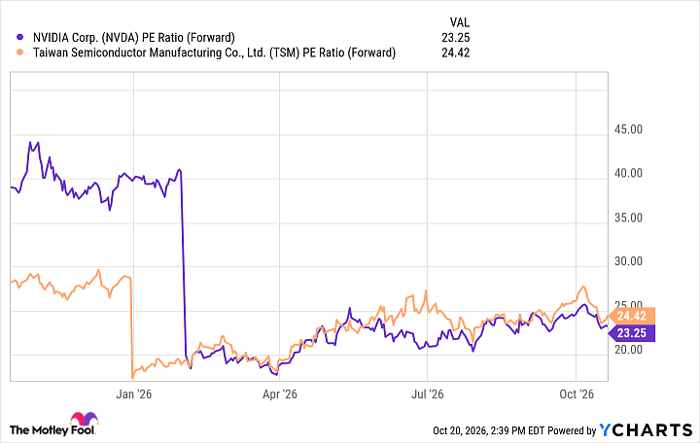
From a stock standpoint, Nvidia and TSMC trade similarly, at 23.3 and 24.2 times their projected earnings next year, respectively. However, the difference in market caps ($5.2 trillion versus $2.2 trillion) leads me to believe that TSMC has more upside. It could double in value and still not be as valuable as Nvidia is now.
NVDA PE Ratio (Forward) data by YCharts
We can't predict how any stock will perform, and you likely can't go wrong with investing in either stock. However, over the next five years, I like TSMC's upside.
Should you buy stock in Nvidia right now?
Before you buy stock in Nvidia, consider this:
The Motley Fool Stock Advisor analyst team just identified what they believe are the 10 best stocks for investors to buy now… and Nvidia wasn’t one of them. The 10 stocks that made the cut could produce monster returns in the coming years.
Consider when Netflix made this list on December 17, 2004... if you invested $1,000 at the time of our recommendation, you’d have $361,596!* Or when Nvidia made this list on April 15, 2005... if you invested $1,000 at the time of our recommendation, you’d have $1,303,935!*
Now, it’s worth noting Stock Advisor’s total average return is 910% — a market-crushing outperformance compared to 211% for the S&P 500. Don't miss the latest top 10 list, available with Stock Advisor, and join an investing community built by individual investors for individual investors.
See the 10 stocks »
*Stock Advisor returns as of October 24, 2026.
Stefon Walters has positions in Microsoft and Taiwan Semiconductor Manufacturing. The Motley Fool has positions in and recommends Alphabet, Amazon, Meta Platforms, Microsoft, Nvidia, and Taiwan Semiconductor Manufacturing. The Motley Fool has a disclosure policy.
Recommended Articles


