


Warren Buffett's Successor, Greg Abel, Has 22% of Berkshire Hathaway Invested in This Stock That Just Crossed the $5 Trillion Mark
Key Points
Berkshire Hathaway’s new CEO, Greg Abel, is likely to keep the company’s strategy and philosophy intact.
The conglomerate still owns plenty of stocks Buffett loves, including Apple, which remains its largest single holding.
Apple’s long-term outlook appears attractive, despite some challenges it has encountered in recent years.
- Motley Fool Issues Rare "Total Conviction" Buy Alert ›
Greg Abel became the CEO of Berkshire Hathaway (NYSE:BRKA) (NYSE:BRKB) at the beginning of the year after the company's longtime leader, Warren Buffett, stepped down. Some investors may worry that Abel will make significant changes to the business.
But so far, the evidence suggests otherwise. Besides closing some positions formerly managed by Todd Combs, an investment lieutenant of Buffett's who also left the company recently, Abel hasn't made that many major changes.
Missed AI’s "Act 1"? Act 2 Could Be 15x Bigger. Most investors think they missed the AI boat because they didn't buy Nvidia in 2005. But according to our analysts, we’re only at the end of "Act 1"—the R&D phase. "Act 2" is the global rollout. Continue »
He has also explicitly said that he intends to maintain the company culture intact, while keeping major stock holdings accumulated during the Buffett era. One company Abel thinks could compound over the long run is Apple (NASDAQ:AAPL), which became Berkshire's top holding years ago during Buffett's tenure and remains so.
Apple accounts for about 22% of the conglomerate's public equity portfolio, and it recently reached a major milestone, closing above a $5 trillion market cap for the first time, and only becoming the second company to do so. With all that said, should retail investors also be bullish on Apple's long-term prospects?

Warren Buffett. Image source: The Motley Fool.
The road to $5 trillion
Things haven't been easy for Apple over the past few years. The company has faced steep tariffs and legal headwinds, among other challenges. Apple has performed fairly well despite all that. How did the company manage that?
The iPhone 17, launched in 2025, has been an important growth driver over the past 12 months. This newest iPhone features various artificial intelligence (AI) capabilities. It has driven a solid renewal cycle, helping Apple generate some of its strongest quarters in years in terms of sales growth.
During the third quarter of its fiscal year 2026, which ended on June 27, Apple's revenue grew 16% year over year to $109.4 billion. Apple's revenue growth has been in double digits for several quarters in a row now, after spending years below that.
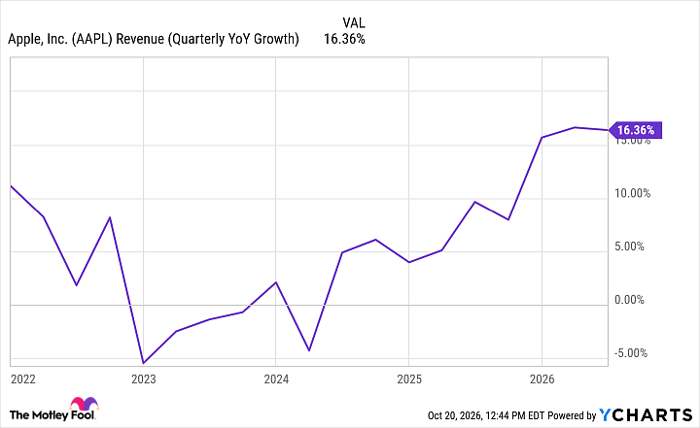
AAPL Revenue (Quarterly YoY Growth) data by YCharts
Meanwhile, the company's earnings per share (EPS) of $2.02 was up 29% year over year. A $0.11 tariff refund positively impacted Apple's EPS, but even without that, it would have grown by almost 22% year over year, a solid performance for a company of this size. Apple's iPhone segment did much of the heavy lifting.
It recorded sales of $54.3 billion, up 21.6% compared to the year-ago period. In fact, Apple has been struggling to keep up with iPhone demand, with the company's former CEO, Tim Cook -- who stepped down at the end of August -- saying demand has exceeded management's expectations.
Supply-constraint problems aside, this highlights that Apple's iPhone remains highly popular and can still drive strong revenue growth. It has been Apple's most important asset on its road to reaching the $5 trillion mark.
What's next for Apple?
Apple's newest iPhone lineup includes the 18 and the company's first attempt at a foldable smartphone, the iPhone Duo. The company also continues to pursue the same AI strategy. It seeks to integrate the technology into its hardware to enhance capabilities in ways that will help attract new users and drive strong renewal cycles among existing ones.
Apple showed this strategy can be successful with the iPhone 17, and the company might only be getting started. The iPhone Duo looks particularly promising, since foldable devices launched by some of the company's competitors have been a hit. So, expect Apple to continue expanding its installed base, which has surpassed 2.5 billion active devices.
Apple's vast ecosystem will also continue to be a source of high-margin, recurring revenue, thanks to the company's subscriptions. Further, Apple generates significant free cash flow, which can allow the company to tap into new opportunities and quickly ramp them up thanks to its vast ecosystem.
It has done so in the past. Devices such as AirPods and Apple Watches quickly grew in popularity, especially because they can connect to Apple's existing devices in ways products outside the company's ecosystem can't. That's another way in which Apple's ecosystem is a strength.
True, the company's challenges have not disappeared, but it has also proven it can navigate them. So, Apple's long-term prospects remain highly attractive. No wonder Abel and Buffett are both bullish on the stock.
We just issued 'double down' alerts on 3 stocks — find out if Apple made our list
Ever feel like you missed the boat in buying the most successful stocks? Then you’ll want to hear this.
On rare occasions, our expert team of analysts issues a “Double Down” stock recommendation for companies that they think are about to pop. If you’re worried you’ve already missed your chance to invest, now is the best time to buy before it’s too late. And the numbers speak for themselves:
- Nvidia: if you invested $1,000 when we doubled down in 2009, you’d have $577,076!*
- Apple: if you invested $1,000 when we doubled down in 2008, you’d have $65,619!*
- Netflix: if you invested $1,000 when we doubled down in 2004, you’d have $350,756!*
Right now, we’re issuing “Double Down” alerts for three incredible companies, available when you join Stock Advisor, and there may not be another chance like this anytime soon.
See the 3 stocks »
*Stock Advisor returns as of October 22, 2026.
Prosper Junior Bakiny has positions in Berkshire Hathaway. The Motley Fool has positions in and recommends Apple and Berkshire Hathaway. The Motley Fool has a disclosure policy.
Recommended Articles


