


TSMC Shares Fall Toward $400 as Strong Q3 Results Fail to Offset CPI Headwinds
TradingKey - TSMC achieves major revenue and profit gains in Q3, but struggles against strong macroeconomic headwinds; stock price risks testing the $400 mark.
On October 15, global foundry leader TSMC (TSM) officially released its Q3 2026 financial report today. Single-quarter revenue and net profit both hit new record highs. However, impacted by macro liquidity tightening and concerns over sticky inflation and delayed rate cuts triggered by hotter-than-expected US September CPI data, its stock price fell by over 2% in pre-market trading, touching a low of $418 at one point and temporarily trading at $421.14.
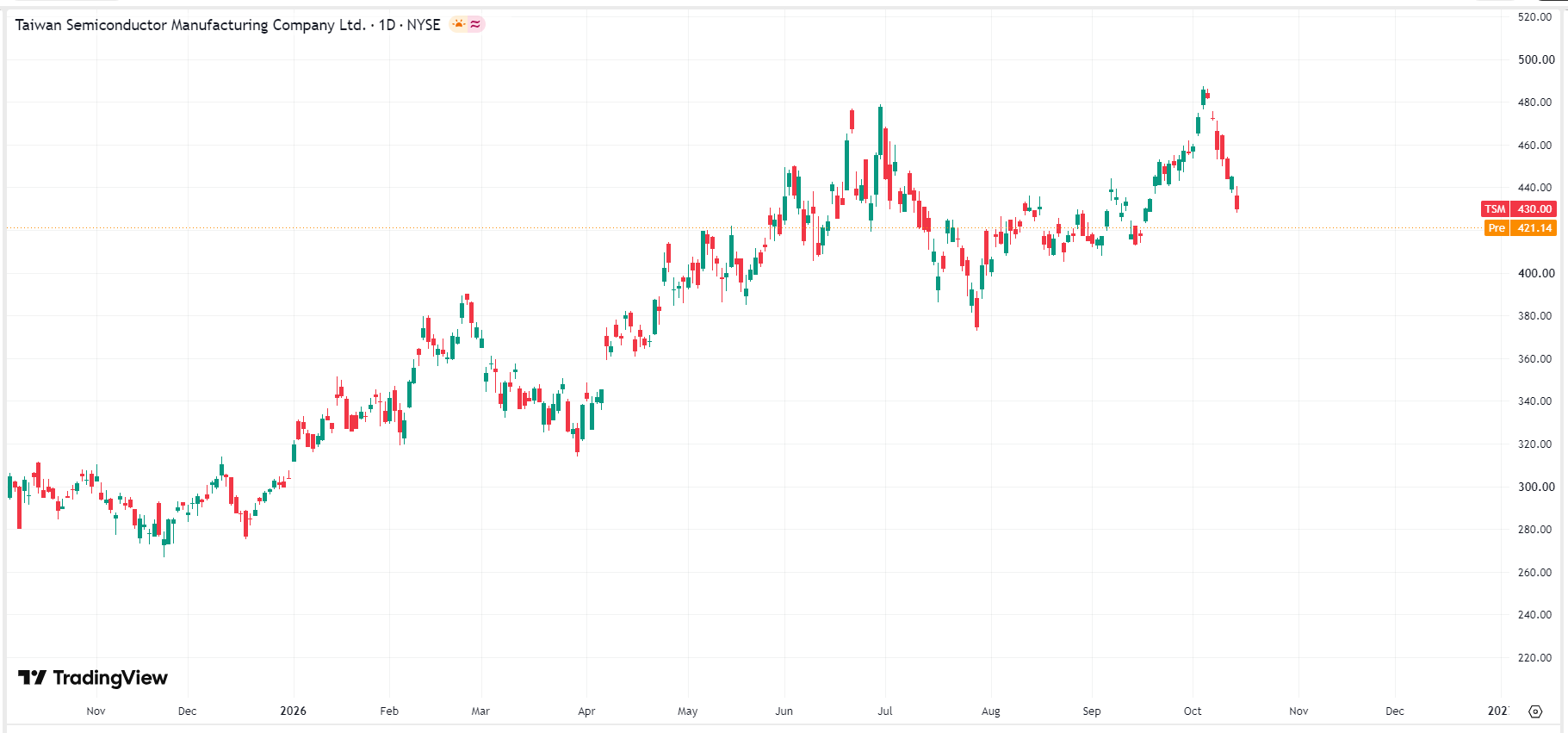 TSMC stock price chart, Source: TradingView
According to the latest financial report, TSMC's consolidated revenue reached NT$1.494 trillion (approximately $46.72 billion), a YoY surge of +50.9%, significantly topping market expectations of $45.62 billion. Single-quarter net profit after tax reached NT$763.06 billion, with earnings per share (EPS) surging to NT$29.43, up +68.7% YoY.
TSMC's Q3 financial results crushed Wall Street and market high expectations, demonstrating the ultimate profitability of the semiconductor monopoly leader. However, TSMC's better-than-expected performance could hardly offset the shock brought by the CPI. US September CPI rose 3.7% year-over-year, while core CPI rose 0.3% month-over-month. Sticky inflation heightened expectations of a Federal Reserve (Fed) rate hike in October, while jumping US Treasury yields directly suppressed the valuation premiums of high-beta tech stocks and semiconductor giants.
In pre-market trading today, semiconductor stocks continued their collective plunge, among which SK Hynix (SKHY) fell more than 6%, Micron (MU) fell over 4%, ASML (ASML) fell over 2%, and Nvidia (NVDA) fell over 1%. Under such selling pressure, TSMC inevitably faced sell-offs.
Currently, TSMC's ADR is trading in the $420–$430 range. If the broader market continues to suffer extreme macro liquidation, TSMC's stock price may decline toward the $400 psychological mark, which also serves as the strong high-conviction position base of the 120-day moving average and top institutions like Macquarie and Morgan Stanley. If the forward P/E ratio drops back to this level, it will trigger extremely strong value buying.
Recommended Articles


