


SpaceX vs. Nvidia: Which Is the Better Trillion-Dollar Artificial Intelligence (AI) Stock for 2027?
Key Points
Nvidia is quietly becoming more than a pure play GPU designer.
SpaceX is signing high-profile AI infrastructure deals, but these capacity agreements come at a high cost.
While SpaceX could be a larger company in the long-run, Nvidia is the more predictable opportunity heading into next year.
- 10 stocks we like better than Nvidia ›
Investors looking for ways to profit from artificial intelligence (AI) have an interesting choice heading into 2027. On one side is Nvidia (NASDAQ: NVDA), the company that essentially supplies the picks and shovels of the AI boom. On the other is Space Exploration Technologies (NASDAQ: SPCX), which has evolved from a rocket company into a vertically integrated technology platform spanning Starlink, AI infrastructure, government contracting, and space exploration.
Both companies have enormous catalysts heading into 2027 and each stock comes with expectations that leave little room for disappointment. But if I had to choose only one for next year, I think the answer comes down to a surprisingly simple idea: which company has the more predictable path to turning AI spending into profits?
Missed Nvidia in 2009? This Rare Signal Is Flashing Again. In 2009, a "Double Down" signal flashed for a little-known chipmaker called Nvidia. For the first time in years, that same "Total Conviction" signal is flashing for a company 1/100th the size of Nvidia. Continue »
Image source: The Motley Fool.
Nvidia's next big opportunity is already here
The biggest catalyst for Nvidia stock in 2027 is the transition from the Blackwell chip architecture to the Vera Rubin platform. Rubin isn't some distant product roadmap. Management says the platform is already ramping into full production, with systems running at Google Cloud, Microsoft Azure, Oracle Cloud Infrastructure, CoreWeave, and Nebius. For the third quarter, Nvidia's server CPU ecosystem, which includes Rubin, is expected to generate $20 billion in revenue and is on pace to more than double by next year.
Rubin is arriving while Nvidia's existing businesses are still growing at a staggering pace. During the second quarter, the company's revenue reached $96.2 billion, up 106% year over year. As usual, the data center segment was the star of the show -- generating $89 billion of revenue and soaring 117% year over year. Management guided third-quarter revenue of approximately $108 billion.
The interesting part of this forecast is that it does not assume any compute revenue from China. This highlights one of Nvidia's biggest potential catalysts for 2027. If China becomes a meaningful market again, Nvidia could have upside that isn't currently reflected in its guidance.
There are risks when it comes to buying Nvidia stock. Alphabet, Amazon, Microsoft, and Meta Platforms are developing custom AI chips. Meanwhile, Advanced Micro Devices continues to win deals with hyperscalers as it tries to take market share in the GPU and CPU landscapes. At a macro level, Nvidia will also need AI infrastructure spending to remain elevated.
SpaceX could be a bigger growth story in the long-run
SpaceX enters 2027 from a much different position. In the second quarter, the company's revenue nearly doubled to $7.8 billion. Growth was primarily fueled by Starlink and AI infrastructure.
SpaceX has signed billions of dollars of AI compute agreements with Anthropic, Google, and Reflection AI. In addition, management recently disclosed two other cloud hosting agreements expected to contribute roughly $1.11 billion of monthly revenue beginning in December as well as another six-month, $6.7 billion capacity deal.
SpaceX says its combined businesses are on track to reach $100 billion in annualized run-rate revenue by the end of the year. Management also expects cumulative compute capacity to approach 10 gigawatts by the end of 2027, underscoring the importance of AI to the growth narrative.
This creates an interesting flywheel. At scale, SpaceX can generate cash from Starlink and its launch cadence and reinvest into AI infrastructure. In the long-run, the company can use Starship to deploy next-generation communications and compute infrastructure into orbit. Taken together, SpaceX believes its rockets, connectivity, and AI infrastructure create a $28.5 trillion addressable market.
The problem is cost. SpaceX spent $18.4 billion on capital expenditures (capex) during the second quarter alone and remains free cash flow negative. Smart investors understand that spectacular growth doesn't necessarily guarantee a stock will rise if enormous capital outlays are required.
Nvidia is my better buy for 2027
SpaceX may have a larger opportunity in the long-run. But for 2027 specifically, Nvidia is my better stock to buy. The reason isn't that SpaceX lacks meaningful catalysts. In fact, it's almost the opposite. SpaceX is simultaneously scaling Starlink, building AI data centers, developing Starship, expanding government operations, and pursuing space-based infrastructure. If these bets pay off, today's business will look much different down the road.
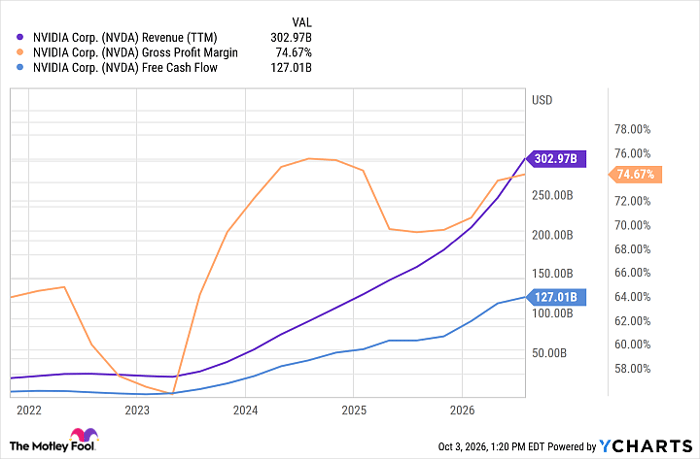
Nvidia offers something I value more over the next year: visibility. For Nvidia, AI spending is already translating into enormous revenue, high gross margins, and substantial cash generation. Rubin provides a new product cycle heading into next year, while unrelenting demand from hyperscalers, frontier labs, sovereign governments, and enterprises continues expanding.
NVDA Revenue (TTM) data by YCharts
Nvidia's recently expanded share repurchase program also gives it another quiet advantage. The company now has $235 billion remaining under its authorization, providing significant firepower to buy back stock through next year. When combined with an attractive valuation profile, Nvidia is hard to pass up.
While SpaceX may be a more exciting story heading into 2027, the reality is that the company could bring more unpredictable surprises than I'd like to see. When I'm choosing between two growth stocks, I'd rather own the company where secular tailwinds are already producing recurring profits than the one still spending aggressively to build its next engine. For this reason, I think Nvidia offers a cleaner investment setup. SpaceX should belong on a watchlist, but I see Nvidia stock as the more prudent choice for 2027.
Should you buy stock in Nvidia right now?
Before you buy stock in Nvidia, consider this:
The Motley Fool Stock Advisor analyst team just identified what they believe are the 10 best stocks for investors to buy now… and Nvidia wasn’t one of them. The 10 stocks that made the cut could produce monster returns in the coming years.
Consider when Netflix made this list on December 17, 2004... if you invested $1,000 at the time of our recommendation, you’d have $370,440!* Or when Nvidia made this list on April 15, 2005... if you invested $1,000 at the time of our recommendation, you’d have $1,470,022!*
Now, it’s worth noting Stock Advisor’s total average return is 955% — a market-crushing outperformance compared to 215% for the S&P 500. Don't miss the latest top 10 list, available with Stock Advisor, and join an investing community built by individual investors for individual investors.
See the 10 stocks »
*Stock Advisor returns as of October 7, 2026.
Adam Spatacco has positions in Alphabet, Amazon, Microsoft, and Nvidia. The Motley Fool has positions in and recommends Advanced Micro Devices, Alphabet, Amazon, Meta Platforms, Microsoft, Nvidia, and Oracle. The Motley Fool has a disclosure policy.
Recommended Articles


