


Micron Stock Price Forecast: Unlikely to Break Record High of $1,255 in Short Term Amid Taiwan Strike Risk
TradingKey - Constrained by Potential Strike Risks in Taiwan, Micron Technology May Struggle to Break $1,255 to Hit New Highs in the Short Term.
On October 8 ET, global semiconductor and memory giant Micron Technology (MU) stock price remained capped at $1,100, falling 1.73% in pre-market trading to stand at $1,069.16, less than 20% away from its all-time high of $1,255. So, will Micron's stock price rebound further and strengthen to sprint toward this target price again?
Over the past two-plus months, Micron's stock price has generally maintained an upward trend, supported by tight high-bandwidth memory supply and robust AI server demand, rebounding nearly 50% from its July low of $740 to recover part of the losses from the first half of the year. However, recent market rumors that supply chain plants in Taiwan face wildcat strike risks have added uncertainty to memory supply and short-term operations, significantly dampening the bullish momentum.
On October 7, the Taiwan Micron Taoyuan Union announced that after six days of strike voting, it obtained the right to strike with a 99.1% approval rate, and revealed that the strike might take a surprise approach. Regarding this strike wave that could break out at any time, the Ministry of Labor stated that it respects the strike vote results, but also called on Micron and the union to negotiate and propose concrete, feasible solutions.
Micron's capacity in Taiwan accounts for over 60% of its global total DRAM supply and serves as the core production base of HBM3e supplied to Nvidia (NVDA)'s Hopper and Blackwell architecture GPUs. If a wildcat strike occurs, even a stoppage of just a few days could interrupt the memory fab's continuous manufacturing process, leading to issues such as wafer scrapping, photolithography line clearance, and equipment recalibration, with the resumption period potentially lasting 2 to 4 weeks.
If a strike actually occurs, it will inevitably drag down shipments in the third and fourth quarters of 2026, delaying short-term revenue recognition and ending Micron's two-month rebound. However, there is still room to avert this potential strike wave. The union previously stated that it would submit demands to Micron's board of directors from October 8 to 9, U.S. time, asking the board to present a proposal regarding compensation and profit-sharing for further negotiation.
Under the psychological impact of potential wildcat strike risks, short-term market capital shows low willingness to chase highs, and investor sentiment has turned wait-and-see, capping Micron's upward momentum. If a full-scale wildcat strike breaks out, Micron's stock price will rapidly test the $1,000 mark or even retest strong support near $900, with a bottoming out and rebound occurring only after operations return to normal.
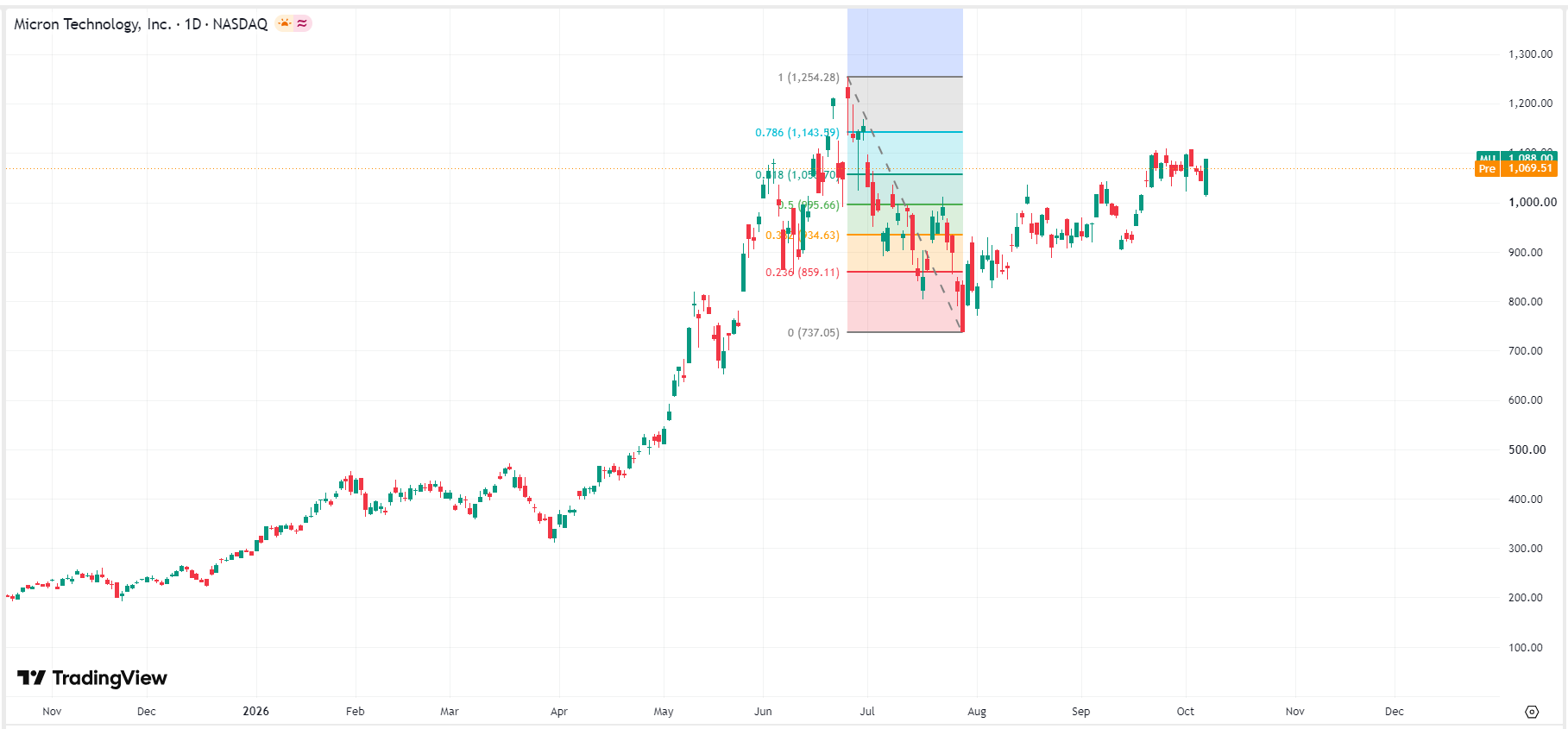
Micron stock price chart, Source: TradingView
Conversely, if Micron management and the union reach a quick agreement or Taiwan's labor department steps in to mediate and successfully defuse the crisis, as market uncertainty dissipates, capital will refocus on the supply-shortage fundamentals of HBM3e. The stock price will resume its rally, expected to challenge and break the all-time high of $1,255 within 1 to 2 months, targeting $1,300–$1,350.
Recommended Articles


