


The United States Debt Just Passed an Auspicious Milestone. Here's What Legendary Value Investor Howard Marks Says Investors Should Do About It.
Key Points
In Howard Marks' latest investing memo, he outlines the risks involved with runaway government debt and deficits.
He also brainstorms portfolio ideas to mitigate the effects.
There are valid moves to make to hedge against a crisis with the U.S. dollar, but none of them are without risk.
- 10 stocks we like better than Meta Platforms ›
Some market commentators have been warning about rising U.S. debt for some time now; however, the problem is becoming more acute today. Long-term interest rates have leaped higher over the past six months. The yield on the 10-year Treasury bond, which dipped below 4% in March, has risen to 5.18% as of this writing. That's the highest 10-year Treasury yield since 2007.
Interest costs to the United States government recently hit $1.25 trillion in 2025, exceeding this year's defense budget, while accounting for 18.5% of tax revenue.
Missed AI’s "Act 1"? Act 2 Could Be 15x Bigger. Most investors think they missed the AI boat because they didn't buy Nvidia in 2005. But according to our analysts, we’re only at the end of "Act 1"—the R&D phase. "Act 2" is the global rollout. Continue »
Escalating federal debt is no doubt concerning to investors. But what are the consequences of it? And how should investors take this into account when building portfolios?
An ignominious milestone
The U.S. national debt has surpassed some notable milestones of late. In August, the debt surpassed $40 trillion, more than doubling since 2017. And while the debt-to-GDP ratio has recently exceeded 120%, even the public debt-to-GDP, which excludes the debt the government owes to itself, has just surpassed 100%.
The primary drivers of the debt are Social Security and Medicare costs, as well as defense spending. There doesn't seem to be any appetite to curb these fairly necessary costs, nor is there much appetite to increase taxes significantly. So, it's a very difficult situation.
Now, the U.S. might be able to limit debt growth. But certain things will need to happen. Higher GDP growth could lead to higher tax revenues. However, if higher growth is accompanied by higher inflation, interest rates will rise or remain high, leading to higher interest and Social Security payments. Therefore, GDP will have to rise with less inflation, which can only come through productivity increases.
Artificial intelligence promises to increase productivity, so the U.S. may reduce its deficit if AI drives real growth and lowers costs. However, that remains to be seen. Real GDP growth was 1.5% last quarter, so GDP outpaced inflation by 1.5%, which is a good start. However, that was a deceleration from the 2.1% real GDP growth in the first quarter of 2026, and much more needs to be done.
What if the situation gets worse?
The likely consequence of runaway debt and deficits would be the debasement of the dollar. After all, if the U.S. inflates its currency, it will be easier to pay down the dollar-denominated debt racked up in the past.
This seems like the "worst case" scenario going forward. If the U.S. is unable to pay its bills, the currency could eventually fall precipitously, enabling the government to lower its deficits and pay down its debt relative to GDP.
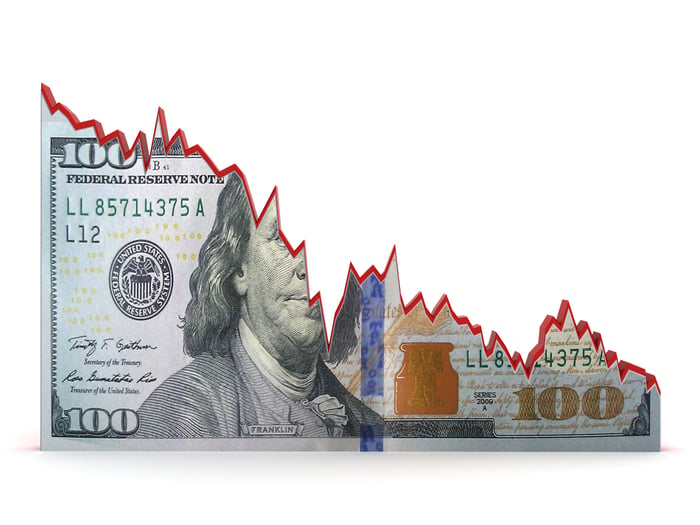
Image source: Getty Images.
There is no silver bullet
Many investors think that rising government debt poses a risk, which means one should sell risk assets, such as stocks. However, that's too simplistic. In fact, if one were to sell stocks and then put one's money into a bank account or bonds, the outcome would likely be worse. That's because keeping money under a mattress or in a fixed-income account increases the risk of losing purchasing power due to inflation.
However, U.S. stocks could also face headwinds, as any company that imports goods or materials will see higher costs. Additionally, higher inflation likely means higher interest rates, which depress valuations, and also stress consumers' ability to buy goods and services.
So, what to do?
In his recent memo, famed value investor Howard Marks offers his perspective on how investors should respond to the escalation of debt.
The most obvious answer would be to diversify into foreign stocks or bonds. If the dollar falls relative to other currencies, the revenue and earnings of foreign companies will be worth more in dollars, and foreign currencies and bonds will be worth more as well.
However, that also comes with other risks, as foreign countries also have their own fiscal and political problems. Meanwhile, despite U.S. debt and deficits, the U.S. is still home to most of the strongest, most innovative, and most powerful companies. And of course, a debasement of the currency hasn't yet occurred, and may not occur for a decade or longer. Marks writes, "Taking money out of the U.S. entails risks that could easily render it unsuccessful, especially if it's done to avoid a problem whose reckoning may be so far off."
A second option would be to buy non-financial assets, such as gold or cryptocurrencies. However, while these assets are meant to preserve purchasing power in the event of debasement, this may not always hold, especially for cryptocurrencies, which are new and untested assets. Non-financial assets also tend not to pay dividends or interest, so investors won't necessarily see cash coming in if they hold them. And if interest rates rise a lot in an effort to contain inflation, these assets may not appreciate as much as some might think.
In other words, diversify
Rising U.S. deficits and debts are a concern for the country, but making big changes to one's portfolio would likely be unwarranted. If anything, investors may want to steer their investments toward companies with pricing power and diversified geographic revenue streams. For instance, among the Magnificent Seven stocks, Meta Platforms (NASDAQ: META) has the highest percentage of revenue coming from outside the U.S., at 62% last year.
So, despite rising debt and deficits, investors shouldn't be deterred from their investment plan. That typically includes regular contributions to a stock and bond portfolio, while keeping a long-term mindset and a prudent level of diversification, both geographic and otherwise.
Should you buy stock in Meta Platforms right now?
Before you buy stock in Meta Platforms, consider this:
The Motley Fool Stock Advisor analyst team just identified what they believe are the 10 best stocks for investors to buy now… and Meta Platforms wasn’t one of them. The 10 stocks that made the cut could produce monster returns in the coming years.
Consider when Netflix made this list on December 17, 2004... if you invested $1,000 at the time of our recommendation, you’d have $383,680!* Or when Nvidia made this list on April 15, 2005... if you invested $1,000 at the time of our recommendation, you’d have $1,382,954!*
Now, it’s worth noting Stock Advisor’s total average return is 937% — a market-crushing outperformance compared to 214% for the S&P 500. Don't miss the latest top 10 list, available with Stock Advisor, and join an investing community built by individual investors for individual investors.
See the 10 stocks »
*Stock Advisor returns as of September 26, 2026.
Billy Duberstein and/or his clients have positions in Meta Platforms. The Motley Fool has positions in and recommends Meta Platforms. The Motley Fool has a disclosure policy.
Recommended Articles


