


Warren Buffett's Top Advice for Investors Bracing for a Market Crash
Key Points
Trying to anticipate a market crash is a losing battle because the stock market is unpredictable.
What's more, the S&P 500 has bounced back from every market crash it has ever experienced.
You should aim to have at least three to six months of living expenses saved in an emergency fund.
- 10 stocks we like better than Berkshire Hathaway ›
This month, Warren Buffett announced he would step down as Berkshire Hathaway chairman, ending his 60-plus-year stint at the company he helped turn into a trillion-dollar juggernaut. With Buffett officially stepping away, now is a good time to reflect on some of the gems he's dropped over the years.
One piece of Buffett advice I always keep in mind is how to brace for a market crash. And while there are no immediate signs of an approaching crash, that's exactly Buffett's point. Buffett famously said: "Predicting rain doesn't count. Building arks does."
Missed Nvidia in 2009? This Rare Signal Is Flashing Again. In 2009, a "Double Down" signal flashed for a little-known chipmaker called Nvidia. For the first time in years, that same "Total Conviction" signal is flashing for a company 1/100th the size of Nvidia. Continue »

Image source: Getty Images.
What Buffett meant by his statement
The stock market has always been irrational, so you can't predict its short-term performance. Trying to time the market and predicting a crash (rain) is more of gambling than investing. Instead, investors should focus on being as prepared as possible (building an ark).
A big part of being prepared is having an emergency fund. Younger adults should aim to save at least three months' worth of expenses, while families may want to aim for at least six months. Everybody's situation is different, so there's no set number; just ensure you have enough to weather unforeseen storms.
An emergency fund helps prevent situations where you may have to sell stocks to cover expenses, which could result in selling at a loss (especially during a crash) or triggering capital gains taxes. Ideally, your investments can remain uninterrupted.
The market has bounced back from every crash it has ever experienced. Investors who kept their stocks and stayed the course reaped the rewards of the bounceback. Since 1980, the S&P 500 has experienced seven true crashes, and yet it's up over 7,000% since then.
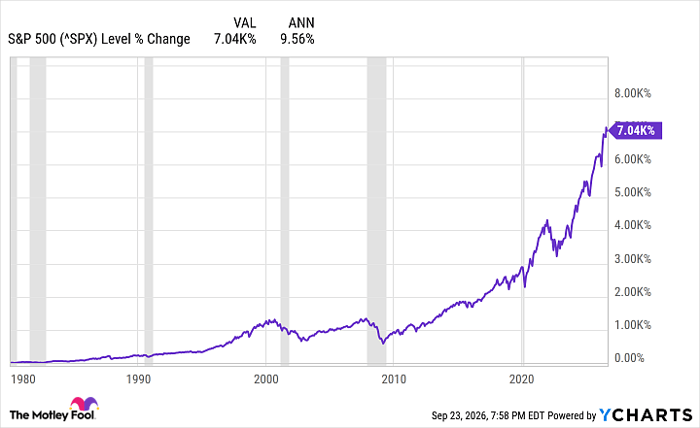
^SPX data by YCharts. Vertical grey bars represent official U.S. recessions.
Market crashes can present buying opportunities
Buffett is arguably the best value investor of all time, with many of his historic deals happening when the market was down. He once said: "Be fearful when others are greedy, and greedy when others are fearful."
Market crashes happen when lots of investors begin dumping their shares at once. In other words, the market is panicking. Instead of looking at the crash as a reason to jump ship (much easier said than done, I know), look at it as a time to go discount shopping and grab quality stocks at much lower prices. If you liked a pair of shoes for $150, you'd probably really like them at $100.
That's another reason an emergency fund matters. It allows you to capitalize on great opportunities whenever they present themselves.
Should you buy stock in Berkshire Hathaway right now?
Before you buy stock in Berkshire Hathaway, consider this:
The Motley Fool Stock Advisor analyst team just identified what they believe are the 10 best stocks for investors to buy now… and Berkshire Hathaway wasn’t one of them. The 10 stocks that made the cut could produce monster returns in the coming years.
Consider when Netflix made this list on December 17, 2004... if you invested $1,000 at the time of our recommendation, you’d have $383,680!* Or when Nvidia made this list on April 15, 2005... if you invested $1,000 at the time of our recommendation, you’d have $1,382,954!*
Now, it’s worth noting Stock Advisor’s total average return is 937% — a market-crushing outperformance compared to 214% for the S&P 500. Don't miss the latest top 10 list, available with Stock Advisor, and join an investing community built by individual investors for individual investors.
See the 10 stocks »
*Stock Advisor returns as of September 26, 2026.
Stefon Walters has no position in any of the stocks mentioned. The Motley Fool has positions in and recommends Berkshire Hathaway. The Motley Fool has a disclosure policy.
Recommended Articles


