


Move Over, Tesla: This $140 Billion Company Looks Like a Superior Robotaxi Investment
Key Points
Cathie Wood predicts that robotaxis could become a $10 trillion industry globally.
For those who want to bet on the future of robotaxis, Uber looks like a better investment than Tesla.
- 10 stocks we like better than Uber Technologies ›
The global robotaxi market is expected to be a huge opportunity for investors. Cathie Wood, the CEO of Ark Invest, believe the robotaxi market will eventually be worth $8 trillion to $10 trillion worldwide.
Wood thinks the transition will occur faster than most people expect. A survey of experts by McKinsey & Co. largely agrees.
Missed AI’s "Act 1"? Act 2 Could Be 15x Bigger. Most investors think they missed the AI boat because they didn't buy Nvidia in 2005. But according to our analysts, we’re only at the end of "Act 1"—the R&D phase. "Act 2" is the global rollout. Continue »
"Autonomous-vehicle technology is developing rapidly," the firm concludes. "[T]he global rollout of robo-taxis is now expected to become reality at a large scale in 2030 ... Overall, experts expect that robo-taxis will be the first commercial application for L4 in mobility -- not privately owned cars."
Similar to the arms race occurring in the AI world right now, there will also be an arms race among robotaxi operators. The nature of that industry should reflect a classic two-sided marketplace. For a robotaxi platform to be successful, it needs ample supply and demand. That is, robotaxi networks will need to deploy a widespread network of vehicles, and provide a service that wins sufficient demand from passengers to justify further supply expansion.
Balancing those aspects during a business's expansion phase can be difficult to do, but the robotaxi companies that figure it out should win big. Given the typical nature of two-sided marketplaces, I wouldn't be surprised if, in the future, just a few networks handle the dominant share of global robotaxi traffic.
Tesla (NASDAQ: TSLA), of course, is primed to succeed. The company has been investing in its self-driving software for years. And its ability to produce low-cost robotaxis at scale is perhaps unmatched in the U.S.
So from a supply standpoint, Tesla may be the best-positioned robotaxi operator long term. From a demand perspective, however, it's another story altogether. Tesla's ride-hailing service is minuscule compared to human-operated platforms like Uber Technologies (NYSE: UBER). Uber has a strong competitive advantage when it comes to existing demand. But there's one other reason Uber stock looks like a superior robotaxi investment than Tesla.
Uber Technologies has several advantages
Last year, Bill Ackman's Pershing Square disclosed a 30 million share stake in Uber. Ackman's rationale for the investment was compelling. He described the business as a "highly profitable and cash-generative growth machine," calling it "one of the best managed and highest quality businesses in the world." Ackman also said he believes Uber's stock price is "likely to more than double over the next three to four years."
It's hard to argue with this thesis from a fundamental perspective. Tesla stock currently trades for more than 200 times free cash flow. Uber, meanwhile, trades at just 14 times free cash flow. Uber's free cash flow has increased in each of the last 14 quarters. Tesla's free cash flow, while consistently positive, has bounced around quite a bit in recent years.
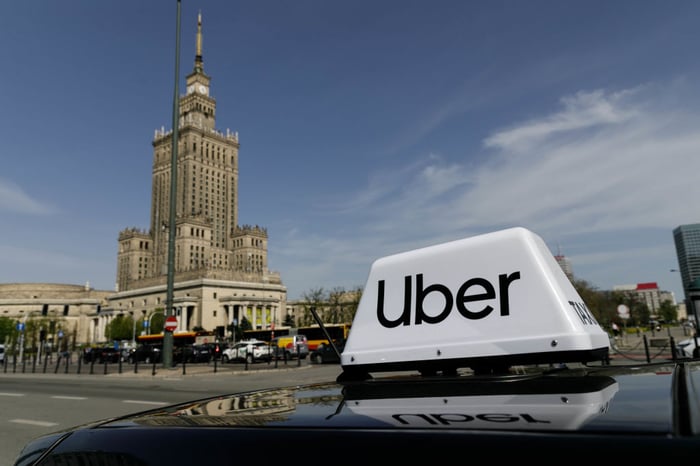
Image source: Getty Images
Why is Uber so cheap compared to Tesla? There are many factors. One of the primary ones, however, is the market's fear that when autonomous vehicles go mainstream, they will eat into Uber's market share or even destroy its business model. I think those fears are overblown given how aggressively Uber has worked to ensure that it will have its own supply of robotaxis, investing in EV makers such as Rivian (NASDAQ: RIVN) and Lucid Group (NASDAQ: LCID), as well as several major autonomous driving software firms.
Ackman agrees. But he also points to Uber's existing user base as a strong, durable competitive advantage.
"Our view is that you're going to want to open your Uber app to decide how you get from one place to another, rather than your Tesla app or your Waymo app," Ackman said in an interview with Fortune in August. "When a company becomes a verb, that's a pretty good sign it's in a dominant position."
I find this argument largely credible. And it doesn't mean that competitors like Tesla won't succeed. The robotaxi market will be so large that there will be room for a consolidated handful of competitors with large networks. Given Tesla's expected supply-side advantage with autonomous vehicles and Uber's demand-side advantage, I expect both companies will be major players in the global robotaxi market. But trading at a valuation that's just a fraction of Tesla's lofty premium, Uber looks like the superior robotaxi investment right now.
Should you buy stock in Uber Technologies right now?
Before you buy stock in Uber Technologies, consider this:
The Motley Fool Stock Advisor analyst team just identified what they believe are the 10 best stocks for investors to buy now… and Uber Technologies wasn’t one of them. The 10 stocks that made the cut could produce monster returns in the coming years.
Consider when Netflix made this list on December 17, 2004... if you invested $1,000 at the time of our recommendation, you’d have $383,680!* Or when Nvidia made this list on April 15, 2005... if you invested $1,000 at the time of our recommendation, you’d have $1,382,954!*
Now, it’s worth noting Stock Advisor’s total average return is 937% — a market-crushing outperformance compared to 214% for the S&P 500. Don't miss the latest top 10 list, available with Stock Advisor, and join an investing community built by individual investors for individual investors.
See the 10 stocks »
*Stock Advisor returns as of September 26, 2026.
Ryan Vanzo has no position in any of the stocks mentioned. The Motley Fool has positions in and recommends Tesla. The Motley Fool recommends Uber Technologies. The Motley Fool has a disclosure policy.
Recommended Articles


