


This Bank Stock Raised Its Dividend 33% This Year, and It's in a Great Position to Keep Raising It
Key Points
Dividend investors need to evaluate a company's operating business to ensure dividends are sustainable.
The banking sector is a good place to look for under-the-radar dividend companies.
- 10 stocks we like better than East West Bancorp ›
The trick to finding great dividend companies is to actually just find great companies.
Companies can pay strong dividends and raise them every year when they have strong operating businesses that generate strong free cash flow or earnings to fund those dividends.
Missed AI’s "Act 1"? Act 2 Could Be 15x Bigger. Most investors think they missed the AI boat because they didn't buy Nvidia in 2005. But according to our analysts, we’re only at the end of "Act 1"—the R&D phase. "Act 2" is the global rollout. Continue »
Often, a high dividend yield will draw investors in, but it could signal that a company is experiencing underlying issues that have sent its share price down and its dividend yield higher. That's why understanding a company's financials is key.
Banks are often a great sector to look for strong dividend stocks. In fact, one bank stock increased its dividend by 33% this year, and it's well-positioned to keep raising it for years to come.

Image source: Getty Images.
A strong regional bank generating strong returns
East West Bancorp (NASDAQ: EWBC) is a large regional bank based in Pasadena, California. The bank ended the second quarter with nearly $85 billion in total assets.
That makes it much smaller than a large, money-center bank like Bank of America, but still fairly large compared to most banks in the country. Most of the bank's loans are commercial real estate and commercial and industrial, but East West also has a large mortgage portfolio.
East West has largely succeeded by finding a niche within the Asian-American community. Interestingly, the bank also holds a banking license in China, which is unique among U.S.-based regional banks.
The company's strategy has worked well, with the bank generating strong returns.
At the end of the second quarter, the bank generated a 1.75% return on average assets and a 16.88% return on average tangible common equity (ROTCE), both of which were quite strong by industry standards, while credit trends remained largely stable.
As such, the bank has been rewarded with a premium valuation, about 75% more than the average for regional banks.
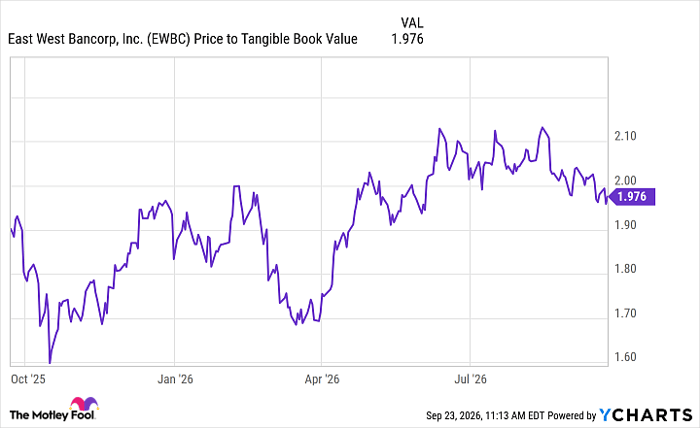
EWBC Price to Tangible Book Value data by YCharts
Assessing the dividend
East West raised its quarterly dividend from $0.60 per share to $0.80 per share earlier this year, due to strong financial performance. Diluted earnings per share rose 14% year over year in 2025. In the second quarter of 2026, they rose 18%.
The annualized yield is now almost 2.6%, which is solid and more than double the average for the S&P 500. Banks are also known for maintaining fairly modest payout ratios, which measure how much of a company's earnings are paid out in dividends.
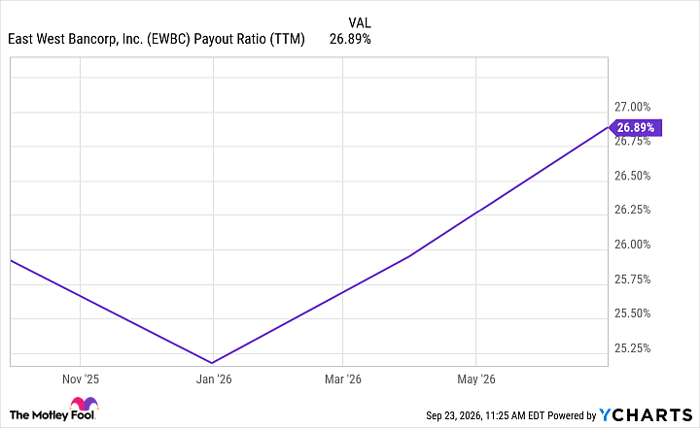
EWBC Payout Ratio (TTM) data by YCharts
The payout ratio is more relevant for banks than free cash flow because bank balance sheets differ from those of most other companies, and there are really minimal capital expenditures at most banks. Banks also must maintain regulatory capital to be prepared for unexpected loan losses.
East West is well capitalized from a regulatory perspective. At the end of the second quarter, the bank had a 15.44% common equity tier 1 (CET1) capital ratio, which looks at a bank's core capital as a percentage of its risk-weighted assets, most of which are loans.
East West has a minimum regulatory CET1 requirement of 7%, meaning it has more than double the required amount.
When assessing bank dividends, the difference between a bank's CET1 ratio and its required minimum ultimately determines how much excess capital banks have to return to shareholders and use to increase lending.
So, I suspect East West will be able to continue raising its dividend for many years to come if it chooses to. The bank is generating strong earnings, maintains a low payout ratio, and has ample excess capital. Dividend investors should check this one out.
Should you buy stock in East West Bancorp right now?
Before you buy stock in East West Bancorp, consider this:
The Motley Fool Stock Advisor analyst team just identified what they believe are the 10 best stocks for investors to buy now… and East West Bancorp wasn’t one of them. The 10 stocks that made the cut could produce monster returns in the coming years.
Consider when Netflix made this list on December 17, 2004... if you invested $1,000 at the time of our recommendation, you’d have $386,781!* Or when Nvidia made this list on April 15, 2005... if you invested $1,000 at the time of our recommendation, you’d have $1,379,943!*
Now, it’s worth noting Stock Advisor’s total average return is 936% — a market-crushing outperformance compared to 213% for the S&P 500. Don't miss the latest top 10 list, available with Stock Advisor, and join an investing community built by individual investors for individual investors.
See the 10 stocks »
*Stock Advisor returns as of September 26, 2026.
Bank of America is an advertising partner of Motley Fool Money. Bram Berkowitz has no position in any of the stocks mentioned. The Motley Fool has no position in any of the stocks mentioned. The Motley Fool has a disclosure policy.
Recommended Articles


