


3 Reasons Why Micron and Sandisk Investors Can Ignore What History Says Will Happen
Key Points
The market still hasn't seen peak AI demand.
Micron and Sandisk are building more capacity because there's an even larger demand wave coming.
- 10 stocks we like better than Micron Technology ›
The memory chip market is historically cyclical.
Demand for computing chips rises, allowing memory chip manufacturers to run their facilities at maximum capacity and see rising margins. After the demand wave is over, it returns to a steadier state of operation, which tends to be less lucrative.
Missed AI’s "Act 1"? Act 2 Could Be 15x Bigger. Most investors think they missed the AI boat because they didn't buy Nvidia in 2005. But according to our analysts, we’re only at the end of "Act 1"—the R&D phase. "Act 2" is the global rollout. Continue »
This results in a cyclical company, and investors aren't always the most keen on buying and holding stocks like that.
However, I think it could be a mistake to avoid memory stocks in the AI era.
The latest demand wave in this industry is unlike any other, and it could provide multiple years of elevated profitability that makes companies like Micron (NASDAQ: MU) and Sandisk (NASDAQ: SNDK) viable investments. I think they're well worth the investment right now, and I've got three reasons why they could defy history and be less cyclical over the next few years.

Image source: Getty Images.
1. Demand is still rising
AI demand from data centers has brought unprecedented demand to companies in many sectors. There are all sorts of companies benefiting from the hundreds of billions of dollars being spent on data centers right now, but memory chips are currently the biggest bottleneck. This industry wasn't prepared for the huge demand rush, mainly because it had ample production capacity for normal demand volumes until the AI wave hit.
Demand from AI hyperscalers has consumed all production capacity and then some, with many companies seeing their order backlogs overrun by multiple years. This has created soaring memory chip prices as companies attempt to get their hands on as much memory as possible, and it isn't going to get better any time soon.
Nvidia (NASDAQ: NVDA) estimates that next year, the big five AI hyperscalers will spend $1.3 trillion on data center capital expenditures, up from $800 billion the year before. That means that demand for memory chips will rise alongside it, further stretching this industry.
Micron is working to alleviate this shortage by building multiple production facilities, but they won't come online until mid-2027 or 2028. Even with those new facilities, there's no guarantee that there will be enough capacity to meet current demand. Sandisk is also investing $31 billion into a new production facility to increase its supply.
The AI arms race is far from over, and it still has several years to go. These two wouldn't be building new production facilities if there wasn't more room to grow.
2. The AI arms race is far from over
While more supply is coming online to ease the supply crunch in the industry, the reality is the AI arms race is far from over. Nvidia estimates that there will be $3 trillion to $4 trillion in data center capital expenditures by 2030, significantly higher than today's level. Even if the memory chip suppliers build out enough production capacity to meet current demand, it could be eclipsed in a few years.
If they have sufficient production to meet demand, their production facilities will still operate near maximum capacity, allowing them to maintain elevated margins and making their stocks solid investments.
3. The latest demand curve may have reset the industry
Lastly, AI has changed the outlook of many in the computing supply industry. It's possible that there is a brand new massive base load for chip producers. This will increase the vast amount of products each company manufactures each year, which means some of these gains are here to stay.
The question is how much of the new business that has come online is sustainable over the long term. The market has doubts about that, which is why each company trades at a pretty low forward earnings multiple.
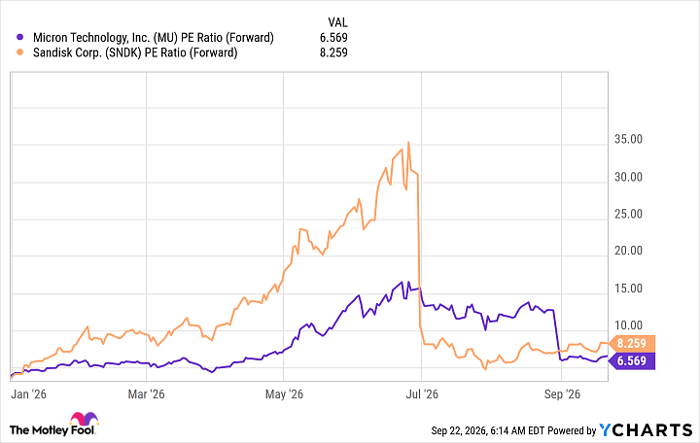
MU PE Ratio (Forward) data by YCharts
If today's rates become the new industry base, there is plenty of room for these stocks to soar. Even if they're half of today's demand, these stocks would still be cheap, making them viable candidates for long-term investing.
Should you buy stock in Micron Technology right now?
Before you buy stock in Micron Technology, consider this:
The Motley Fool Stock Advisor analyst team just identified what they believe are the 10 best stocks for investors to buy now… and Micron Technology wasn’t one of them. The 10 stocks that made the cut could produce monster returns in the coming years.
Consider when Netflix made this list on December 17, 2004... if you invested $1,000 at the time of our recommendation, you’d have $384,839!* Or when Nvidia made this list on April 15, 2005... if you invested $1,000 at the time of our recommendation, you’d have $1,385,657!*
Now, it’s worth noting Stock Advisor’s total average return is 936% — a market-crushing outperformance compared to 213% for the S&P 500. Don't miss the latest top 10 list, available with Stock Advisor, and join an investing community built by individual investors for individual investors.
See the 10 stocks »
*Stock Advisor returns as of September 24, 2026.
Keithen Drury has positions in Nvidia. The Motley Fool has positions in and recommends Micron Technology and Nvidia. The Motley Fool has a disclosure policy.
Recommended Articles


