


Global Bond Markets Are in Turmoil. Here's Why Investors Shouldn't Panic.
Key Points
Investors may understandably be worried about higher rates.
However, yields may be rising for good reasons, too.
Yields at this level -- or higher -- are the norm.
- 10 stocks we like better than S&P 500 Index ›
Suddenly, the bond market is getting more attention than the stock market, as rising global bond yields are causing widespread concern -- even panic -- among financial ministers and central bankers, Wall Street financiers, and ordinary investors.
That's because government bond yields of almost every major economy have soared in 2026. That includes the U.S., the United Kingdom, France, Germany, and Japan. The only exception is China, where yields on sovereign bonds have drifted lower this year.
Missed Nvidia in 2009? This Rare Signal Is Flashing Again. In 2009, a "Double Down" signal flashed for a little-known chipmaker called Nvidia. For the first time in years, that same "Total Conviction" signal is flashing for a company 1/100th the size of Nvidia. Continue »
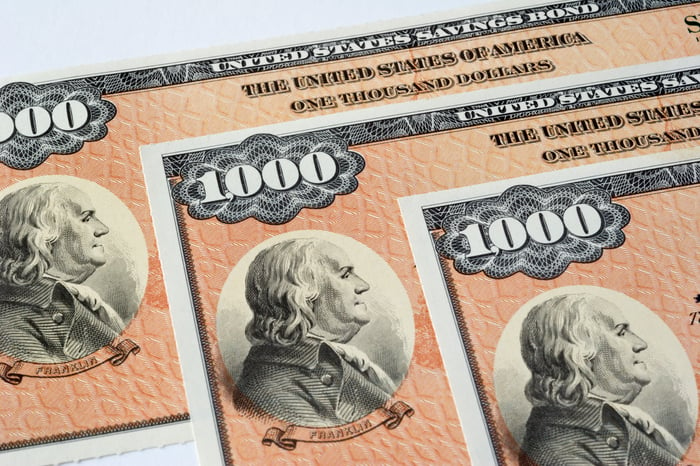
Image source: Getty Images.
And the yield on what is perhaps the world's most important asset, the 10-year U.S. Treasury note, rose above 5% in recent weeks and now sits just below that threshold, more than 1 percentage point higher than where it was in February and the highest it's been since 2007. The 30-year Treasury bond yield recently touched a 19-year high.
That's problematic, because most borrowing rates are tied to these yields, from car and home loans to credit cards and corporate borrowing. And higher yields make bonds more attractive relative to risk assets like stocks, drawing capital from equity markets and pushing stocks lower.
The rise in global yields was a major topic of discussion at the Federal Reserve's monetary policy conference in Jackson Hole, Wyoming, last month, as central bankers from across the planet tried to figure out what is driving yields higher so broadly and so rapidly.
There are many reasons for soaring yields
And these officials, among them some of the world's most sophisticated financial and economic minds, admitted they don't really know the underlying cause. I think Federal Reserve Chair Kevin Warsh summed it up nicely, using a term I learned long ago in grad school: It's overdetermined.
That is, there are multiple causes for spiking yields, any one of which would be sufficient to send them to current levels. Those causes include soaring government debt levels, persistently high inflation, and competition for capital from AI hyperscalers that are issuing massive amounts of bonds to fund data centers, among others.
But I don't think investors need to panic, at least not yet, for a couple of reasons. First, the stock market -- so far at least -- seems to be taking rising bond yields in stride. The S&P 500 (SNPINDEX: ^GSPC) is up about 12% year to date. And while it has essentially been trading sideways since early August, it hasn't turned down due to rising yields. And keep in mind that September is historically a weak month for the stock market.
Second, rising yields may just reflect a very healthy economy. Economist and market analyst Ed Yardeni says rising yields are a "vote of confidence in the economy" and are the result of strong economic growth. Essentially, robust economic activity raises overall demand for capital as companies invest and consumers spend, so those with capital (in this case, bond investors) demand higher yields on their investments. Clearly, the AI infrastructure build-out is a huge part of that dynamic.
Yields may just be normalizing after remaining abnormally low for years
Finally, a little history of yields can be very reassuring at a time like this. Yes, yields are rising somewhat rapidly this year. But in fact, yields at current levels are, historically, the norm, not the anomaly.
Until the great financial crisis of 2007-2009, 10-year Treasury yields routinely hovered around 5%, or even higher. They then fell to a lower level for more than a decade. As Ken Rogoff, former chief economist of the International Monetary Fund and something of an economic historian, told the crowd at Jackson Hole, yields might just be normalizing this year after remaining abnormally low for almost two decades.
As Warsh suggested, I believe multiple factors have driven yields higher this year. And while the bond market -- always -- bears watching, right now it's nothing to be overly alarmed about.
Should you buy stock in S&P 500 Index right now?
Before you buy stock in S&P 500 Index, consider this:
The Motley Fool Stock Advisor analyst team just identified what they believe are the 10 best stocks for investors to buy now… and S&P 500 Index wasn’t one of them. The 10 stocks that made the cut could produce monster returns in the coming years.
Consider when Netflix made this list on December 17, 2004... if you invested $1,000 at the time of our recommendation, you’d have $389,154!* Or when Nvidia made this list on April 15, 2005... if you invested $1,000 at the time of our recommendation, you’d have $1,406,303!*
Now, it’s worth noting Stock Advisor’s total average return is 949% — a market-crushing outperformance compared to 214% for the S&P 500. Don't miss the latest top 10 list, available with Stock Advisor, and join an investing community built by individual investors for individual investors.
See the 10 stocks »
*Stock Advisor returns as of September 23, 2026.
The Motley Fool has a disclosure policy.
Recommended Articles


