

Elon Musk's K2 economy post answers a chart of AI spending at 3.63% of GDP

Source Cryptopolitan

Elon Musk responded with a one-line quote post on X on Thursday to a chart projecting US AI infrastructure spending at 3.63% of GDP. “An Earth economy is less than a trillionth the size of a K2 economy,” Musk wrote.

Andrew Chen, an investor, posted the chart hours earlier with the caption “Epic.”

Brookings puts the buildout at $10.3 trillion through 2032

The figure is from a Brookings Papers on Economic Activity paper by Stijn Van Nieuwerburgh of Columbia University, “Financing the AI buildout.” AI investment in data center buildings, power systems, networking and specialized chips will average 3.63% of US GDP a year from 2025 to 2032, the paper projects.

That is more than any other spending spree like that in the US. Railroads averaged 2.24% of GDP between 1870 and 1890, compared with 1.13% for the interstate highway drive between 1956 and 1973.

Telecom and fiber averaged 1.1% from 1996 to 2003. Next came canals and electrification at 0.66% and 0.5%.

“The projected buildout would be larger relative to the economy than the major U.S. canal, railroad, electrification, highway, and telecommunications investment booms,” Van Nieuwerburgh writes.

The Brookings version estimates a total AI investment of $10.3 trillion from 2025 to 2032. A March draft of the same paper put it at about $8.2 trillion, or 2.8% of GDP.

Van Nieuwerburgh traces the risk to off-balance-sheet deals

Musk’s “K2” refers to the Kardashev scale, a method to classify civilizations based on the energy they control. A Type II civilization uses close to the entire energy output of its parent star.

Musk’s post didn’t reference the paper or the spending figures. But the analogy does fit a line he has pushed before.
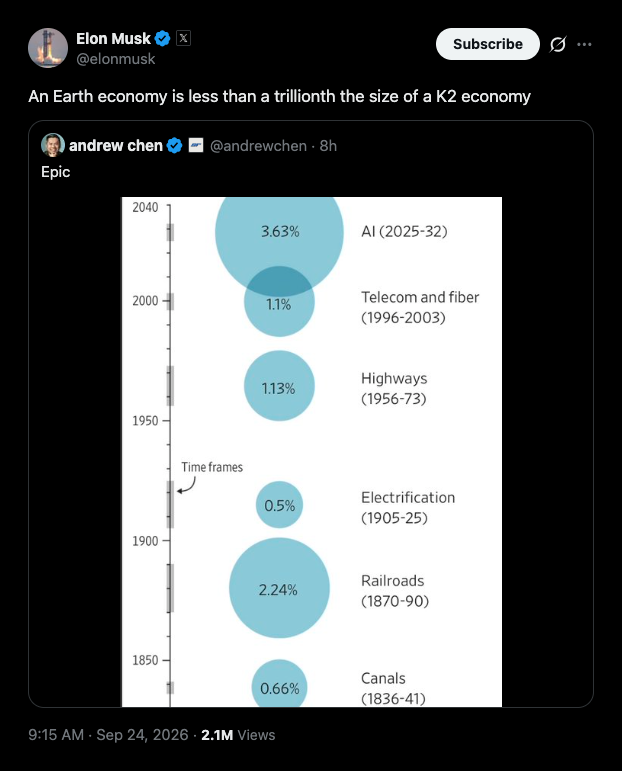
Musk meets a chart putting AI spending at 3.63% of GDP with a Kardashev II comparison.
Elon Musk’s Sept 24 2026 post on X quoting Andrew Chen’s chart of US infrastructure spending as a share of GDP.

In January, SpaceX pitched a plan to the Federal Communications Commission to launch up to 1 million orbital data center satellites as a first step toward Kardashev II status, Cryptopolitan reported.

And Van Nieuwerburgh warns of a move from transparent on-balance-sheet corporate spending to opaque off-balance-sheet financing through joint ventures, private credit, securitization, special purpose vehicles and lease commitments.

He writes that those structures rely on “uncertain AI demand, rapid technological change, timely access to power and hardware, and the continued credit quality of a small number of [data center] tenants.”

“It would be premature to conclude that AI infrastructure already poses systemic risk comparable to earlier credit booms,” Van Nieuwerburgh writes.

Off-balance-sheet structures remain important “because they may make correlated exposures hard to observe before a downturn,” he adds.

According to Cryptopolitan, the OECD lifted its 2026 global growth forecast to 2.9% on AI infrastructure spending. On Friday, Van Nieuwerburgh will present the paper at Brookings’ fall conference.

The smartest crypto minds already read our newsletter. Want in? Join them.

Disclaimer: For information purposes only. Past performance is not indicative of future results.
placeholder
Dollar holds above 100 near a 3-month high — three Fed speakers and a $69 billion auction land tonightThe dollar index closed at 100.43 on Monday, its highest close since late July, after a weekly gain of about 1% — the best in more than three months — and is holding above the 100.00 handle in Asia. Three Fed officials speak tonight alongside a $69 billion two-year note auction, the first leg of $183 billion of Treasury supply this week.
Author  Suzie
Sep 22, Tue
The dollar index closed at 100.43 on Monday, its highest close since late July, after a weekly gain of about 1% — the best in more than three months — and is holding above the 100.00 handle in Asia. Three Fed officials speak tonight alongside a $69 billion two-year note auction, the first leg of $183 billion of Treasury supply this week.
placeholder
October hike odds climb toward 60% as Goldman and BofA both flip — what Warsh's "dose of accommodation" really changedRate futures now price roughly 55% to 62% for a 25bp hike at the October 27-28 FOMC, up from about 30% before Chair Warsh's post-meeting framing that the Fed is merely "removing some accommodation." Goldman Sachs has added an October hike to its forecast and Bank of America now sees moves in both October and December. Here is the repricing, the language behind it, and the two data points that decide it.
Author  Irene Q.
Sep 23, Wed
Rate futures now price roughly 55% to 62% for a 25bp hike at the October 27-28 FOMC, up from about 30% before Chair Warsh's post-meeting framing that the Fed is merely "removing some accommodation." Goldman Sachs has added an October hike to its forecast and Bank of America now sees moves in both October and December. Here is the repricing, the language behind it, and the two data points that decide it.
placeholder
Memory chips surge, Nasdaq notches a second straight record close — why the Dow fell 185 points anywayMicron gained 5%, SanDisk 6.8%, Seagate 4% and Western Digital 3% as the memory complex led the Nasdaq Composite to a second consecutive record close of 27,244.28. But the Dow fell 185 points as JPMorgan, Wells Fargo and Schwab slid more than 3% each — a split tape that says more about positioning than about the economy.
Author  Irene Q.
Sep 23, Wed
Micron gained 5%, SanDisk 6.8%, Seagate 4% and Western Digital 3% as the memory complex led the Nasdaq Composite to a second consecutive record close of 27,244.28. But the Dow fell 185 points as JPMorgan, Wells Fargo and Schwab slid more than 3% each — a split tape that says more about positioning than about the economy.
placeholder
US input costs rose at the fastest pace in four years — the September flash PMI beat is an inflation story, not a growth storyUS September flash PMIs came in far above expectations, with the composite at 58.4, a five-year high. But the detail that moved markets was input cost inflation at its fastest since October 2022, driven by fuel, transport and supply shortages. Brent is back above $100 and the 10-year Treasury yield has hit its highest since 2007.
Author  Suzie
Sep 24, Thu
US September flash PMIs came in far above expectations, with the composite at 58.4, a five-year high. But the detail that moved markets was input cost inflation at its fastest since October 2022, driven by fuel, transport and supply shortages. Brent is back above $100 and the 10-year Treasury yield has hit its highest since 2007.
placeholder
Gold Price Forecast: Gold Drops Below $4,300, Will It Continue to Fall? As of the European session on September 24, gold prices (XAUUSD) extended their correction, dipping below $4,300 intraday to hit a low of $4,262.45. After previously rebounding close to $
Author  TradingKey
Sep 24, Thu
As of the European session on September 24, gold prices (XAUUSD) extended their correction, dipping below $4,300 intraday to hit a low of $4,262.45. After previously rebounding close to $
goTop
quote