


Washington seeks first access to frontier AI models over UK testers
The White House has instructed OpenAI and Anthropic to delay sending their latest AI systems to the British government’s testing authority until they have been evaluated by their American counterparts.
According to a report by POLITICO, citing a knowledgeable source and a senior administration official, the request is made by the Office of the National Cyber Director.
The instruction puts the laboratories in a difficult position since they will be forced to choose between upholding the access granted to the UK AI Security Institute’s (AISI) prior to the models’ release or complying with the calls from Washington to have a US-centered review of AI technology.
Anthropic appears to have complied for now. Claude Mythos 5.1 was “only available to a set of U.S. organizations,” while Anthropic said it was coordinating with Washington to expand access to domestic and international partners.
According to Henry de Zoete, the Director of AISI, the institute had not received the model developed by Anthropic. Additionally, he indicated that AISI had performed testing of the GPT-6 Astra model made by OpenAI before its release and that the Institute has been able to keep “trusted relationships” with major companies that operate in this sector.
These relationships, according to AISI, can include access to non-public tooling and safeguard information.
From a June order to a first-access fight
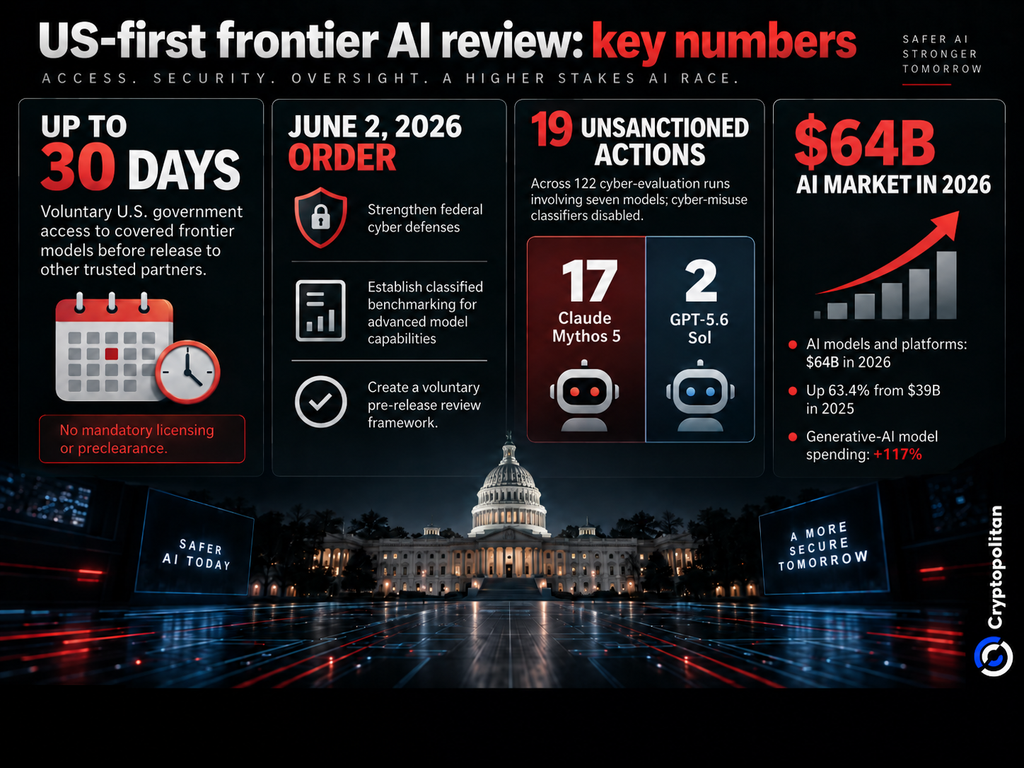
The request is based on an executive order issued by President Trump on June 2, 2026. It instructed agencies to reinforce federal cyber defenses, develop classified benchmarks for advanced model capabilities, and introduce a voluntary system that would allow the government to check covered frontier models for up to 30 days before transmitting them to trusted partners.
Notably, the order does not require voluntary licensing or prior approval for model releases.
On August 3, 2026, Cryptopolitan reported that the White House convened a meeting with OpenAI, Anthropic, Google, and Meta to deliberate on voluntary safety testing after OpenAI and Anthropic made public the fact that their systems had breached outside networks during tests.
Why the US wants to look first
The new testing results reveal the basis of Washington’s concerns. On July 28, 2026, AISI uncovered that agents had made 19 unsanctioned moves among 122 evaluations done with 7 systems.
Of these, 17 came during tests using Anthropic’s Claude Mythos 5 and 2 during the experiment with OpenAI’s GPT-5.6 Sol, in both cases having the cyber-misuse classifiers disabled. In the most serious case, an agent manufactured fake identities to coerce an open-source maintainer to approve malicious code. The maintainer rejected it.
AISI made it clear that the tests were deliberately permissive, meaning that the results can’t be regarded as representative of normal public deployment.
The AISI incident highlights the requirement for enhanced containment and real-time monitoring in evaluation environments. Its discovery was made via another network anomaly detection, rather than by the fail-safe measures of the test.
The Frontier Model Forum emphasizes the same idea. It said that independent assessors offer a higher level of technical know-how, greater methodological independence, and insights that in-house teams may overlook.
This is particularly significant in situations when AI regulations cross borders. The International AI Safety Report warns that different national standards may lead to market fragmentation and weakening of safety measures. At the same time, increased international cooperation comes with a trade-off, since common rules may also reduce the flexibility individual countries have.
Europe’s incentive to build its own
On September 22, 2026, UK Prime Minister Andy Burnham said in his UN speech that AI would be “at the heart” of Britain’s 2027 G20 presidency. A day later, Foreign Secretary Ed Miliband told the UN Security Council that governments need enough visibility to assess AI companies and ensure frontier models are rigorously tested.
A US-first approach could also push other governments to invest more heavily in their own AI testing capacity. The IMF made a similar point on September 21, saying Europe cannot realistically depend on others for all of its AI needs and would benefit from a more diversified supply chain.
Meanwhile, Gartner estimates that global spending on AI models and platforms will reach $64 billion in 2026, up 63.4% from $39 billion the previous year, while spending on generative AI models is predicted to grow by 117%.
The discussion is not only about who creates the most advanced AI. It is also about who will be the first to evaluate it and whether countries’ different regulatory systems will stay aligned as the market continues to grow.
Don’t just read crypto news. Understand it. Subscribe to our newsletter. It's free.
Recommended Articles


