


California enacts seven data center laws that could redraw the AI compute map
On Monday, California Governor Gavin Newsom signed a package of seven bills implementing new reporting requirements and regulations regarding water use and the cost of electricity that will affect the economics of building AI facilities in the state.
However, the bills are relevant outside of California, because energy costs, electrical grid development, water availability, and land utilization are becoming key factors in choosing locations for data centers. According to International Energy Agency forecasts, electricity consumption of data centers around the world will increase from 485 TWh in 2025 to 950 TWh in 2030, making physical bottlenecks harder to ignore.
What the seven bills change
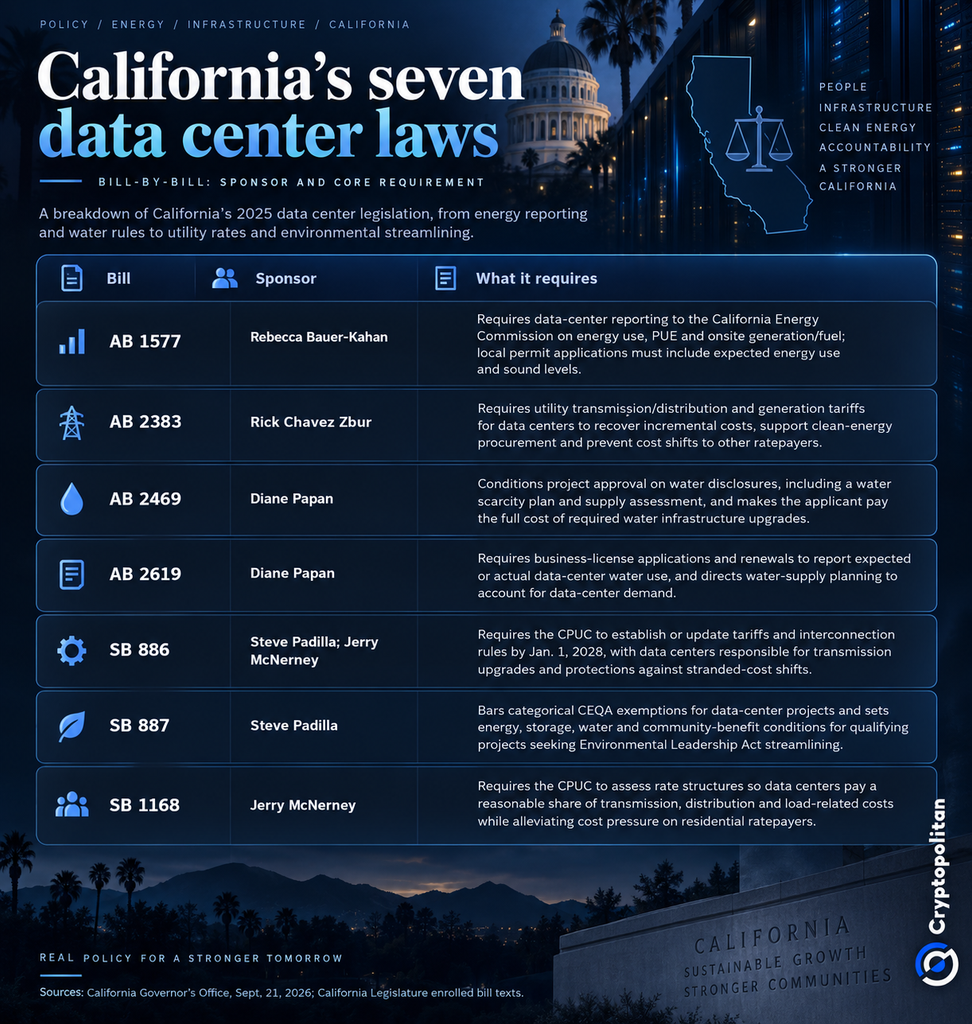
The bills place greater importance on disclosure and cost distribution than on outright limitations. Assembly Bill (AB) 1577 establishes energy and operational reporting requirements to the California Energy Commission and mandates that proposed data centers provide estimates of their yearly consumption of electricity and other relevant data to local regulators. AB 2383 sets electricity tariff requirements with the goal of recovering costs due to incremental generation and grid losses, while avoiding transferring them to other customers.
Water availability and use are covered under AB 2469 and AB 2619. Specifically, AB 2469 mandates water supply and scarcity information before any local approvals and requires the applicant to pay for necessary water infrastructure improvements. AB 2619, on the other hand, requires companies needing business permits to indicate their anticipated water consumption when applying and verify how much water they actually used every year during renewal applications.
Senate Bill (SB) 886 requires the California Public Utilities Commission to establish or update tariffs and interconnection rules by January 1, 2028. This includes requirements on how to determine costs for transmission upgrades and stranded-cost protections assigned to large data centers. Similarly, SB 1168 requires the commission to look into the rate structures to ensure data centers end up paying their fair share of transmission, distribution and load-related costs. SB 887 restricts the use of categorical CEQA exemptions for data center projects and sets requirements that must be met in order to use the streamlining provisions of the Environmental Leadership Act.
As per Newsom, they are “ensuring that Californians remain in the driver’s seat” and make sure that the business entities do not make a profit at their expense. The Data Center Coalition cautioned that such regulations might turn California into an unattractive place for new operations and lead the projects to be relocated to other states.
Power, not paperwork, decides where compute lands
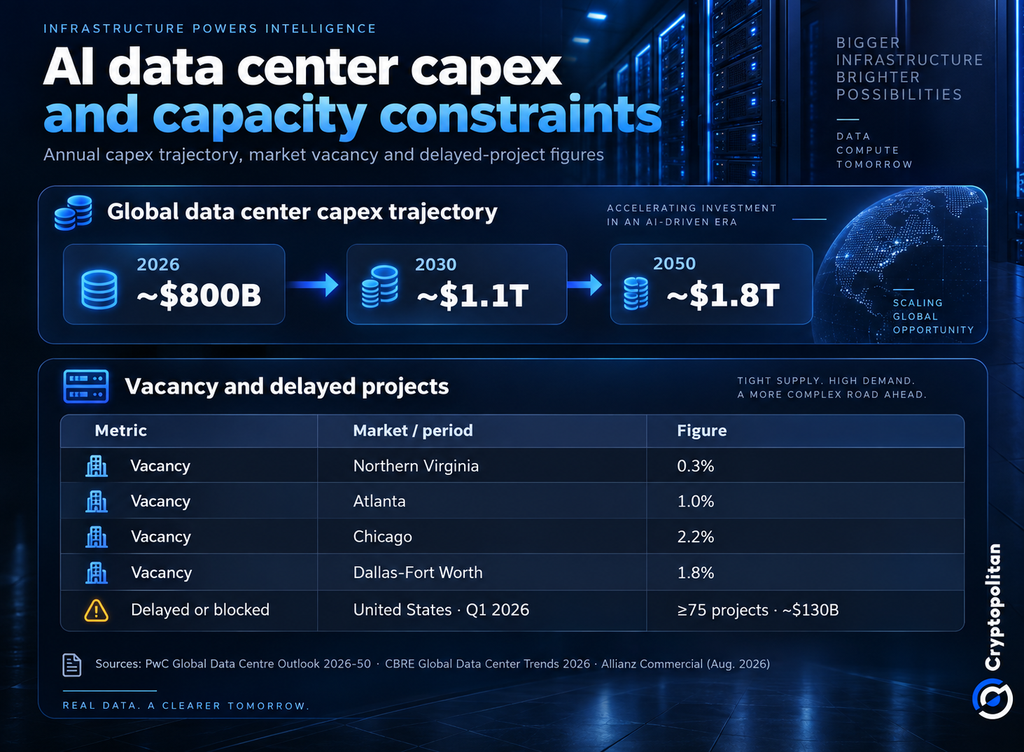
The package comes at a time when spending on data centers is on the rise and where access to power matters almost as much as access to capital. According to PwC, global spending on data centers until 2050 will amount to approximately $31.6 trillion, with annual spending increasing from nearly $800 billion in 2026 to reaching $1.1 trillion in 2030 and almost $1.8 trillion in 2050, with the most optimistic scenario approaching $50 trillion.
The pressure is already apparent in important centers. According to the CBRE report, during the first quarter of 2026, the vacancy rate was at 0.3% in Northern Virginia, 1% in Atlanta, 2.2% in Chicago, and 1.8% in Dallas, Fort Worth. As per the findings published by Allianz Commercial, in the first quarter of 2026, local opposition caused at least 75 construction projects in the US, which cost about $130 billion, to be postponed or canceled. The delays and/or cancellations were attributed to limited availability of power, land, and skilled labor, and challenges in securing permits.
Europe reaches for a rating label
California is not taking action all by itself. The European Commission on Monday opened a 12-week consultation on minimum performance standards for data centers. Responses are due December 14, with a legislative proposal to follow in the second quarter of 2027. The Commission also introduced its new energy efficiency package based on a common EU rating system and label.
The Patagonia signal
The broader issue is whether increased oversight will result in curtailed investments in artificial intelligence infrastructure or simply alter the destination of the investments. Cryptopolitan has reported that developers are considering Patagonia in Argentina, including Neuquén and Chubut, for energy projects using gas, hydro, wind and solar energy.
This does not imply that California’s regulations are necessarily going to lead to projects moving out of the state. The short-term effect will depend on how the agencies implement the legislation, how much it affects costs and schedules, and whether different geographic locations can provide the necessary elements (e.g., power, fiber, financing, and customers) for projects to turn from plans to operating capacity.
Don’t just read crypto news. Understand it. Subscribe to our newsletter. It's free.
Recommended Articles


