


Dow Jones Industrial Average edges up as Trump floats a meeting with Iran
- DJIA edges up near 51,900 as Trump floats a meeting with Iran.
- Chicago Fed President Goolsbee lists energy as one of four sources of inflation.
- Xi Jinping visits the White House on Thursday with 200 Boeing jets already agreed.
The Dow Jones Industrial Average trades near 51,900 after its worst week since March. Crude Oil fell back under $100 after President Trump told Fox News he'd probably be open to meeting Iran's President Masoud Pezeshkian at the United Nations General Assembly this week. LPL Financial's Jeffrey Roach says Fed Chair Warsh's committee has tied its inflation outlook to a steadier Crude Oil price, and that's what the index is trading on.
Crude Oil is back under $100 on a probably
Crude Oil trades just above $95, down for a fourth straight session, and Brent, the international benchmark, just above $100. Trump's remark came in a phone interview with Fox News on Sunday in which he also named destroying Iran or leaving its economy to collapse as his other options. Chevron (CVX), the only one of the 30 that produces Crude Oil, was the biggest loser in the index when trading opened.
For the other members, a lower Crude Oil price means cheaper gasoline, diesel and jet fuel, and lower readings in the inflation numbers the Fed sets rates by. It's possible this is the meeting that ends the war, though Crude Oil also went under $100 when Trump announced a ceasefire in April and when he called talks nearly done in May.
One of the four things pushing inflation up got cheaper on Monday
Chicago Fed President Goolsbee named four things pushing inflation up in a speech in London on Monday: strong demand, tariffs, energy and other disruptions to supply. Inflation was last estimated at 3.7% for July against a 2% target, and he said the Fed's response to overheating demand isn't in doubt. That response is a higher rate aimed at spending, which is what Visa (V) and American Express (AXP) collect their fees on.
Chair Warsh used his press conference on September 16 to stress how strong domestic spending and business investment have been. President Goolsbee, who doesn't vote on rates this year, added that spending on artificial intelligence may be running ahead of what the economy can supply. Microsoft (MSFT), Amazon (AMZN) and Alphabet (GOOG, GOOGL) run three of the biggest cloud businesses, so some of that spending is being done by members of the index.
Thursday's meeting has a date and 200 Boeing jets attached
China's President Xi Jinping is due at the White House on Thursday for a state visit, and he's skipping the General Assembly. Boeing (BA) has the clearest stake of any member of the index. China agreed in May to buy 200 of its planes, the first big Chinese order since 2017, and confirmed the deal without naming the models or delivery dates.
The two sides are also due to discuss the trade truce agreed in October 2025, which kept Chinese rare earths flowing and runs out about five weeks after the summit. China has pressed to extend it through the rest of Trump's term, and Washington has favoured a few months. Rare earths go into the magnets in Boeing's jets and in the phones Apple (AAPL) sells, so the length of the extension matters to both.
Treasury Secretary Bessent held talks with Chinese Vice Premier He Lifeng ahead of the visit. Bessent has said Washington will see whether China commits to more Boeing planes when Xi arrives. Trump has said the order could reach 750 planes if China does a good job with the first batch, which leaves the customer on probation.
August orders can't show anything agreed at the summit
S&P Global's flash Purchasing Managers Index (PMI) surveys for September come out on Wednesday at 13:45 GMT. Manufacturing is forecast at 53.5 after 53.9, and services at 56 after 56.5. Any reading above 50 means more companies reported growth than decline, so both are forecast to keep growing, just more slowly. For Visa and American Express, services near 56 means more card spending and a stronger case for the rate increase that would slow it.
Durable goods orders for August follow on Friday at 12:30 GMT, forecast at -0.3% after 1.1%. Orders excluding transportation are forecast at 0.6% after 0.4%. The gap between the two is transportation, which swings mostly on aircraft orders, and in this index aircraft means Boeing.
Levels and bias
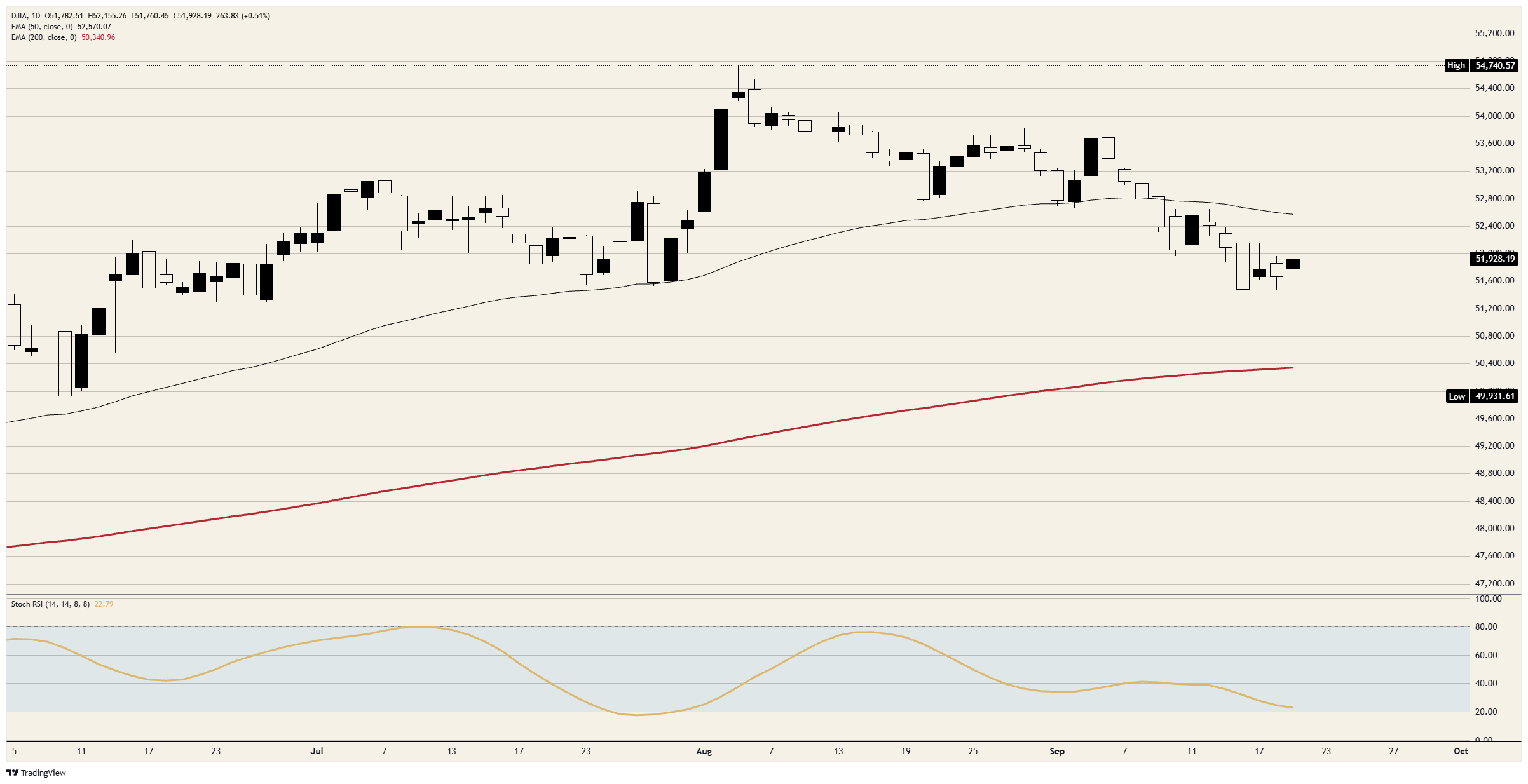
Resistance: Monday's high came back to the September 17 high just above 52,100, the second time in three sessions the index has turned lower there. Above that is the falling 50-day Exponential Moving Average (EMA) near 52,600, which no session since the Fed's rate increase has reached.
Support: Monday's low just above 51,750 is where the drop from the high stopped. Below it are the September 18 low just under 51,500 and the September 16 low near 51,200, the lowest the index has traded since June.
Bias: Bearish below the matching highs just above 52,100. The September 18 low just under 51,500 is the first objective and the September 16 low near 51,200 the second. The daily Stochastic Relative Strength Index (Stoch RSI), a momentum gauge, is near 23 and has barely moved since September 18, so it's low but not turning up. A daily close above 52,200 would make the call wrong.
Dow Jones daily chart
Dow Jones FAQs
The Dow Jones Industrial Average, one of the oldest stock market indices in the world, is compiled of the 30 most traded stocks in the US. The index is price-weighted rather than weighted by capitalization. It is calculated by summing the prices of the constituent stocks and dividing them by a factor, currently 0.152. The index was founded by Charles Dow, who also founded the Wall Street Journal. In later years it has been criticized for not being broadly representative enough because it only tracks 30 conglomerates, unlike broader indices such as the S&P 500.
Many different factors drive the Dow Jones Industrial Average (DJIA). The aggregate performance of the component companies revealed in quarterly company earnings reports is the main one. US and global macroeconomic data also contributes as it impacts on investor sentiment. The level of interest rates, set by the Federal Reserve (Fed), also influences the DJIA as it affects the cost of credit, on which many corporations are heavily reliant. Therefore, inflation can be a major driver as well as other metrics which impact the Fed decisions.
Dow Theory is a method for identifying the primary trend of the stock market developed by Charles Dow. A key step is to compare the direction of the Dow Jones Industrial Average (DJIA) and the Dow Jones Transportation Average (DJTA) and only follow trends where both are moving in the same direction. Volume is a confirmatory criteria. The theory uses elements of peak and trough analysis. Dow’s theory posits three trend phases: accumulation, when smart money starts buying or selling; public participation, when the wider public joins in; and distribution, when the smart money exits.
There are a number of ways to trade the DJIA. One is to use ETFs which allow investors to trade the DJIA as a single security, rather than having to buy shares in all 30 constituent companies. A leading example is the SPDR Dow Jones Industrial Average ETF (DIA). DJIA futures contracts enable traders to speculate on the future value of the index and Options provide the right, but not the obligation, to buy or sell the index at a predetermined price in the future. Mutual funds enable investors to buy a share of a diversified portfolio of DJIA stocks thus providing exposure to the overall index.
Recommended Articles


