


Gold springs from $4,110 as Oil rout eases inflation heat
- Gold rebounds over 1% as WTI tumbles below $90.
- Fed's Williams tempers rate-hike urgency while other officials remain hawkish.
- ADP, Core PCE and NFP now steer bullion’s next move.
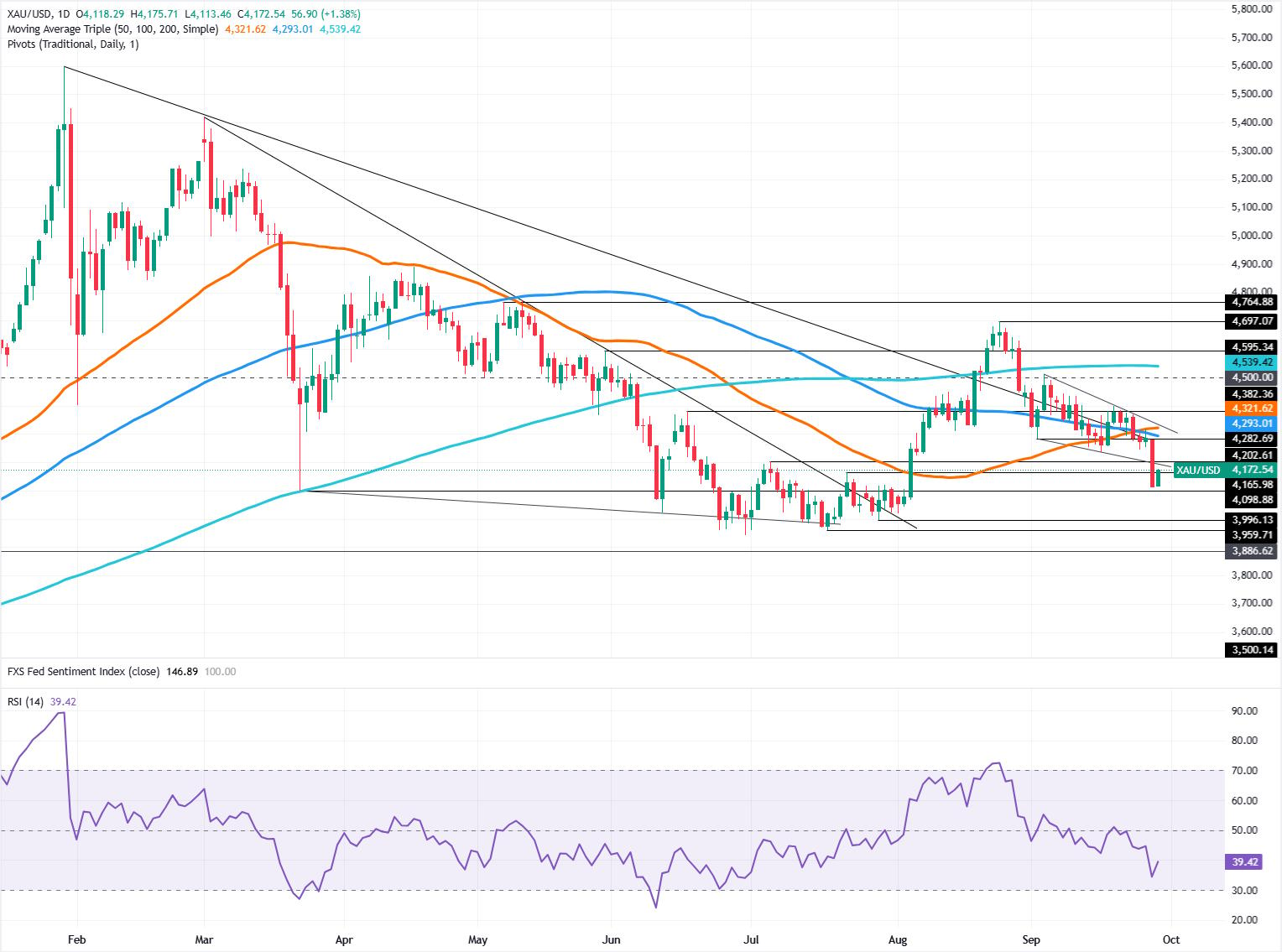
Gold (XAU/USD) price registers solid gains of over 1.30% on Tuesday despite hawkish rhetoric from Federal Reserve (Fed) officials, after hitting a multi-week low near $4,110 on Monday. The XAU/USD pair trades at $4,170 after bouncing off daily lows of $4,113.
XAU/USD rebounds sharply as collapsing crude offsets stubborn Dollar and yield strength
Bullion’s recovery is mainly attributed to lower energy prices. West Texas Intermediate (WTI), the US crude benchmark, collapses during the trading session, down 4.27% to $89.10 per barrel. Although this eased inflationary pressures, US Treasury yields and the Greenback remain higher, as New York Fed President John Williams said they’re in no rush to raise rates.
Williams added that price stability is “foundational for the economy,” and that inflation should ease as shocks have “largely played out.”
The US 10-year Treasury yield is up two basis points at 5.255%, near 2004 levels. The US Dollar Index (DXY), which tracks the buck’s performance against six currencies) gains 0.20% at 101.37.
Usually, a higher Dollar makes bullion more expensive for foreign buyers, but the drop in energy prices underpinned the yellow metal.
Aside from Williams dovish tilt, others like St. Louis Fed Alberto Musalem, Chicago’s Fed Austan Goolsbee and Fed Governor Michael Barr, remained in the hawkish camp.
Musalem said that policy is “still accommodative,” while Goolsbee said that “persistent inflation is like playing with fire.” Meanwhile, Governor Barr was more direct, stressing that policy needs “recalibration” and further rate increases.
Data-wise, the Conference Board reported that consumer confidence deteriorated in September, with the poll showing Americans' anxiety about the high cost of living amid rising gasoline prices. Dana Peterson, the chief economist of the Conference Board, wrote, “References to prices, the high cost of goods and services, and oil and gas prices in particular, rose to new heights.”
The Job Openings and Labor Turnover Survey (JOLTS) in August reported a decline from 7.335 million to 7.079 million, indicating that job openings declined while layoffs remained low, reaffirming the low-hiring, low-firing scenario.
Other data showed that job openings fell in August, though layoffs remained low, reaffirming that the US labor market could withstand further tightening by the Federal Reserve.
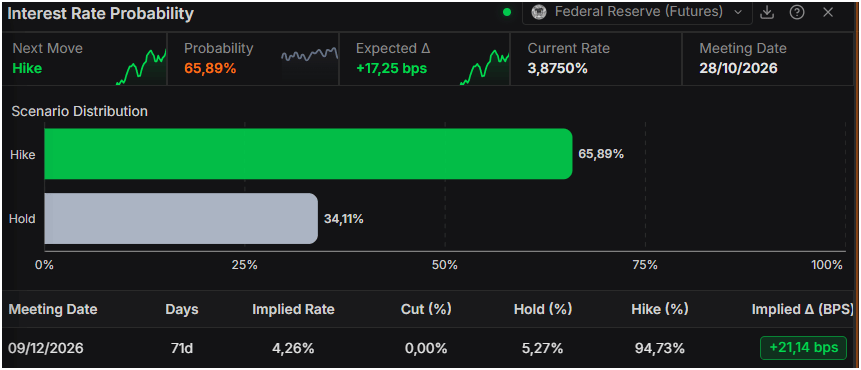
Money markets currently see a 68% probability of a Fed rate hike in October and a 95% chance of an increase in December, according to the Prime Terminal data.
Traders' eyes shift to Wednesday’s data, focused on the ADP National Employment Change, the Federal Reserve’s favorite inflation gauge, the Core Personal Consumption Expenditures (PCE) Price Index, Gross Domestic Product (GDP) figures for Q3 on its first reading and September’s Nonfarm Payrolls print.
XAU/USD technical analysis: Gold climbs, but faces strong resistance near $4,200
After bottoming near $4,100, XAU/USD is aiming higher but is about to test the bottom trendline of the ‘bullish wedge’, which, if cleared, could open the door to reclaim $4,200.
Nevertheless, momentum remains tilted to the downside, as indicated by the Relative Strength Index (RSI), which remains below its 50-neutral level. With that said, Gold’s path of least resistance is tilted to the downside.
Therefore, bullion’s first support is the September 28 swing low of $4,110. Below is $4,100, followed by the psychological $4,000 mark. The next support area sits at $3,996, the July 29 low of the day (LOD), followed by the yearly low of $3,941.
Gold FAQs
Gold has played a key role in human’s history as it has been widely used as a store of value and medium of exchange. Currently, apart from its shine and usage for jewelry, the precious metal is widely seen as a safe-haven asset, meaning that it is considered a good investment during turbulent times. Gold is also widely seen as a hedge against inflation and against depreciating currencies as it doesn’t rely on any specific issuer or government.
Central banks are the biggest Gold holders. In their aim to support their currencies in turbulent times, central banks tend to diversify their reserves and buy Gold to improve the perceived strength of the economy and the currency. High Gold reserves can be a source of trust for a country’s solvency. Central banks added 1,136 tonnes of Gold worth around $70 billion to their reserves in 2022, according to data from the World Gold Council. This is the highest yearly purchase since records began. Central banks from emerging economies such as China, India and Turkey are quickly increasing their Gold reserves.
Gold has an inverse correlation with the US Dollar and US Treasuries, which are both major reserve and safe-haven assets. When the Dollar depreciates, Gold tends to rise, enabling investors and central banks to diversify their assets in turbulent times. Gold is also inversely correlated with risk assets. A rally in the stock market tends to weaken Gold price, while sell-offs in riskier markets tend to favor the precious metal.
The price can move due to a wide range of factors. Geopolitical instability or fears of a deep recession can quickly make Gold price escalate due to its safe-haven status. As a yield-less asset, Gold tends to rise with lower interest rates, while higher cost of money usually weighs down on the yellow metal. Still, most moves depend on how the US Dollar (USD) behaves as the asset is priced in dollars (XAU/USD). A strong Dollar tends to keep the price of Gold controlled, whereas a weaker Dollar is likely to push Gold prices up.
Recommended Articles


