


Brent swings $105.63 to $102.33 as Gulf risk meets an 'energy ceasefire' — can $100 hold into CPI?


Mitrade Insights — Brent crude opened the new week with a round trip traders will remember: a spike to $105.63 in early Asian hours on fresh Gulf supply incidents, then a full reversal to $102.33 after the US announced that Russia and Ukraine had agreed to an immediate "energy ceasefire" and that 300,000+ tonnes of Russian diesel would head to global markets. At last look Brent traded near $103.46 (−1.02%) and WTI had slid through $90 to $90.49 (−1.29%) — a session that maps the two forces now fighting over every barrel: war-risk premium up, ceasefire discount down. And it lands three days before a US CPI print in which energy is still the main reason inflation sits above 3%.
The move: one session, two tapes
Friday's settlement had already set the stage: Brent closed at $104.72 (+0.4%) and WTI at $91.85 (+0.4%), with the Middle East supply picture tightening. Monday's Asian session delivered both sides of the trade at once:
| Session marker | Brent | WTI |
|---|---|---|
| Friday settle | $104.72 (+0.4%) | $91.85 (+0.4%) |
| Monday Asian high | $105.63 | $92.62 |
| Monday Asian low | $102.33 | $89.61 |
| Last (Asian afternoon) | $103.46 (−1.02%) | $90.49 (−1.29%) |
That is a $3.30 range in a single session for Brent — on thin Monday liquidity, with Tokyo markets closed for a holiday and the US bond market shut for Columbus Day, weekend headlines moved prices more than usual.
Why: the weekend delivered two opposite catalysts
Upward force — the Gulf. Over the weekend, missile strikes hit Riyadh's King Khalid International Airport (12 killed, 309 injured on Saturday, with further strikes on Sunday), and shipping incidents spread in the Strait of Hormuz, where one supertanker reportedly hit a mine and at least one more vessel was struck. The US said it was weighing a response. For oil, this is the classic war-risk premium: roughly a fifth of global seaborne crude transits Hormuz, and every incident there re-prices the tail risk of a disruption.
Downward force — the ceasefire and the diesel. On Sunday the US president announced a Russia-Ukraine "energy ceasefire" effective immediately — no further strikes on each other's energy infrastructure. Ukraine's president said the announcement was news to him but added that Kyiv would honour a workable ceasefire; Moscow has not confirmed. More concretely for physical markets, Russia is to ship 300,000+ tonnes of diesel immediately under a deal announced Friday that offers temporary sanctions relief in exchange for fuel supply.
The tape's verdict: the diesel headline and the ceasefire promise carry more near-term weight than the Gulf escalation — for now. Energy equities said the same thing on Monday: Australian oil and gas names (Woodside, Santos, Beach) fell 1–2% even as crude spiked.
The physical market: the Brent-WTI spread tells the story
The Brent-WTI spread sits near $13 ($103.46 vs $90.49) — historically wide, and a signal that the distortion is concentrated in seaborne crude, where the Gulf risk premium applies, rather than in US inland barrels. That's also why the diesel angle matters so much: distillate supply into winter has been the tightest part of the barrel complex, and 300,000 tonnes arriving from Russia is a genuine physical loosening, not just a headline.
Analysts at Commonwealth Bank noted that Friday's rise was a tug-of-war between "the prospect of a wave of Russian diesel hitting global markets" and "mounting supply risks" — a description that fits Monday even better than it fit Friday.
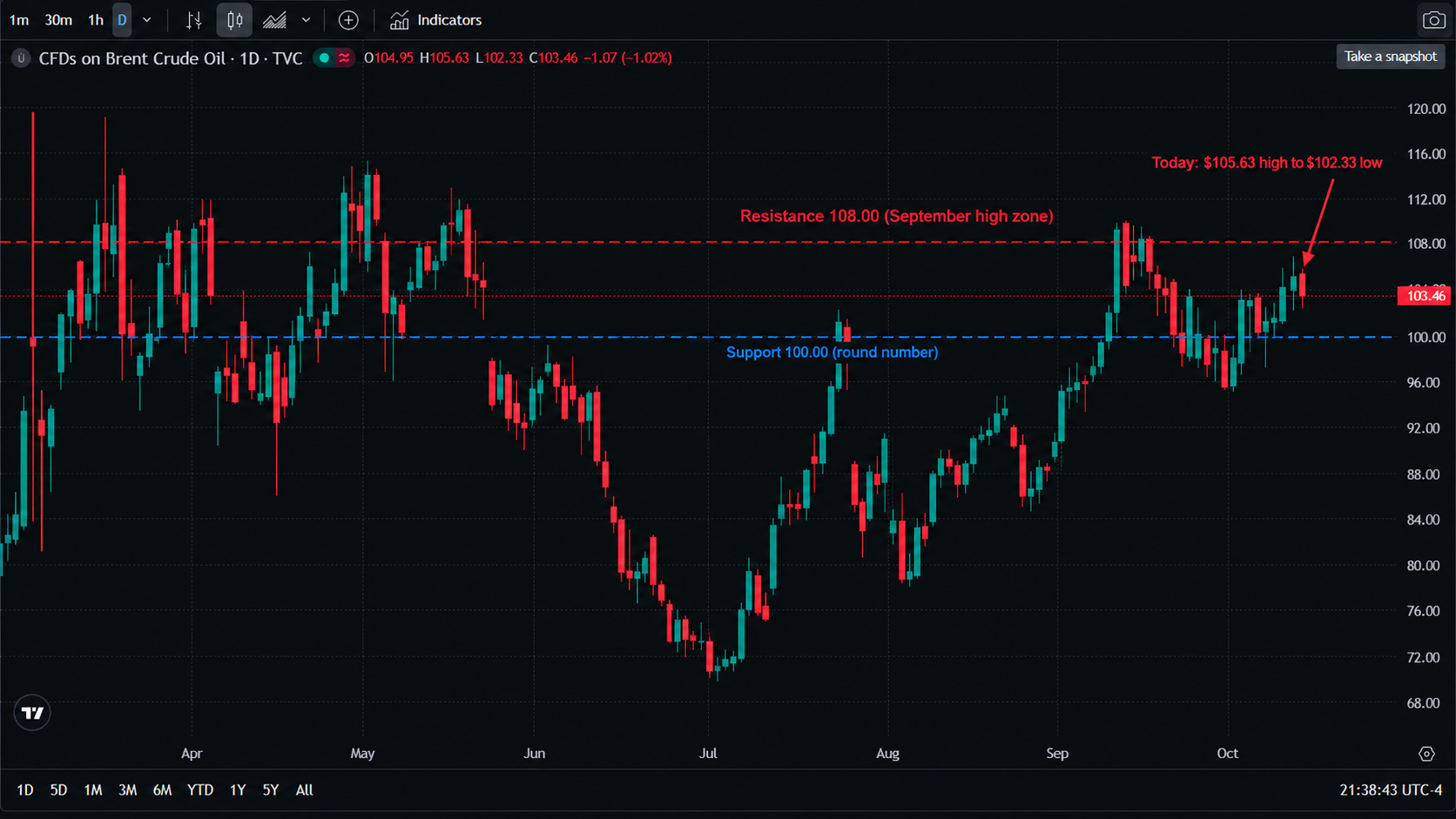
* Chart source: TradingView official chart screenshot, data source TVC (CFDs on Brent Crude Oil).
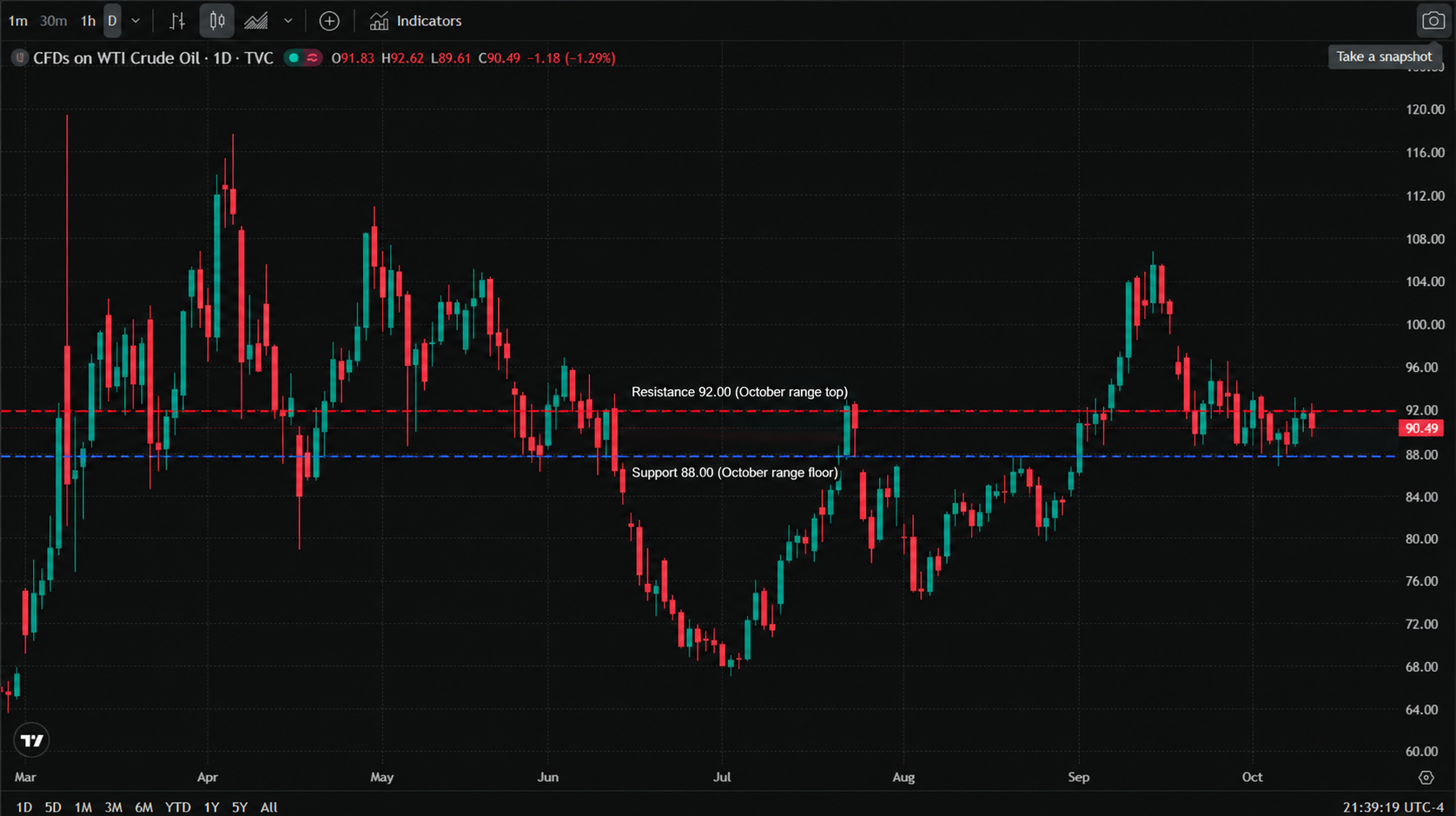
* Chart source: TradingView official chart screenshot, data source TVC (CFDs on WTI Crude Oil).
Levels
Brent key levels. Support: $102.33 (Monday's low — the ceasefire reaction low) / $100 (round number, and the line the market defended through most of early October) / $96 (late-September breakout zone). Resistance: $105.63 (Monday's high) / $108 (September spike zone) / $110 (round number).
WTI key levels. Support: $89.61 (Monday's low) / $88 (October range floor) / $84 (September breakout base). Resistance: $92.62 (Monday's high) / $96 (September shelf) / $100 (round number).
The structure to respect: as long as the ceasefire headline holds the tape, Brent's $100 line is the anchor — a close below it would signal the market is fully pricing a de-escalation discount. A failure of the ceasefire (or a fresh Hormuz incident) flips the tape straight back to $105–108.
What to watch: Wednesday's CPI runs through crude
This is where oil stops being just an oil story. Wednesday's US September CPI (8:30 ET, consensus 3.7% year-over-year) is the last inflation print before the Fed's October 27–28 meeting, and energy has been the single biggest reason headline CPI sits above 3% — energy prices were up roughly 16% year-over-year in August, with gasoline contributing over a third of that month's increase. Every $5 move in crude re-prices that arithmetic.
Scenario A — the ceasefire holds, diesel flows. The war-risk premium bleeds out of Brent; crude drifts toward $100 (WTI toward $88), and energy becomes a disinflationary input for the CPI math and the Fed's December decision. Lower fuel costs would also ease the strain on the consumer sentiment data that has been running at multi-year lows.
Scenario B — the ceasefire fails or the Gulf escalates again. A resumed strike campaign against energy infrastructure — or another Hormuz incident — rebuilds the premium quickly: Brent back through $105.63 toward $108, WTI to $96. That version feeds directly into an upside CPI surprise and puts the Fed's "one more hike" back in play, which would pressure equities and support the dollar.
For traders, the practical point is that this is a two-catalyst week with a single fuse line: Wednesday's CPI. Oil's next $5 and the Fed's next move are now the same trade.
Read more
* The content presented above, whether from a third party or not, is considered as general advice only. This article should not be construed as containing investment advice, investment recommendations, an offer of or solicitation for any transactions in financial instruments.


