




What Is an IPO, and Should You Buy One? My Contrarian Take After 15 Years at The Fool.
Key Points
Most IPOs underperform the market over a three-year period.
Some new issues, like SpaceX, are often overhyped and crash after an initial pop.
Other stocks go public with little fanfare and deliver steady growth.
- 10 stocks we like better than Viking ›
IPO stands for initial public offering.
This is the process by which most companies enter the public markets, meaning their stock can be owned by a willing buyer. Start-ups and private companies typically go public with the help of investment banks, which underwrite the offering. The process takes several weeks. First, a company files a detailed prospectus, also known as an S-1, with the SEC, and then goes on a roadshow to pitch the IPO to investors.
Missed Nvidia in 2009? This Rare Signal Is Flashing Again. In 2009, a "Double Down" signal flashed for a little-known chipmaker called Nvidia. For the first time in years, that same "Total Conviction" signal is flashing for a company 1/100th the size of Nvidia. Continue »
Shortly before the offering, a listing price, or what the IPO buyers are paying, is set based on investor demand, and then the stock begins trading publicly. Once it's listed on an exchange, it can be bought and sold like any other stock.
Image source: Getty Images.
Should you buy an IPO?
The traditional investing advice is to avoid IPOs. IPO stocks, typically defined as stocks that have gone public within the last year, are more volatile than the broad market, and they also underperform the S&P 500 on average. Historically, IPOs jump about 19% on their first day of trading, according to research shared in The Wall Street Journal. However, the average return of an IPO held from the end of its first trading day for three years is 21% lower than a comparable market index.
A lot of IPOs enter the market overhyped at high valuations and crash after an initial pop. We saw this recently with Space Exploration Technologies (NASDAQ: SPCX), which is now trading slightly above its IPO price of $135 but lost more than 50% of its value from peak to trough after popping out of the gate.
There's a slew of other IPOs that went public during the pandemic, only to crash in the 2022 bear market. Some of those have bounced back to new heights, while others have struggled.
My contrarian take on buying an IPO
In general, I think investors should steer clear of IPOs. I think that's especially true of overhyped issues like SpaceX, which typically crash after an initial pop. We saw something similar with Figma, another recent high-profile IPO, which is now trading below its IPO price even as it more than tripled in its initial trading days.
If you are going to buy this kind of IPO, you should wait until the initial hype cycle has completed, as the initial pop is almost always followed by a pullback. Some IPO stocks, like Airbnb, remain significantly above their IPO price but still underperform the market. Don't chase a hot IPO, and remember that valuation always matters over the long term.
However, other less-hyped IPOs don't have an initial pop and do go on to be big winners. With the benefit of two decades of hindsight, we can see that Netflix would have been a great IPO purchase. The streaming stock, which went public in 2002 when the market was still reeling from the dot-com bust, jumped just 12% on its opening day and then headed lower over the following months. Since then, it's been one of the best-performing stocks this century with market cap growth of roughly 1,000x. Netflix has a higher price-to-sales ratio now than it did when it went public.
Chipotle, which went public in 2006, doubled on its opening day but then delivered only modest growth over the next year. Additionally, the stock traded at a price-to-earnings ratio similar to levels we've seen in recent years, suggesting investors were ignoring its growth potential.
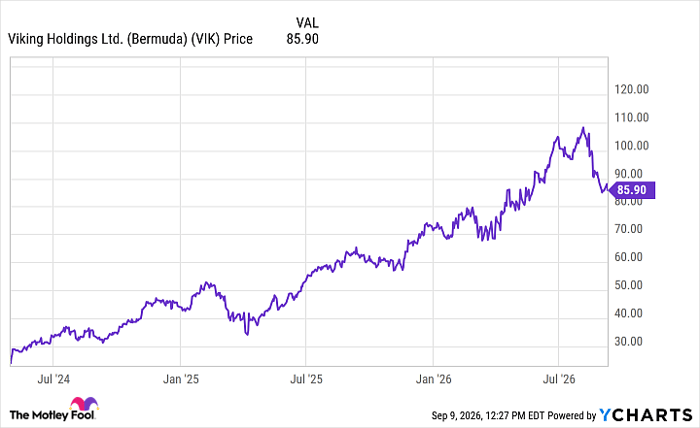
More recently, I think Viking Holdings (NYSE: VIK), the parent of the cruise line of Viking Cruises, is a good example of a winning IPO. The company went public with little fanfare, but had a strong business model, differentiated positioning in its industry, and a reasonable valuation.
The stock rose a modest 9% on its opening day and has continued to march higher since then, as the chart below shows.
VIK data by YCharts
What it means for investors
Overall, IPOs are best treated with caution, especially in an era when so much of the gains accrue to the company before it goes public, as we saw with SpaceX, and are likely to see with OpenAI and Anthropic, which are aiming to go public in the coming months.
However, there are still winners to be found. Look for companies that have reasonable valuations, competitive advantages, and relatively little media attention as they go public. Viking Holdings won't be the last steady IPO winner.
Should you buy stock in Viking right now?
Before you buy stock in Viking, consider this:
The Motley Fool Stock Advisor analyst team just identified what they believe are the 10 best stocks for investors to buy now… and Viking wasn’t one of them. The 10 stocks that made the cut could produce monster returns in the coming years.
Consider when Netflix made this list on December 17, 2004... if you invested $1,000 at the time of our recommendation, you’d have $414,015!* Or when Nvidia made this list on April 15, 2005... if you invested $1,000 at the time of our recommendation, you’d have $1,385,459!*
Now, it’s worth noting Stock Advisor’s total average return is 960% — a market-crushing outperformance compared to 213% for the S&P 500. Don't miss the latest top 10 list, available with Stock Advisor, and join an investing community built by individual investors for individual investors.
See the 10 stocks »
*Stock Advisor returns as of September 9, 2026.
Jeremy Bowman has positions in Airbnb, Figma, and Netflix. The Motley Fool has positions in and recommends Airbnb, Figma, Netflix, and Viking. The Motley Fool has a disclosure policy.
Recommended Articles


