




Why's Everyone Talking About Bloom Energy Now?
Key Points
AI has created an electricity bottleneck.
Bloom is positioning itself as a potential solution to the AI industry's growing "time-to-power" problem.
The opportunity is enormous, but the investment isn't risk-free.
- 10 stocks we like better than Bloom Energy ›
For years, Bloom Energy (NYSE: BE) looked like a promising technology company searching for its big opportunity.
Now it may have found one. The company makes fuel cell systems that generate electricity. That might not sound like the most exciting business in the artificial intelligence boom, but AI has created a problem that could be almost as important as chips: There isn't enough electricity to power all the data centers companies want to build.
Missed Nvidia in 2009? This Rare Signal Is Flashing Again. In 2009, a "Double Down" signal flashed for a little-known chipmaker called Nvidia. For the first time in years, that same "Total Conviction" signal is flashing for a company 1/100th the size of Nvidia. Continue »
That's where Bloom comes in.
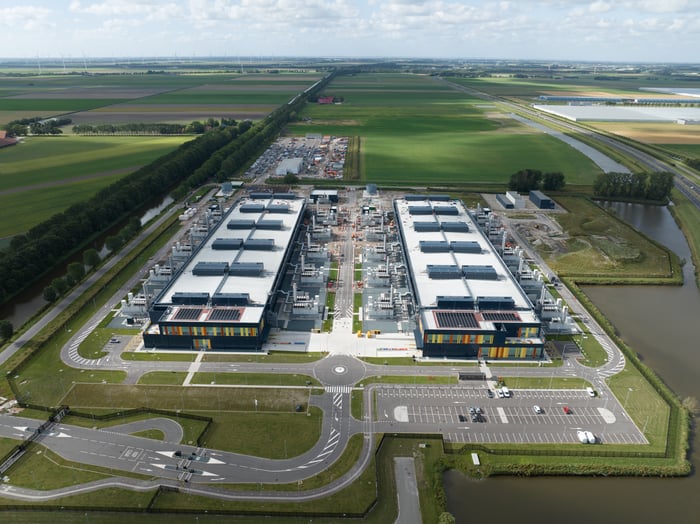
Image source: Getty Images.
The AI boom has created an electricity problem
Building an AI data center isn't just about buying thousands of powerful chips. Those chips consume enormous amounts of electricity. A hyperscale data center can require hundreds of megawatts of power, and developers increasingly face a frustrating problem: The grid can't always deliver that power quickly enough.
Imagine a technology company spends billions of dollars on land, buildings, servers, and GPUs. The facility is ready to go. Then the utility says: "Come back in a few years. We'll have the electricity by then."
That's not a minor inconvenience. For an AI company racing to deploy computing capacity, waiting years can mean leaving billions of dollars of equipment sitting idle.
This has created a new bottleneck in the data center industry: time to power.
Bloom's business model is surprisingly simple
For starters, it's important to know that Bloom sells power-generating equipment.
Its flagship product, the Bloom Energy Server, uses solid oxide fuel cells -- electrochemical devices -- to convert fuel into electricity. Instead of generating electricity at a distant power plant and sending it through the grid, Bloom can generate electricity at or near the facility that needs it.
Traditionally, electricity generated in power plants must travel through long transmission lines and the grid before reaching data centers. Using Bloom Energy Servers, data centers can generate their own electricity on-site. That distinction matters enormously when electricity is scarce.
While Bloom Energy is not the only company providing on-site electricity generation system -- there are other solutions like gas turbines -- it offers enormously shorter time to deploy. Management estimates that Bloom can ship 3.25 MW worth of fuel cells every 1-2 days, meaning a 1 GW data center can have its power need installed in less than a year. By comparison, several natural gas turbine manufacturers have order books filled out to 2030 and beyond.
To be fair, Bloom doesn't replace the grid. It simply gives customers another way to get power while they wait for the grid to catch up. And so far, customers seem to like the solution.
In the second quarter of 2026, Bloom generated a record $1.1 billion in revenue, up 166% from a year earlier. Product revenue jumped 215%, while the company swung from an operating loss to generally accepted accounting principles (GAAP) operating income of $182 million. Bloom also raised its full-year 2026 revenue guidance to $3.9 billion to $4.2 billion, implying roughly 100% growth at the midpoint.
Winning big customers and partnerships
Another reason for investors to get excited is that Bloom Energy has secured major wins in recent quarters.
Take its collaboration with Oracle. Bloom Energy will deliver solutions to some of Oracle's data centers, targeting on-site power for an entire data center within 90 days. This provides Oracle with reliable, clean, and cost-efficient power that supports its growth strategy with certainty.
And then there's Brookfield. The asset manager has expanded its financing framework for Bloom-related AI power deployments from $5 billion to $25 billion, helping data center owners to fund their on-site power requirements.
These partnerships lend enormous credibility to Bloom Energy's products and solutions, positioning the company well to scale its business in the years to come.
But there's a catch
Investors shouldn't confuse a huge opportunity with a guaranteed winner.
Bloom still needs to prove that its extraordinary growth can continue. The company must scale manufacturing without sacrificing margins or reliability. On the demand side, customers need to keep placing large orders, even as competitors improve their own technologies.
Moreover, Bloom faces an important question: How much of today's demand represents a temporary response to the AI power crunch, and how much becomes a durable new market?
That's what will determine whether Bloom becomes a long-term growth stock or just a spectacular short-term growth story.
What does it mean for investors?
Bloom Energy spent years trying to convince investors that its fuel cell technology could matter. AI has given the company that opportunity.
The idea here is simple: The grid can't provide electricity fast enough to build AI infrastructure, and customers will come knocking on its door for fast, reliable on-site power systems.
That's why a company once known mainly for fuel cells and hydrogen has suddenly become one of the most interesting stocks in the AI infrastructure race.
Should you buy stock in Bloom Energy right now?
Before you buy stock in Bloom Energy, consider this:
The Motley Fool Stock Advisor analyst team just identified what they believe are the 10 best stocks for investors to buy now… and Bloom Energy wasn’t one of them. The 10 stocks that made the cut could produce monster returns in the coming years.
Consider when Netflix made this list on December 17, 2004... if you invested $1,000 at the time of our recommendation, you’d have $414,015!* Or when Nvidia made this list on April 15, 2005... if you invested $1,000 at the time of our recommendation, you’d have $1,385,459!*
Now, it’s worth noting Stock Advisor’s total average return is 960% — a market-crushing outperformance compared to 213% for the S&P 500. Don't miss the latest top 10 list, available with Stock Advisor, and join an investing community built by individual investors for individual investors.
See the 10 stocks »
*Stock Advisor returns as of September 9, 2026.
Lawrence Nga has no position in any of the stocks mentioned. The Motley Fool has positions in and recommends Bloom Energy, Brookfield Asset Management, and Oracle. The Motley Fool has a disclosure policy.
Recommended Articles


