




Micron's Operating Margin Surged Past 80% for the First Time Ever. History Says This Is What's Coming Next.
Key Points
Micron's demand cycle may stay elongated due to huge demand for its products from AI hyperscalers.
Investors are worried about the cyclical nature of the memory market.
- 10 stocks we like better than Micron Technology ›
Micron (NASDAQ: MU) is one of the three leading names in the memory chip space. It produces both DRAM and high-bandwidth memory, and its fingers are on the pulse of the whole tech industry due to its size and breadth. Recently, it set a new operating margin record, which one might naturally view as a positive. However, that fact should be raising some red flags for investors.
Why? Well, the memory chip industry is cyclical, and normally, once its margins reach a peak, it's time to get out. But is that the case here? After all, this is the biggest up phase of a cycle Micron has ever seen. Well, I expect that history has some valuable lessons to teach.
Missed Nvidia in 2009? This Rare Signal Is Flashing Again. In 2009, a "Double Down" signal flashed for a little-known chipmaker called Nvidia. For the first time in years, that same "Total Conviction" signal is flashing for a company 1/100th the size of Nvidia. Continue »
Image source: The Motley Fool.
Cyclical businesses are tough to invest in
The memory chip industry is highly cyclical due to the technology being commoditized. There isn't a ton that separates Micron's memory chips from those of its chief competitors, Samsung and SK Hynix, and its customers have no problem switching from one provider to another if it means getting a lower price. As a result, memory chip prices are dictated by supply-and-demand rules.
Right now, demand for memory is off the charts due to AI hyperscalers spending hundreds of billions of dollars on AI data centers. Their build-outs have consumed all the available memory chips that the world has the capacity to produce, and they still need much more -- a situation that has caused prices to skyrocket. Nothing like this has ever been seen in the memory chip industry.
Furthermore, AI companies plan to increase their spending on data centers over the next few years, and while the memory-chip makers are working to bring new production capacity online, the increase from those new facilities may not be enough to bring supply and demand back into balance. Additionally, it will be mid-2027 to 2028 before Micron's new production facilities are online.
This may extend the shortage phase of this memory cycle for several years, but that's not exactly what history tells us happens.
Could a crash be coming?
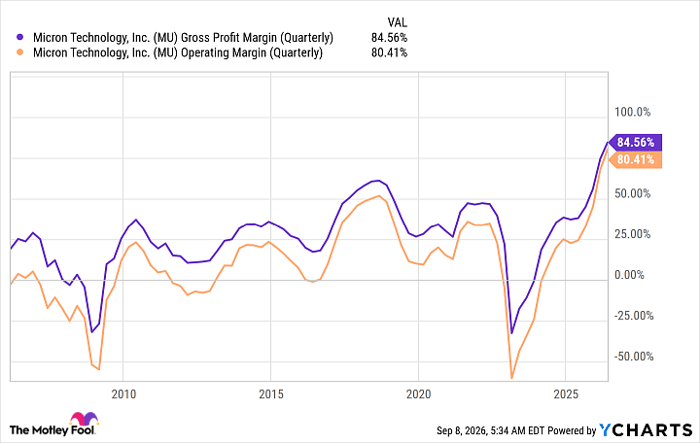
Over the past two decades, Micron's gross and operating margins have gone up and down based on the demand cycle.
MU Gross Profit Margin (Quarterly) data by YCharts.
There were obvious crashes during the financial crisis of 2008 and 2009, as demand for electronics dropped. There was another in 2023 when the world was convinced we were heading into a recession. Between those dips, there were minor peaks and valleys, but nothing compares to what investors are seeing now. Prior to the current peak, Micron reached its highest margin levels in 2019, when its gross margin hit 61% and its operating margin hit 52%. We're clearly well above those levels, and it doesn't appear that there's a lot higher that these figures can go.
All of this stems from soaring memory chip prices: Micron is paying roughly the same amount for its inputs, but it can sell its products for much more than it used to. That has led to soaring profits and taken Micron's stock to new heights. However, history tells us that these peaks are often followed by deep valleys. Should investors expect that to be the case this time?
I don't think so.
Micron's management recently told investors that based on what it can see, the "tightness" in the memory chip market won't subside until after 2027 at the earliest. That leaves several quarters for Micron to enjoy its prolonged peak, but what happens after that?
As mentioned above, new production facilities could increase supply to the point where demand no longer outpaces it. Without a shortage, memory chip prices could tumble and take Micron's profit margins down with them. However, that doesn't mean the elevated demand cycle is over. Most projections point to the massive AI build-out lasting through at least 2030, which means Micron will have an elevated demand cycle, but its margins may fall to the historical peaks of 50% to 60%. That's still a great, viable business at those levels, and I think Micron can remain a strong investment. In addition, Micron now has numerous multiyear contracts that include pricing floors and sales volume minimums with some of its largest clients. Those deals should support strong margins for the company through 2030.
I don't think history will repeat itself for Micron's stock through 2030, and that makes it a strong buy now.
Should you buy stock in Micron Technology right now?
Before you buy stock in Micron Technology, consider this:
The Motley Fool Stock Advisor analyst team just identified what they believe are the 10 best stocks for investors to buy now… and Micron Technology wasn’t one of them. The 10 stocks that made the cut could produce monster returns in the coming years.
Consider when Netflix made this list on December 17, 2004... if you invested $1,000 at the time of our recommendation, you’d have $414,015!* Or when Nvidia made this list on April 15, 2005... if you invested $1,000 at the time of our recommendation, you’d have $1,385,459!*
Now, it’s worth noting Stock Advisor’s total average return is 960% — a market-crushing outperformance compared to 213% for the S&P 500. Don't miss the latest top 10 list, available with Stock Advisor, and join an investing community built by individual investors for individual investors.
See the 10 stocks »
*Stock Advisor returns as of September 9, 2026.
Keithen Drury has no position in any of the stocks mentioned. The Motley Fool has positions in and recommends Micron Technology. The Motley Fool has a disclosure policy.
Recommended Articles


