




Social Security Is Facing a Financial Crisis, and Congress May Be Too Late to Act
Key Points
Social Security has been running at a deficit since 2010, paying out more in annual benefits than it receives in wage tax revenue.
Based on the outlook for outlays and taxes, by the fourth quarter of 2032, the program will completely deplete the trust fund where it stored its prior surpluses.
Among the most direct ways to address the program's funding shortfall would be to raise Social Security taxes or raise or eliminate the wage base limit.
- The $23,760 Social Security bonus most retirees completely overlook ›
There's no denying that Social Security is one of the most important social programs in the U.S., helping to keep tens of millions of Americans financially afloat. For decades, the program has held stable, but now it stands at a crossroads the likes of which it hasn't faced since the early 1980s.
From the mid-1980s through 2009, Social Security collected more money in wage taxes than it distributed in benefits. The surplus was stashed away (in a bookkeeping sense) in the Old-Age and Survivors Insurance (OASI) Trust Fund, waiting to be drawn upon when outflows exceeded inflows. That started to happen 16 years ago.
Missed Nvidia in 2009? This Rare Signal Is Flashing Again. In 2009, a "Double Down" signal flashed for a little-known chipmaker called Nvidia. For the first time in years, that same "Total Conviction" signal is flashing for a company 1/100th the size of Nvidia. Continue »
Since 2010, each year's benefit payments have exceeded what the program brought in. At the expected depletion rate, the Social Security program will only be able to continue paying retirees and other beneficiaries their full benefits until the fourth quarter of 2032. At that point, the Trust Fund will run dry, and -- barring changes to the law -- the program will only have current wage taxes to cover its outlays. That won't be enough.
So, with that crisis looming and no signs of Congress planning to take action, what should current and future Social Security recipients prepare for?
The Social Security disconnect
The Social Security program is primarily funded through tax revenue. Each paycheck, most American workers pay 6.2% of their wages into Social Security. Their employer pays a matching 6.2%. This revenue goes into the OASI Trust Fund, but then goes rapidly back out again, directly covering the monthly benefits being paid to today's retirees.
Over the past few years, the amount paid out from the OASI Trust Fund has considerably exceeded the amount it has brought in, leaving the program operating at a deficit.
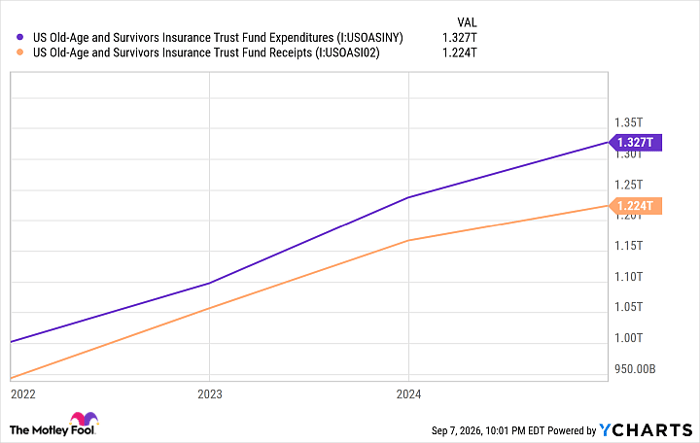
US Old-Age and Survivors Insurance Trust Fund Expenditures data by YCharts.
According to the Social Security Administration (SSA), once the Trust Fund runs out of cushion -- beginning in the fourth quarter of 2032 -- the program will only have sufficient funding to pay out benefits at 78% of the rates Americans have been promised.
Many recipients already complain about how Social Security covers less and less of their expenses, so a 22% cut to benefits would spell trouble for tens of millions of retirees around the country.
What is causing the disconnect?
Several factors are driving the program's deficit, but much of it comes down to a demographic shift. The baby boom generation has been in the process of retiring and claiming their benefits for the better part of two decades, and the relative size of that group is reducing the proportion of the population that is working and contributing wage taxes to the program.
People are also living longer, which increases the time they collect benefits. According to the most recent data from the National Center for Health Statistics, U.S. life expectancy is the highest it has been in well over a century of record-keeping.
Combine these factors, and we're stuck with an issue that only Congress can address.

Image source: Getty Images.
What can Congress do?
The most direct (and likely unpopular) route Congress could take is to raise wage taxes. For political reasons, however, neither party wants to be the one to raise taxes, cut benefits, or both, and face the potential backlash.
Without going that route, Congress could also raise the threshold for how much of a person's income is subject to the Social Security tax. Right now, only earned income up to $184,500 (the "wage base limit") is subject to Social Security tax. Beyond that level, earnings are free from the wage tax. Raising the limit by a considerable amount, or eliminating it altogether, would increase the program's tax revenue.
Congress could also raise the full retirement age again, as it did via reforms passed in 1983. Or it could take a combination approach.
Regardless, the program isn't in a fix-it-quick situation. Although a solution could be decided upon fairly quickly, it would likely take years to fully enact or to make a tangible difference in the program's deficit. In the meantime, current recipients should prepare for an eventual cut to their benefits, and future recipients should expect Social Security to cover a smaller part of their retirement budgets. As the saying goes: Hope for the best, but prepare for the worst.
The $23,760 Social Security bonus most retirees completely overlook
If you're like most Americans, you're a few years (or more) behind on your retirement savings. But a handful of little-known "Social Security secrets" could help ensure a boost in your retirement income.
One easy trick could pay you as much as $23,760 more... each year! Once you learn how to maximize your Social Security benefits, we think you could retire confidently with the peace of mind we're all after. Join Stock Advisor to learn more about these strategies.
View the "Social Security secrets" »
The Motley Fool has a disclosure policy.
Recommended Articles


