




Investors: Sept. 16 Will Be a Critical Day for the Stock Market. Here's What You Need to Know.
Key Points
The market is awaiting the Federal Reserve's statement on Sept. 16 regarding whether it will hike or maintain interest rates.
Holding inflation-resistant assets is a good idea right now.
Don't sell anything in a panic, no matter what happens.
- These 10 stocks could mint the next wave of millionaires ›
On Wednesday, Sept. 16, the Federal Reserve will announce its latest decision on short-term interest rates. The group's decision will have ramifications for the economy and the stock market. CME Group's FedWatch tool was estimating a 60% chance of a rate hike as of Sept. 8, after the August nonfarm payrolls report showed jobs had grown well above analysts' consensus expectations.
For the S&P 500 (SNPINDEX: ^GSPC), Nasdaq Composite (NASDAQINDEX: ^IXIC), and Dow Jones Industrial Average (DJINDICES: ^DJI), a rate hike would likely be a bearish outcome, albeit a transient and relatively minor one. The bigger and longer-lasting impact could come from what the new Fed Chair, Kevin Warsh, says about the ongoing fight against inflation in light of the Fed's action (or inaction).
Missed Nvidia in 2009? This Rare Signal Is Flashing Again. In 2009, a "Double Down" signal flashed for a little-known chipmaker called Nvidia. For the first time in years, that same "Total Conviction" signal is flashing for a company 1/100th the size of Nvidia. Continue »
Here's what you need to know in advance of the event.
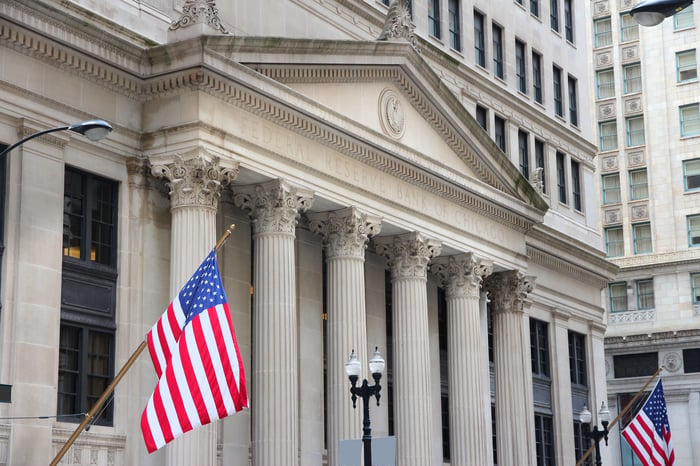
Image source: Getty Images.
Inflation is running hot, per the metric the Fed watches the most closely
The Consumer Price Index (CPI), which tracks what households pay for a broad basket of goods and services, from rent and groceries to airfares and used cars, climbed by 3.4% in the 12 months ending in July 2026. That was actually a deceleration from prior readings, but it's still well above the Fed's long-term target of 2% annual inflation. But the CPI isn't the main metric determining the Fed's potential actions.
At a keynote speech given at Jackson Hole, Wyoming, on Aug. 28, Warsh pointed to the 12-month change in the personal consumption expenditures (PCE) price index, the Fed's preferred gauge for judging the pace of inflation, at 3.7%, with the six-month change running at 4.1%. He also said that 54% of the 199 items in the PCE's basket of goods had seen their prices rise by more than 3% over the past year.
That suggests there is ample data supporting the view that inflation is running higher than desired. It also suggests there will probably be a rate hike on Sept. 16.
But probability is not inevitability.
August's producer price index data will be released on Thursday, Sept. 10, and the August CPI data will be published on Friday, Sept. 11. If they come in cooler than expected, they could be used to justify holding interest rates steady. If they come in hot, it dramatically increases the likelihood that rates will be increased.
Investors shouldn't panic
There will likely be some market volatility on the day of the rate decision, as well as on the days when those other data points are reported.
If you're invested for the long haul, as you should be, there is not much to do to prepare. Whatever happens will probably have little influence on the prices of the shares of the companies you hold within a few months of the Fed's decision, and certainly even less influence in the years that follow.
The larger and more enduring issue here is the credibility of the Federal Reserve as an institution that is responsible for managing inflation (among other things).
In his short tenure as Fed chair, Warsh has scaled back traditions such as providing forward guidance, which signaled future rate moves in advance. With less clarity on how the Fed is thinking about the economy, the market will inevitably be a bit more surprised by its actions, which means there will be more volatility.
Another important wrinkle is that Warsh is facing pressure from the Trump administration to keep rates low.
While the institution is supposed to be independent from the executive branch, President Trump has reportedly spoken with Warsh multiple times since his appointment to the position in May 2026. Trump has also repeatedly demanded lower interest rates in his statements on social media. Other administration figures, including Vice President JD Vance, have also advocated for cuts. If Warsh opts to hold rates steady without a very convincing explanation for why elevated inflation is tolerable, investors are apt to reasonably conclude that the Fed gave in to political pressure, and that its independence is either under severe threat or already gone.
If it looks like Warsh is unwilling to hike rates despite even more data pointing to higher-than-desired inflation, especially if the administration's pressure intensifies, some investors are likely to consider reallocating a much larger share to inflation-resistant assets like real estate or commodities like gold.
Until then, sit tight, as this new Fed chair has yet to convince the market of his resolve.
Where to invest $1,000 right now
When our analyst team has a stock tip, it can pay to listen. After all, Stock Advisor’s total average return is 960%* — a market-crushing outperformance compared to 213% for the S&P 500.
They just revealed what they believe are the 10 best stocks for investors to buy right now, available when you join Stock Advisor.
See the stocks »
*Stock Advisor returns as of September 9, 2026.
Alex Carchidi has no position in any of the stocks mentioned. The Motley Fool has no position in any of the stocks mentioned. The Motley Fool has a disclosure policy.
Recommended Articles


