




Rivian's Much-Hyped R2 Is About More Than Boosting Sales -- Here's the Hidden Value
Key Points
Rivian's R2 will certainly open the door to a wider market and increase deliveries.
Rivian will reap the rewards from its efforts to reduce costs and improve unit economics.
The R2 will also be Rivian's opportunity to use its more affordable vehicles in a robotaxi program, in this instance with Uber Technologies.
- 10 stocks we like better than Rivian Automotive ›
Investors love to check automakers' quarterly (or otherwise) delivery figures, especially when it comes to young electric vehicle (EV) makers that are surviving amid low volume and scale. Rivian's (NASDAQ: RIVN) R2 has been long-hyped, and on June 9, 2026, customers finally began receiving their prized ride. However, while Wall Street analysts obsess over delivery charts and the smallest gains or losses, savvy investors know the R2 is about much more than increasing deliveries and revenue for the young EV maker. Here is one big development that's often forgotten.
Rivian robotaxi
One of Rivian's underappreciated strengths is its ability to bring in investment from larger companies that see value in Rivian's software technology or vehicles as a service. In this case, Rivian's mass-market R2 was a solid choice for Uber Technologies (NYSE: UBER) to add to its numerous investments for robotaxi joint ventures. Uber will invest up to $1.25 billion in Rivian through 2031, after it meets certain conditions and milestones, and the statement from Uber CEO Dara Khosrowshahi emphasizes Rivian's growing value with its vertical integration.
Missed Nvidia in 2009? This Rare Signal Is Flashing Again. In 2009, a "Double Down" signal flashed for a little-known chipmaker called Nvidia. For the first time in years, that same "Total Conviction" signal is flashing for a company 1/100th the size of Nvidia. Continue »
"We're big believers in Rivian's approach -- designing the vehicle, compute platform, and software stack together, while maintaining end-to-end control of scaled manufacturing and supply in the U.S.," Khosrowshahi said in a press release.
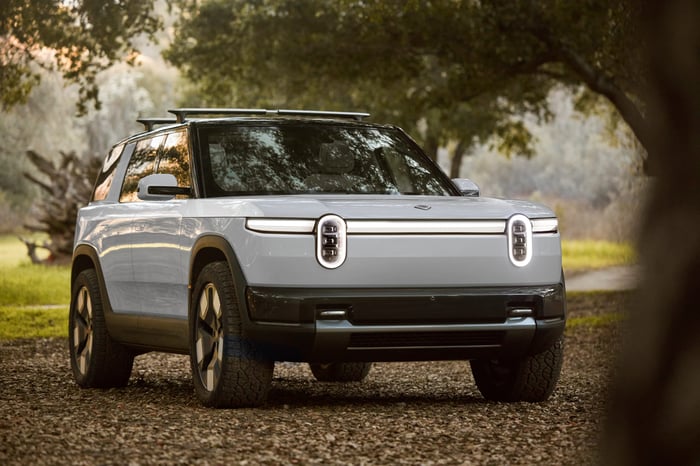
Rivian's R2 will be used by Uber as part of its robotaxi program. Image source: Rivian.
Uber and Rivian expect to deploy 10,000 fully autonomous R2 robotaxis during their joint venture's first phase. San Francisco and Miami are circled in red to host the initial R2 robotaxi deployments in 2028, with the target of entering 25 additional cities by 2031. If all goes well for the joint venture, there's an option for the companies to negotiate the purchase of up to 40,000 additional R2 vehicles beginning in 2030.
Before you brush this aside as not moving the needle, consider that, right now, a big chunk of Tesla's market capitalization and value is driven by its robotaxi potential. Ark Invest, run by Cathie Wood, has Tesla's robotaxi driving between 88% and 90% of the projected future enterprise value in its multiyear models. Bank of America Global Research believes the robotaxi potential drives 52% of Tesla's overall valuation. Even on the lower end, Morningstar estimates robotaxis to drive about 30% of Tesla's valuation.
What it all means
Sure, Rivian's R2 is about opening the door to a much wider market and driving deliveries higher. Beyond that, however, Rivian's R2 is about powering the future opportunities that could generate significantly higher margins than the vehicle sale itself. Under the Uber and Rivian partnership, Uber agreed to pay licensing fees to use Rivian's autonomous driving software. This recurring high-margin revenue stream would be a huge boost to gross profits down the road, and it could help drive its stock price higher in the near term if investors see Rivian's robotaxi isn't all hype.
Should you buy stock in Rivian Automotive right now?
Before you buy stock in Rivian Automotive, consider this:
The Motley Fool Stock Advisor analyst team just identified what they believe are the 10 best stocks for investors to buy now… and Rivian Automotive wasn’t one of them. The 10 stocks that made the cut could produce monster returns in the coming years.
Consider when Netflix made this list on December 17, 2004... if you invested $1,000 at the time of our recommendation, you’d have $414,015!* Or when Nvidia made this list on April 15, 2005... if you invested $1,000 at the time of our recommendation, you’d have $1,385,459!*
Now, it’s worth noting Stock Advisor’s total average return is 960% — a market-crushing outperformance compared to 213% for the S&P 500. Don't miss the latest top 10 list, available with Stock Advisor, and join an investing community built by individual investors for individual investors.
See the 10 stocks »
*Stock Advisor returns as of September 9, 2026.
Bank of America is an advertising partner of Motley Fool Money. Daniel Miller has no position in any of the stocks mentioned. The Motley Fool has positions in and recommends Tesla. The Motley Fool recommends Uber Technologies. The Motley Fool has a disclosure policy.
Recommended Articles


