




The 22% Sales Boost Hiding in Your Crypto Checkout
By Kate L., Commercial Director of NOWPayments
If you run an e-commerce business, your next conversion win may come not from another campaign, but from giving ready-to-buy customers a payment method they can actually use.
As Commercial Director of NOWPayments, I work where crypto adoption meets business reality. One problem appears repeatedly: merchants can have demand and still lose the sale at payment. For this article, I reviewed checkout research alongside six months of NOWPayments e-commerce data to examine where conversion leaks, how crypto expands addressable demand, and why implementation determines the result.
This distinction matters because product demand and payment conversion are not the same thing. A customer can want the product, accept the price, and still leave because the available payment methods do not work for them.
This article is part of the Crypto That Works for Business series, a collection of materials about the commercial results behind crypto payments. We begin with e-commerce conversion. Future editions will explore other areas where better payment infrastructure can unlock revenue, reduce costs, and remove friction from growth.
The Conversion Leak Hiding in Checkout
Payment problems account for a meaningful share of abandoned checkouts.
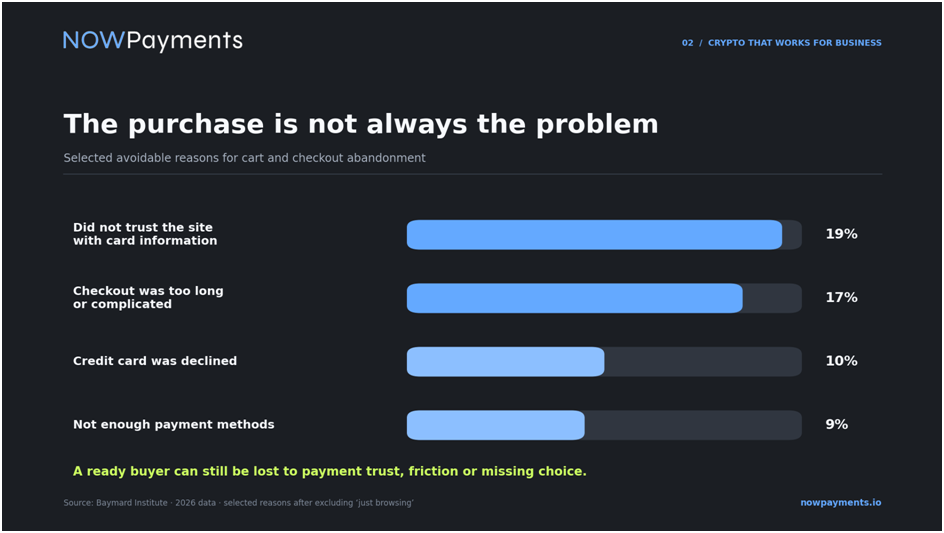
When I went through Baymard Institute’s checkout research, the headline number was striking: the average cart-abandonment rate is 70.22%. Some of that is unavoidable. 42% of respondents said they were simply browsing or were not ready to buy.
The reasons that remain are more useful for merchants. After excluding those shoppers, Baymard found that 19% left because they did not trust the site with their card information, 17% found the checkout too complicated, 10% had their card declined, and 9% could not find enough payment options. These customers did not necessarily reject the product. The payment experience stopped them from completing the order.
Adding payment choices is not about decorating a checkout with more logos. It is about allowing more qualified customers to complete the purchase.
More Relevant Payment Methods Mean More Addressable Demand
Crypto can provide another such path – particularly for global customers, crypto-native audiences, privacy-conscious buyers, and users who cannot or do not want to rely on cards.
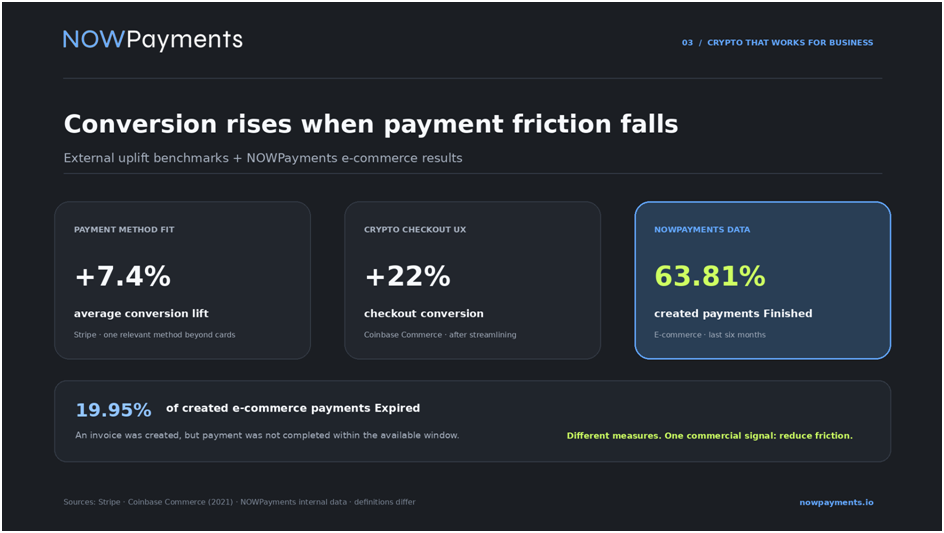
A large-scale payment-method study found that offering at least one relevant option beyond cards produced an average 7.4% increase in conversion and a 12% increase in revenue. A separate crypto-checkout case reported a 22% increase in checkout conversion after the payment experience was streamlined.
NOWPayments’ data provides another view. Over the last six months, 63.81% of payments created by e-commerce partners reached Finished status. Another 19.95% expired, meaning the invoice was created but not paid within the available window.
These figures begin later than conventional cart-abandonment metrics and are not directly comparable. Both, however, show that purchase intent can still be lost at payment.
Crypto Converts, but Implementation Decides How Well
Adding crypto creates a conversion opportunity, but the implementation determines how much of that opportunity a merchant captures.
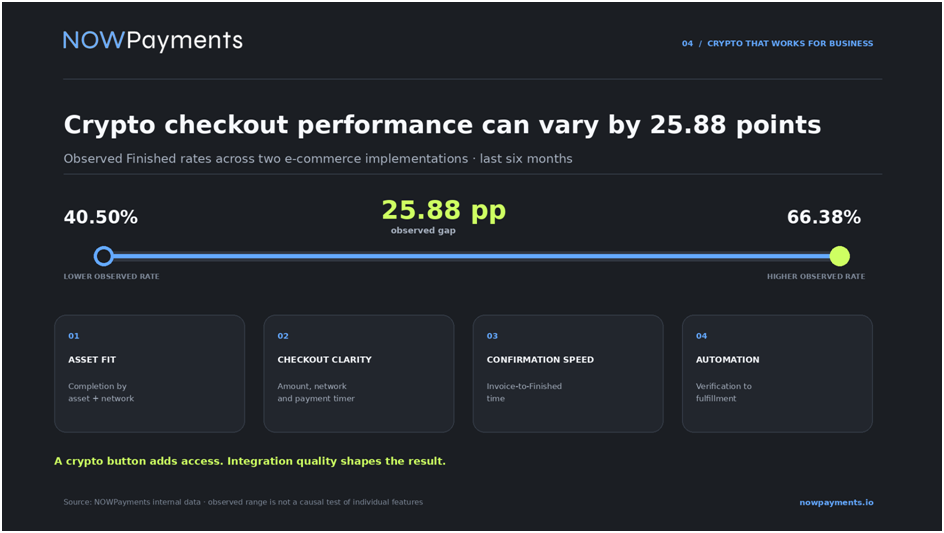
Across two e-commerce implementations in the same six-month dataset, Finished rates ranged from 40.50% to 66.38% – a gap of 25.88 percentage points.
I would not present this as a ranking. The businesses serve different audiences and operate different customer journeys, and the data does not isolate one feature as the cause. The useful finding is the size of the variation.
In my experience, merchants get better results when they answer four questions before launch:
- Are the right assets and networks available?
- Are the amount, network, and payment window clear?
- How quickly is the payment detected and confirmed?
- Can the gateway handle payment errors and trigger fulfillment automatically?
A crypto button creates another route to payment. The quality of the integration shapes how well that route converts.
Coverage Has to Match Actual Demand
Crypto is not one payment method. Customers choose an asset and a network based on what they hold, which wallet they use, and the fees they expect to pay.
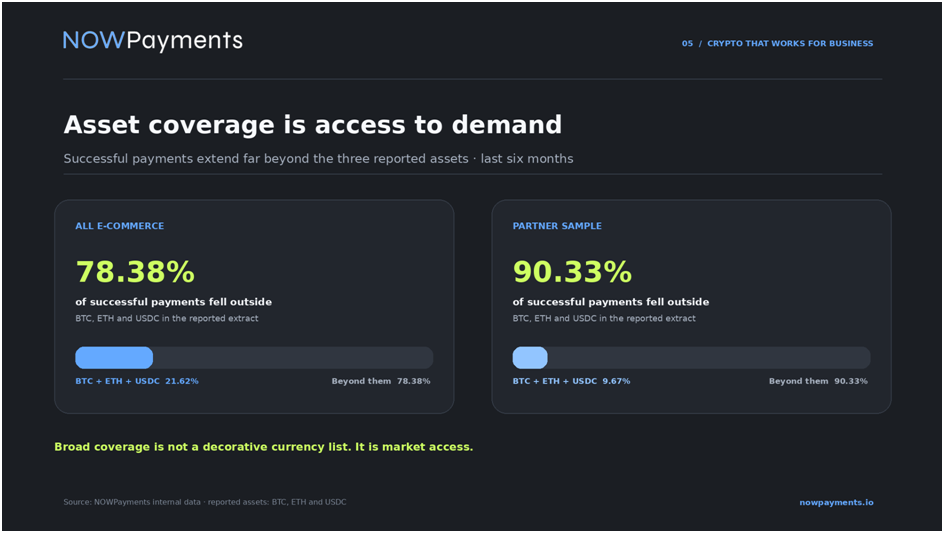
In NOWPayments’ e-commerce data, BTC accounted for 16.11% of successful payments, ETH for 3.88%, and USDC for 1.63%. Together, the three assets represented 21.62%.
In one partner sample, they represented only 9.67%: BTC accounted for 4.55%, ETH for 3.17%, and USDC for 1.95%. A currency mix that works for one merchant may therefore miss most of another merchant’s demand.
Demand also changes. A separate NOWPayments stablecoin analysis found that USDT accounted for 66.92% of stablecoin transaction volume in the first half of 2026. Meanwhile, USDC transaction count increased 209.02% year over year, while its volume rose 101.63%.
Merchants need broad underlying coverage without overwhelming customers at checkout.
CoinsBee reported greater payment flexibility and stronger conversion after expanding asset availability through NOWPayments. Genghis supports more than 300 cryptocurrencies across more than 98 networks and uses signed webhooks to connect payment confirmation with automatic delivery.
The longest currency list does not automatically win. The gateway must fit the merchant’s audience, product, and purchasing journey.
The Checkout Should Answer Before Support Does
More options help only when customers understand what to do next.
A crypto checkout should answer four questions immediately:
- Which asset and network should I use?
- How much should I send?
- How much time do I have to complete the payment?
- What happens after the payment is confirmed?
Unclear instructions and hidden timers create exit points. Delays after confirmation create another: the customer has paid, but the order still appears incomplete.
In my experience, a strong crypto checkout should feel uneventful. It presents clear instructions, detects the transaction quickly, and connects confirmation with the order flow.
Measure the Whole Payment Funnel
Crypto checkout should be measured as a conversion channel, not simply enabled as a technical feature.
The same five questions should guide the strategy from beginning to end:
- Find the leak: Where do customers leave – at payment selection, invoice creation, or payment completion?
- Offer relevant methods: Do the available payment options reflect real customer demand?
- Evaluate the implementation: How many created invoices reach Finished status, and how quickly?
- Know the audience: Which assets and networks produce completed payments for this specific merchant?
- Remove friction: Are the instructions clear, and does a confirmed payment move the order forward?
These metrics locate the leak. If customers select crypto but do not create an invoice, the entry point may be unclear. Frequent expirations may point to instructions, asset availability, network selection, or timing. Completed payments that do not trigger orders indicate a fulfillment problem.
The business case is no longer limited to whether an online store should accept crypto. The real question is whether the store can make crypto one of its most effective payment options.
Global brands have already moved crypto checkout beyond the experimental stage. Tesla accepts Dogecoin for eligible products in its online store, while Balenciaga has introduced crypto payments through its US e-commerce site. Within the NOWPayments ecosystem, CoinsBee and Genghis demonstrate how the right integration converts that demand into sales. Merchants that delay may be losing customers they have already paid to acquire.
To me, mass adoption begins when crypto produces measurable commercial results. NOWPayments’ data shows the opportunity: 63.81% of created e-commerce payments reached Finished status. The 40.50% to 66.38% range between implementations shows why choosing and configuring the right gateway matters.
Businesses can explore NOWPayments’ e-commerce payment infrastructure to evaluate crypto as part of their checkout funnel.
Next: Where Else Is Payment Friction Costing You Revenue?
Checkout is only one place where money gets stuck. Similar friction can appear wherever a business accepts, moves, or pays out funds.
If this article finds its audience, another edition of Crypto That Works for Business will examine another overlooked point in the payment journey – and what businesses can change to keep more revenue moving.
Where is payment infrastructure quietly costing your business money?
Methodology note: The 22% headline figure is a provider-reported result following a crypto-checkout redesign, not a guaranteed outcome. NOWPayments’ e-commerce data covers the last six months. “Finished” and “Expired” are invoice-level statuses and are not directly comparable with cart-abandonment metrics. Stablecoin figures come from a separate platform-wide analysis covering the first half of 2026. E-commerce asset figures cover BTC, ETH, and USDC only. Partner-level variation does not establish causation by any single checkout feature.
Recommended Articles


