




CoreWeave: Funding Pressure Behind Rapid Expansion
An appealing bullish narrative is taking shape in the market: Compared with Nebius (NBIS.US), CoreWeave boasts a larger revenue scale, a bigger order backlog, and more active compute online, yet its price-to-sales (P/S) valuation is far lower than Nebius's, suggesting it could be a leading AI-specialized cloud (Neocloud) player clearly mispriced by the market.
The revenue multiple reveals only half the truth. CRWV's "cheapness" is built entirely on its aggressive debt financing and capital structure. CoreWeave's core business model is effectively monetizing long-term customer contracts up front by pledging them, using extreme financial leverage to fuel capital expenditures and compute construction. However, after accounting for heavy hardware depreciation, the company's current operating profit falls severely short of covering interest expenses, while free cash flow continues to suffer massive cash burn.
We believe CoreWeave's valuation discount relative to Nebius is justified to some extent, reflecting its high leverage, customer concentration, and uncertainty over GPU asset value. Until post-depreciation profitability, interest coverage, and cash flow deficits show sustained improvement, we maintain a bearish stance on CRWV.
I. The Rise of Neoclouds: Why the AI Era Requires a New Kind of Cloud
The global cloud computing market continues to be dominated by hyperscalers such as AWS, Microsoft Azure, and Google Cloud. Traditional public clouds rely on general-purpose virtualization architectures to build comprehensive ecosystems covering databases, object storage, cybersecurity, and developer toolchains, designed to meet diverse corporate IT needs. However, the hardware and software stacks of traditional public clouds were not built for large-scale AI tasks requiring high-density orchestration across tens of thousands of GPUs.
The explosion of generative AI has fundamentally reshaped the demand structure of cloud computing. Large model training and inference require not only massive GPU allocations, but also extremely high rack power density, efficient liquid cooling, ultra-low-latency lossless network interconnects, and dedicated distributed cluster scheduling systems.
Against this backdrop, emerging AI-specialized clouds (Neoclouds), represented by CoreWeave, Nebius, and Lambda, have risen rapidly. Rather than replicating the vast and bloated general-purpose SaaS/PaaS ecosystems of traditional clouds, they focus capital and engineering capabilities squarely on AI compute infrastructure, positioning themselves as "vertical high-performance GPU providers" focused on delivering ultimate compute performance.
1. Core Advantages of Neoclouds
The advantages of Neoclouds are mainly reflected in three areas:
- Ultimate Delivery Speed: The capability to deliver high-end compute clusters at the scale of tens of thousands of GPUs at once, significantly reducing the time costs for customers to procure chips, build data centers, and debug networks on their own.
- Ultra-High Effective Utilization: Through high-speed networking, storage, and job scheduling optimizations, Neoclouds reduce GPU idle time, communication bottlenecks, and training failures, enhancing the effective utilization rate across the entire cluster.
- Lower Total Cost of Ownership (TCO): The training cost of an AI model depends on the total completion time and the hourly rate per compute unit. Even if a Neocloud's nominal GPU hourly rental rate is not the lowest in the market, if it can boost cluster effective utilization and shorten training cycles, the customer's total cost of ownership for the entire project remains significantly superior to that of traditional clouds.
2. Customer Base Profile: Who Is Purchasing Neocloud Compute, and How Long Will Demand Last?
Based on public disclosures and market observations, Neoclouds' core customer base is clearly divided into three main tiers:
- Hyperscalers and Big Tech Companies: Such as Microsoft and Meta. They have strong in-house build capabilities, but their power grid interconnection and data center construction pace may lag behind compute demand growth, leading them to use Neoclouds as an external capacity supplement.
- Frontier AI Labs and AI-Native Enterprises: Such as OpenAI and Anthropic. Model iteration speed determines product competitiveness; rather than waiting for in-house infrastructure to be built, they urgently need Neoclouds to rapidly deliver dedicated clusters comprising advanced GPUs, high-speed networking, and storage.
- Enterprise Customers and Quantitative Computing Firms: Covering enterprise clients such as Databricks and Grammarly, as well as high-frequency/quantitative hedge funds. These customers seek to integrate AI into their products or business operations, but generally have no need to build their own data centers or maintain large-scale GPU clusters, choosing instead to have Neoclouds provide and manage the underlying infrastructure.
These three demand drivers jointly support market expansion: Frontier models continue to scale up training, AI agents and real-time applications drive high-concurrency inference, and enterprises are beginning to deploy generative AI into real-world business operations. Meanwhile, long construction cycles for grid connection, transformers, and high-density data centers keep the supply of premium compute constrained in the short term. Data sovereignty and localization requirements will also propel the development of specialized and hybrid clouds.
Demand is not without a ceiling. Hyperscalers are accelerating the buildout of their own data centers and custom AI chips; model quantization, distillation, and inference optimizations may reduce the compute required per task; and increased GPU supply could erode Neoclouds' current scarcity premium. The long-term addressable market ultimately hinges on whether AI applications can generate sufficient revenue to support customers in continuously raising capital expenditures.
Therefore, Neoclouds are more likely to serve as a specialized complement to traditional public clouds rather than a full replacement. Their growth space stems from rising total AI compute demand and capacity shortfalls that traditional clouds cannot meet in a timely manner in the short term.
II. How CoreWeave Operates: The Financing Loop of Contracts, GPUs, and Debt
Founded in 2017, CoreWeave originally operated in cryptocurrency mining, accumulating early experience in GPU procurement and high-density compute equipment operations. As AI compute demand surged, the company gradually pivoted these capabilities toward cloud computing, launching the CoreWeave Cloud Platform in 2020.
CoreWeave is often summarized as a 'cloud company renting Nvidia GPUs,' but that description captures only the outer layer. What customers actually buy is not individual GPUs, but fully integrated compute clusters ready to run AI tasks directly. CoreWeave packages GPUs, power, liquid cooling, high-speed networking, and storage together, making them easier to use via Kubernetes, Slurm, monitoring, and inference services. Customers bring their models and workloads, while the company keeps the chips, facilities, and software running continuously, charging based on committed capacity or actual usage.
1. How Long-Term Orders Support Financing and Expansion
CoreWeave's revenue primarily derives from long-term committed contracts. These contracts typically employ a take-or-pay structure: as long as the company delivers compute as agreed, the customer must pay the agreed amount rather than paying strictly based on actual usage.
In 2Q26, committed contracts contributed 98% of revenue. As of year-end 2025, prepayments on active contracts accounted for approximately 15%–25% of total contract value on a weighted-average basis. Long-term contracts enhance revenue visibility, and prepayments cover a portion of upfront investments; however, GPUs and data centers must be deployed before revenue can be recognized, requiring the company to bridge the funding gap through external financing.
The overall project financing flywheel works as follows:
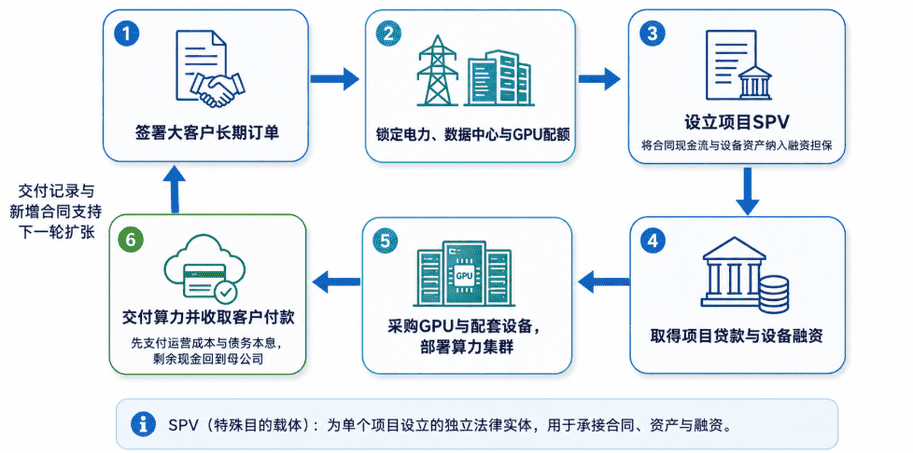
To secure construction capital, CoreWeave typically establishes a project SPV—an independent entity set up specifically to hold the project's contracts, assets, and financing. Customer contracts provide future cash flows, while assets such as GPUs, servers, accounts receivable, and restricted cash serve as collateral support, with lenders concurrently evaluating customer credit, contract terms, and asset values.
Once a project goes online, customer payments are typically first used to cover operating costs and debt principal and interest, with remaining cash flowing back to CoreWeave. This model resembles infrastructure project finance rather than the asset-light growth of a software company: the advantage is that debt repayment schedules can be closely matched with contract terms, leveraging the credit of mega-cap clients to reduce financing costs; the risk is that not all debt is completely ring-fenced from the parent company, as CoreWeave may still provide guarantees and remain subject to debt covenants.
Financing Facility | Size & Purpose | Pricing & Credit Characteristics |
DDTL 3.0 | $2.6 billion, to support equipment required for OpenAI long-term contract | SOFR + 4%, maturing in 2030 |
DDTL 4.0 | Initial borrowing capacity of $7.5 billion, up to $8.5 billion after asset stabilization | Floating portion at SOFR + 2.25%, fixed portion at ~5.9%; financing facility rated A3/A(low) |
DDTL 5.5 | $2.6 billion, executed after 2Q26; company has drawn down $1.2 billion | SOFR + 5.5%, maturing in September 2031 |
Note: The investment-grade rating for DDTL 4.0 applies to the specific financing facility and does not represent an investment-grade rating for the CoreWeave parent entity as a whole. DDTL stands for Delayed Draw Term Loan, allowing the company to draw down funds in tranches as project construction progresses; SOFR is the standard benchmark rate for US dollar floating-rate loans, where 'SOFR + 4%' indicates a margin of 4 percentage points above the benchmark rate.
DDTL 4.0 demonstrates that high-quality customer contracts can lower financing costs for specific projects, but the pricing on DDTL 5.5 shows that new capital is not continuously getting cheaper. This model enables rapid expansion when customers fulfill their contracts, projects go online on schedule, and GPU values remain stable; if any link deteriorates, pressure quickly transmits across revenue, asset values, and financing capacity simultaneously.
2. Nvidia: The Largest Moat, and Also a Risk Amplifier
Nvidia plays three concurrent roles in CoreWeave's business: GPU supplier, shareholder, and backstop for a portion of unused capacity. Currently, all of the company's GPUs are sourced from Nvidia; in January 2026, Nvidia invested an additional $2 billion. The two parties also entered into a capacity agreement with an initial value of $6.3 billion: if designated capacity is not utilized by other customers, Nvidia will purchase the remaining compute provided delivery conditions are met.
This relationship helps CoreWeave secure capital and cutting-edge chips while providing a demand buffer for a portion of unsold capacity. However, these protections are not fully independent: CoreWeave's compute supply relies on Nvidia; the rental rates and collateral values of older GPUs are vulnerable to Nvidia's product iteration cycle; and the $6.3 billion capacity agreement covers only a subset of remaining capacity under specific conditions. Should GPU rental rates decline or Nvidia adjust its partnership strategy, CoreWeave's revenue, asset values, and financing conditions could come under pressure simultaneously. Thus, Nvidia is both CoreWeave's most crucial competitive advantage and the source of its single-supplier and asset-concentration risks.
III. Understanding CoreWeave's Four Most Important Metrics
CoreWeave's revenue and order backlog are growing rapidly, but for an asset-heavy company like this, demand alone does not directly generate shareholder returns. An order must sequentially transform into deliverable capacity, revenue, and post-depreciation profit, ultimately leaving residual cash after debt service:
Do customers genuinely need compute? (Revenue Backlog) → Can the company deliver on time? (Active Power vs. Contracted Power) → Do invested assets generate profits? (Asset Turnover & Post-Depreciation Profit) → How much value remains for shareholders after financing? (CapEx, Debt & Interest)
These four sets of metrics evaluate demand, delivery, asset returns, and debt capacity, respectively, covering the complete chain from order signing to shareholder value creation. If any link breaks, high growth may yield only greater capital needs rather than higher per-share returns. We place capital expenditure and debt first because this is precisely where CoreWeave's current risks are most concentrated.
1. CapEx, Debt, and Interest: Is the Cash Generated Enough to Cover Interest?
This is the most critical set of metrics for understanding CoreWeave's valuation discount and serves as the core of our bearish thesis.
As of 2Q26, CoreWeave bears heavy financial obligations:
- Heavy Debt and Lease Obligations: The company's principal debt stands at a staggering $35.6 billion. Subtracting cash and cash equivalents yields a self-calculated net debt of $30.1 billion (equivalent to 2.3x expected FY26 revenue). Adding $16.3 billion in operating lease liabilities brings total net financial obligations to $46.4 billion (equivalent to 3.6x full-year revenue).
- Operating Cash Flow Falls Far Short of Capital Outlays: 1H26 operating cash flow reached only $3.66 billion, whereas capital expenditures soared to $14.12 billion, resulting in a self-calculated simplified free cash flow (FCF) deficit of -$10.45 billion. The midpoint of FY26 full-year CapEx guidance ($37.0 billion) represents 2.9x the midpoint of revenue guidance.
- Operating Profit Fails to Cover Interest Expenses: In 2Q26, the company's Adjusted Operating Income was just $128 million, compared with net interest expense of $640 million (with 3Q26 interest guidance surging further to $860–$940 million).
CoreWeave's current operating profit falls far short of even paying its interest. Scaling compute requires the company to invest upfront in vast quantities of GPUs, data centers, and power facilities. With operating cash flow unable to self-sustain, the company relies heavily on new debt, customer prepayments, and equity refinancings. If financing costs rise or GPU collateral values come under pressure, continuously rising interest expenses will further erode cash flow, triggering a negative feedback loop.
2. Asset Turnover and Post-Depreciation Profit: How Profitable Are Assets After GPU Depreciation?
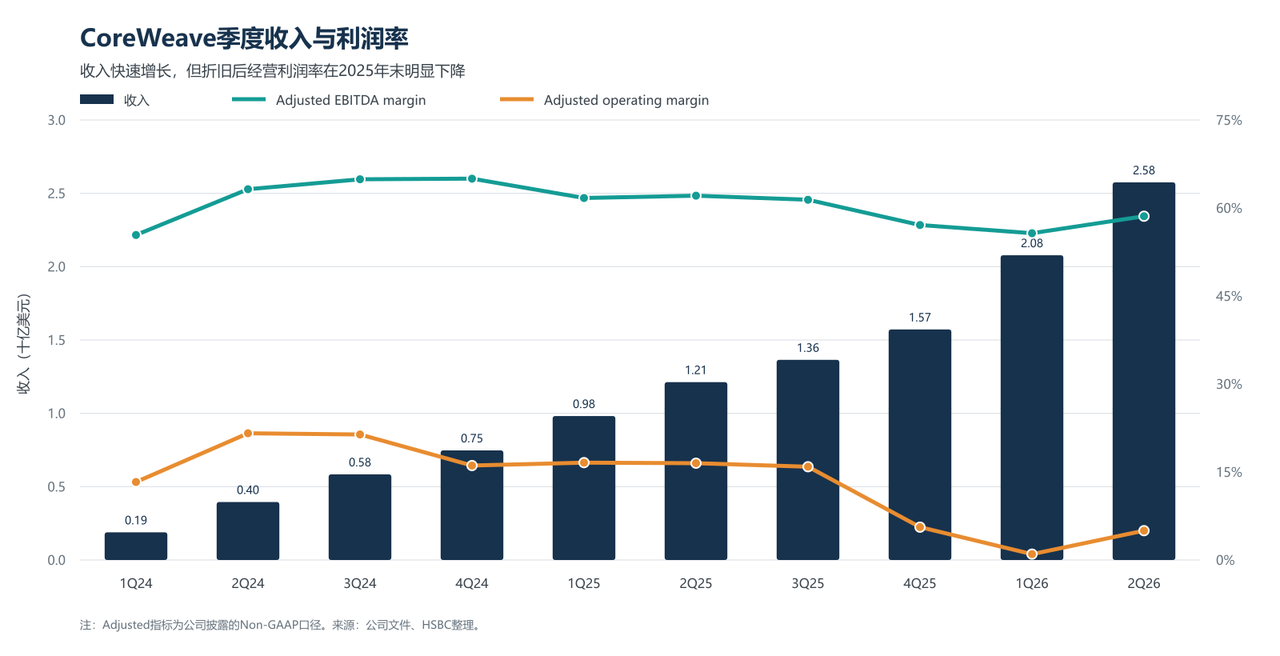
CoreWeave's Adjusted EBITDA Margin of nearly 60% appears impressive on the surface, but its true operating profitability must be re-evaluated after accounting for heavy hardware depreciation.
- Limited Asset Turnover Efficiency: HSBC estimates that 2Q26 annualized revenue represents ~0.29x average gross PP&E (excluding construction in progress); including operating lease right-of-use assets lowers this ratio to ~0.21x. Its long-term model assumes asset turnover improves to 0.33x, implying that every $100 of operational fixed assets generates ~$33 in annual revenue.
- Depreciation Consumes a Large Portion of Revenue: CoreWeave currently uses a six-year accounting depreciation period for technical equipment; in comparison, Nebius previously used four years and extended it to five years starting in 2026, which is still shorter than CoreWeave's. Under a simplified assumption that the aforementioned $100 consists entirely of technical equipment depreciated straight-line over six years, annual depreciation is ~$16.70, representing ~51% of the $33 in revenue; remaining revenue must cover power, data center operations, staffing, and other expenses.
- Stark Contrast Between EBITDA and Operating Margin: After deducting depreciation, 2Q26 Adjusted Operating Margin drops to ~5%, revealing that its true operating profitability is relatively thin.
The real risk is not merely high depreciation expenses, but the possibility that the economic value of GPUs declines faster than the six-year accounting depreciation schedule. If rental rates for older GPUs drop, revenue and collateral values will face simultaneous pressure, whereas debt costs will not decrease accordingly. Only when existing assets can continuously drive revenue growth without a proportional increase in CapEx—allowing post-depreciation profit to cover interest—will our current bearish thesis be weakened.
3. Active Power vs. Contracted Power: How Much Secured Power Is Actually Online?
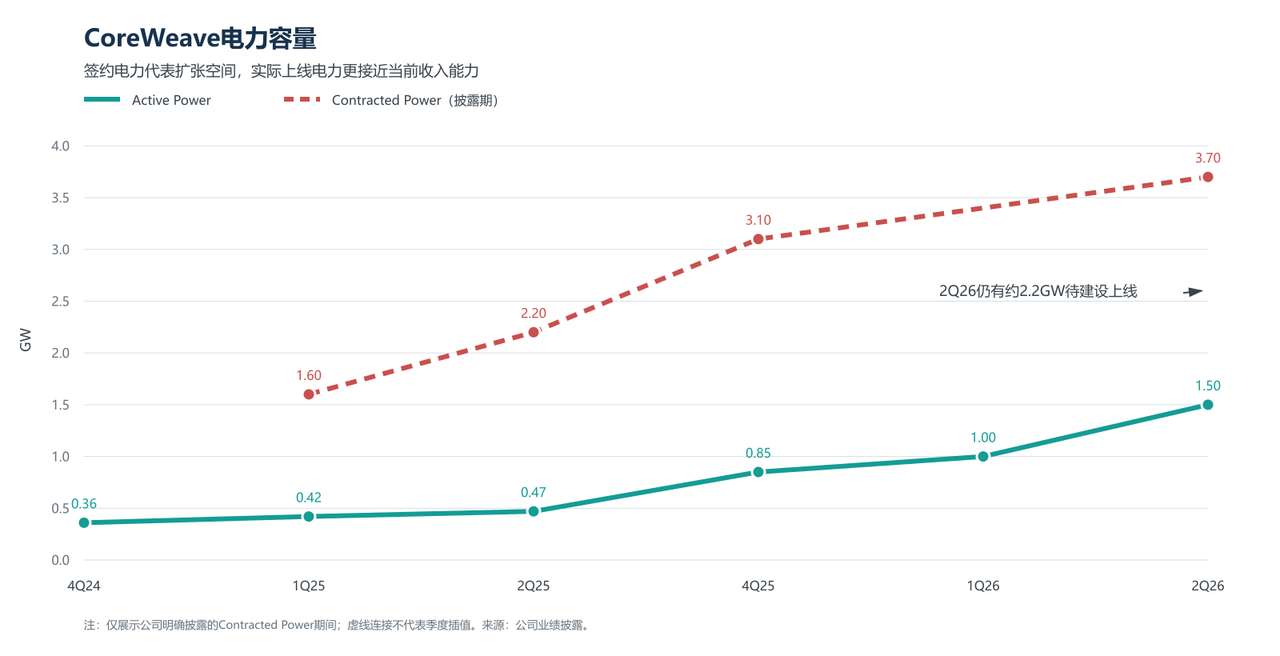
- Contracted Power refers to forward capacity already secured through power, land, or data center agreements.
- Active Power refers to capacity that is online and ready to support GPU workloads.
- Active Power grew from ~0.36 GW at year-end 2024 to 1.5 GW in 2Q26, while 2Q26 Contracted Power reached 3.7 GW.
- Currently, about 41% of contracted power is online, leaving a gap of approximately 2.2 GW between the two.
Contracted Power of 3.7 GW represents future expansion space, but 1.5 GW of Active Power is much closer to current deliverable capacity. The 2.2 GW gap between the two represents both potential growth and unfinished data center construction, GPU procurement, and financing obligations.
4. Revenue Backlog: How Fast Will the $104 Billion Backlog Convert into Revenue?
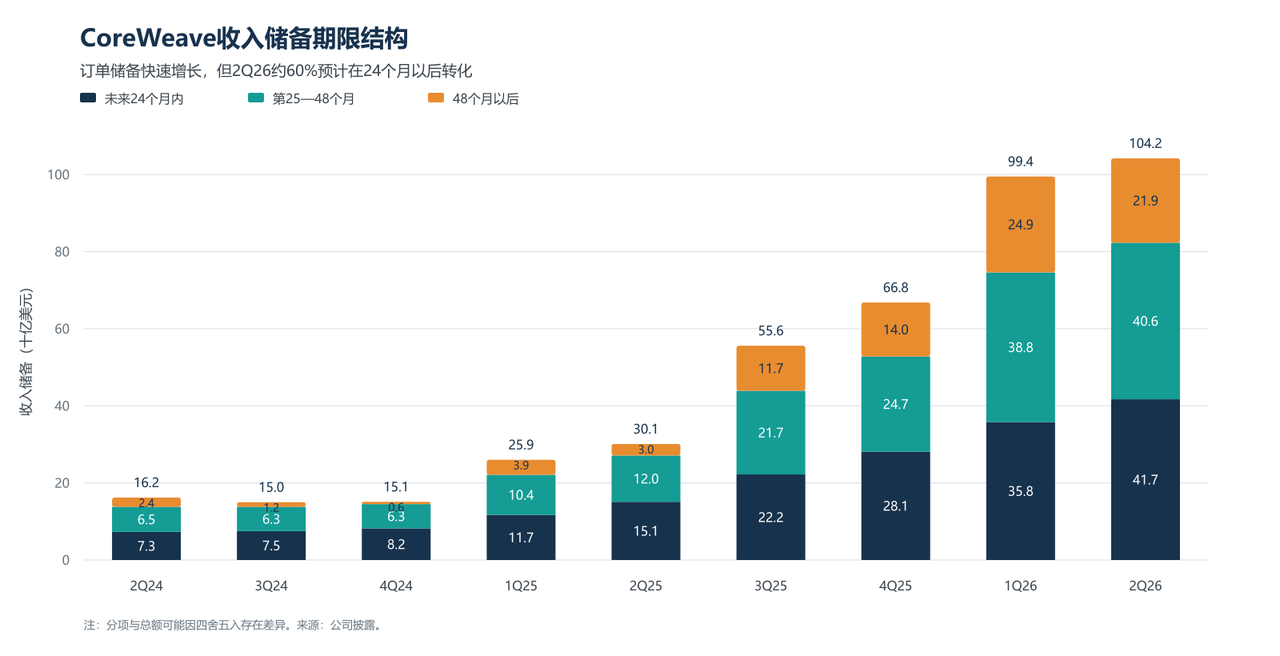
Revenue Backlog is the company's stated reserve of future contractual revenue; Revenue Backlog expanded from $25.9 billion in 1Q25 to ~$104.2 billion in 2Q26, reflecting rapid growth in customer demand. Based on the company's disclosed contract revenue recognition schedule, 41% is expected to be recognized over the next 24 months, 39% in months 25–48, and the remaining 20% in months 49–78.
Under a high-CapEx, high-leverage structure, this $104 billion backlog leaves very little margin for error. Roughly 59% of contract revenue will not be recognized until after two years, whereas GPU, data center, and power outlays must occur upfront, while debt continuously accrues interest. If projects are delayed, revenue and cash collection slide backward, but CapEx and interest pressures do not disappear in tandem, potentially widening the company's funding deficit. Thus, a massive backlog provides strong revenue visibility while simultaneously imposing construction and financing liabilities that must be executed on schedule.
IV. CoreWeave vs. Nebius: Different Growth Trajectories, Different Risk Pricing
Both CoreWeave and Nebius are building full-stack AI clouds, but they differ in customer go-to-market strategies, asset accounting policies, and financing structures. Comparing these differences explains the valuation gap between the two.
- Customers and Business Model: CoreWeave takes a top-down path, relying first on large customer orders from Microsoft, OpenAI, and Meta before expanding to broader enterprise clients. Nebius enters via AI-native companies, developers, and enterprise clients, accumulating customers through multi-tenant full-stack cloud, pay-as-you-go, and reserved capacity before supplying dedicated capacity to mega-cap clients like Microsoft—a route akin to "encircling the cities from the countryside."
- Scale and Growth: In 2Q26, CoreWeave generated $2.575 billion in revenue, up 112% year-over-year; Nebius Group recorded $582 million in revenue, up 454% year-over-year. CoreWeave is larger in scale, whereas Nebius is still in an earlier stage, with its high growth rate benefiting from a lower base.
- Depreciation Policy: CoreWeave depreciates technical equipment over six years. Nebius previously used four years and extended it to five years starting in 1Q26, remaining one year more conservative than CoreWeave.
- Financing Structure: CoreWeave relies on customer contracts and asset-backed project loans, while carrying corporate bonds, convertible debt, and substantial lease liabilities. Nebius held ~$8 billion in cash at the end of 2Q26, with debt consisting mainly of convertibles, leaving its cash interest and refinancing pressures relatively low and its profile currently more resilient.
- Valuation: As of September 1, 2026, CoreWeave and Nebius had market caps of ~$45.1 billion and $54.7 billion, respectively, against TTM revenues of $7.59 billion and $1.36 billion. CoreWeave traded at ~5.9x market cap/TTM revenue and ~9.9x standard EV/TTM revenue; Nebius traded at ~40x and 41x. CRWV is indeed cheaper, but its discount reflects higher leverage, lease commitments, and weaker post-depreciation earnings; NBIS's premium reflects faster growth and a stronger balance sheet, but also entails greater valuation drawdown risk.
V. CoreWeave's Biggest Risks
If Capital Markets Tighten, the Expansion Flywheel Could Reverse: GPU and data center spending occurs before revenue recognition, obligating CoreWeave to maintain continuous access to bond, loan, convertible, and equity markets. Should AI CapEx slow, or long-term interest rates and credit spreads widen, new orders, GPU rental rates, collateral values, and financing terms could deteriorate simultaneously, forcing the company to accept higher interest rates, delay construction, or issue additional shares.
Growth Remains Dependent on a Few Customers and a Single GPU Vendor: In 2Q26, the top three customers generated 72% of revenue, with ~93% of incremental revenue coming from existing customer expansions. Customers like Microsoft and Meta can build their own data centers and possess strong bargaining power; while existing take-or-pay contracts provide some protection, if key clients fail to renew or reduce new orders upon expiration, CoreWeave will need to find replacement demand. GPUs can be re-leased, but the cluster size, location, and network setup required by new clients may not match, and reconfiguring and re-tenanting take time, potentially causing interim idle capacity or discounted rentals. Upstream concentration is equally severe: all current GPUs are sourced from Nvidia, which also acts as shareholder, technology partner, and backstop for remaining capacity, making chip supply, financing access, and demand sources highly correlated.
Six-Year Depreciation May Overstate the Economic Life of GPUs: CoreWeave depreciates technical equipment over six years, but the real issue is the price at which older hardware can be leased over time. If next-generation chips rapidly drive down compute costs per unit, rental rates for older GPUs could fall faster than book value, dragging down asset turnover and post-depreciation profit margins while weakening loan collateral value, potentially triggering asset impairments and higher refinancing costs.
Pending Capacity Creates Delivery and Financing Risks: The ~2.2 GW gap between 2Q26 Active Power and Contracted Power represents both growth reserves and unfinished construction obligations. If grid interconnection, transformers, liquid cooling, GPU delivery, or construction experience delays at any stage, the company incurs equipment outlays and interest first without recognizing scheduled revenue. Therefore, backlog, GPU assets, and financing capacity are not three independent layers of protection, but mutually depend on projects being delivered on schedule.
VI. Investment View: Rapid Growth, but Shareholder Returns Remain Unproven
Research Stance: Bearish; prefer to stay on the sidelines at present stage.
Why We Hold a Bearish View
- Revenue and backlog are growing rapidly, but every round of expansion requires upfront CapEx and new financing;
- Post-depreciation operating profit cannot yet cover interest, and organic cash flow is unable to support the current pace of construction;
- Customer concentration, the Nvidia relationship, GPU asset values, and financing conditions are highly correlated; deterioration in any single link could ripple across the others.
What Would Invalidate the Bearish Thesis
If AI demand remains robust and new clusters come online on schedule with steady utilization, revenue growth could outpace subsequent capital investments, driving improvements in asset turnover and post-depreciation profit margins. If financing costs fall and rental rates for older GPUs prove firmer than expected, pressures on interest expense and asset values would also ease. Such developments could drive earnings improvements and valuation re-ratings, serving as key conditions to continuously monitor against our bearish stance.
CoreWeave is not an uncompetitive company, but rather an AI infrastructure investment backed by long-term contracts and fueled by high leverage. CRWV's discount relative to NBIS is genuine, but until post-depreciation profit, interest coverage, and free cash flow are validated, this discount reflects risk pricing rather than a clear undervaluation.
The above content is compiled based on public information and third-party research reports. The self-calculated metrics and judgements herein may be influenced by accounting standards, valuation timing, and forward-looking assumptions, and do not constitute investment advice tailored to any specific investor.
Recommended Articles


