




Better Stock: Lucid vs. Rivian (Hint: It's All About Shareholder Dilution)
Key Points
While Rivian and Lucid have much in common, there are a few factors that separate the two.
Rivian's traditional IPO gave it a large cash cushion compared with Lucid which undertook a SPAC merger.
Rivian has diluted shareholders far less than Lucid, and is positioned to continue that trend.
- 10 stocks we like better than Rivian Automotive ›
The U.S. transition to electric vehicles (EVs) hasn't been a smooth ride thus far. Following the end of the federal $7,500 EV tax credit and a weakening of fuel economy regulations, young EV makers have had a tough time generating as much demand as anticipated only a few years ago.
That said, the transition will go on, and will eventually accelerate, and that leaves investors who want to buy into this EV future a few options.
Missed Nvidia in 2009? This Rare Signal Is Flashing Again. In 2009, a "Double Down" signal flashed for a little-known chipmaker called Nvidia. For the first time in years, that same "Total Conviction" signal is flashing for a company 1/100th the size of Nvidia. Continue »
On the riskier end of the scale, investors might be comparing Rivian Automotive (NASDAQ: RIVN) and Lucid Group (NASDAQ: LCID). Here's one major factor to remember: shareholder dilution.
Why dilution matters
It's worth repeating, though most investors are aware: Shareholder dilution is simply the aftermath of when a company creates new shares of a stock for capital; as the pool of shares grows larger, an individual's stake gets less valuable. This is hugely important for investors buying into young companies that are capital-intensive, as they could need multiple capital raises that could be dilutive. That's one of the biggest differences between Lucid and Rivian right now, and it's more important than ever.
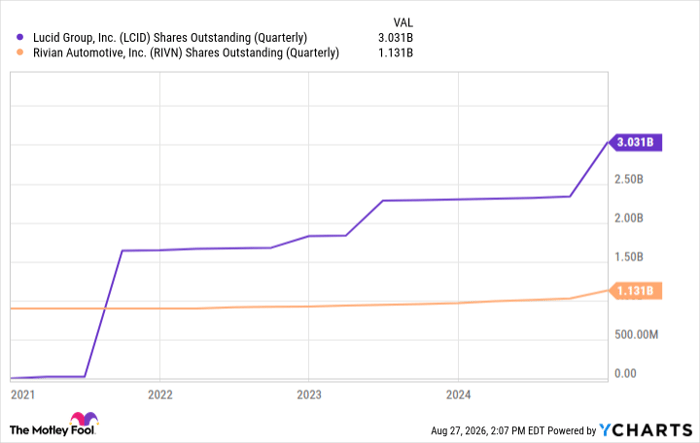
LCID Shares Outstanding (Quarterly) data by YCharts
Let's start from the beginning, because it matters. Rivian chose a standard initial public offering (IPO), and the timing was nearly perfect. The market was giving massive valuations, and Rivian sold 153 million shares at $78 per share, raising nearly $14 billion (after underwriters fully exercised their options) in one of the largest debuts in 2021.
That gave Rivian a large cash cushion to fund investments and expenditures without needing to raise additional capital nearly as soon as Lucid, which chose to go public through a special purpose acquisition company (SPAC) merger. While Lucid received a solid valuation initially, it received a much smaller cash infusion of only about $4.4 billion.
Lucid ended the second quarter of 2026 with $3 billion in total liquidity, but its cash and cash equivalents were a lesser $732 million. Management expects that liquidity to last well into 2027, but already, analysts are predicting capital raises will be necessary and could be very shareholder dilutive. Lucid is working to curb its cash burn and is aiming to generate $1.4 billion in cash-flow improvements, but even that is likely just buying time until the next selling of shares or infusion from Saudi Arabia's Public Investment Fund, which already owns a massive chunk of the young EV maker.
Rivian, on the flip side, actually has better liquidity than it appears. Rivian ended the second quarter with $5.3 billion in cash and cash equivalents, but including its credit facility, its total liquidity reached about $5.8 billion. Following the second quarter, Rivian announced one of its rare capital raises and added about $1.3 billion in net proceeds, lifting its liquidity to almost $7.2 billion.
But wait, there's more. Thanks to Rivian's partnership with Volkswagen, the former expects a non-recourse loan capital and milestone investments to add another $1.4 billion, and Uber Technologies is expected to invest another $250 million in 2026 and over $700 million in subsequent years.
Lastly, Rivian's $4.5 billion Department of Energy loan is earmarked to help fund the company's second manufacturing plant in Georgia. All in all, investors have transparency of about $14 billion in Rivian's expected liquidity. That is a vastly superior position compared to Lucid, and gives investors confidence that there will be less shareholder dilution in the near term.

Rivian R2. Image source: Rivian.
What it all means
Lucid makes some of the world's most advanced EVs, and will continue to do so. However, Lucid has also been troubled with recalls, production hiccups, delays, and supplier issues, and has struggled to scale fast enough to lower overhead and reduce costs. Those issues have hindered Lucid's ability to improve its gross margin consistently, as rival Rivian has already done.
Investors comparing these two young EV makers must remember shareholder dilution, because $1 invested in Rivian right now is far more likely to hold its value going forward. Lucid investors likely can't say the same.
Should you buy stock in Rivian Automotive right now?
Before you buy stock in Rivian Automotive, consider this:
The Motley Fool Stock Advisor analyst team just identified what they believe are the 10 best stocks for investors to buy now… and Rivian Automotive wasn’t one of them. The 10 stocks that made the cut could produce monster returns in the coming years.
Consider when Netflix made this list on December 17, 2004... if you invested $1,000 at the time of our recommendation, you’d have $446,157!* Or when Nvidia made this list on April 15, 2005... if you invested $1,000 at the time of our recommendation, you’d have $1,377,357!*
Now, it’s worth noting Stock Advisor’s total average return is 984% — a market-crushing outperformance compared to 212% for the S&P 500. Don't miss the latest top 10 list, available with Stock Advisor, and join an investing community built by individual investors for individual investors.
See the 10 stocks »
*Stock Advisor returns as of September 3, 2026.
Daniel Miller has no position in any of the stocks mentioned. The Motley Fool recommends Uber Technologies. The Motley Fool has a disclosure policy.
Recommended Articles


