




If the September Effect Hits Artificial Intelligence (AI) Stocks This Year, History Says This Is the Best Place to Hide
Key Points
Between 1928 and 2025, the S&P 500 has dropped by an average of 1.1% during the month of September.
Unusually high concentration among megacap artificial intelligence (AI) stocks could fuel a larger drop in the stock market as institutions trim their winners.
After selling in September, smart money usually redeploys capital into low-risk assets such as certain blue chip stocks, bonds, and gold.
- 10 stocks we like better than S&P 500 Index ›
Calendar dates are not supposed to matter in efficient markets. Stock prices should reflect a company's cash flows, as well as sentiment toward macroeconomic variables such as interest rates. The fact that Labor Day is right around the corner shouldn't matter. Yet for nearly a century, one month has exhibited a noticeably different pattern from the rest of the year.
September is the only month in which the S&P 500 (SNPINDEX: ^GSPC) has posted a negative long-run average return, down roughly 1.1% between 1928 and 2025. While there is no single reason for September's historical weakness, much of the declines are attributed to portfolio managers returning from summer vacations and rebalancing their portfolios. This means liquidity that had thinned out during July and August has to absorb new selling pressure.
Missed Nvidia in 2009? This Rare Signal Is Flashing Again. In 2009, a "Double Down" signal flashed for a little-known chipmaker called Nvidia. For the first time in years, that same "Total Conviction" signal is flashing for a company 1/100th the size of Nvidia. Continue »
Investors should care because the September Effect is influential enough to manifest in even the most crowded growth trades. Let's explore what that could mean for artificial intelligence (AI) stocks.

Image source: Getty Images.
What is the September Effect, and why does it matter?
One practical reason to notice patterns around September is concentration risk. When a handful of richly valued growth stocks dominate the S&P 500, a seasonally weak month can turn into a harsher de-risking event rather than a gentle period of digestion. That is the setting in which AI stocks now sit. More specifically, the largest AI companies, known as the "Magnificent Seven" -- Nvidia, Apple, Alphabet, Microsoft, Amazon, Tesla, and Meta Platforms -- now make up nearly 34% of the S&P 500's value.
Since OpenAI commercially launched ChatGPT and ignited the firestorm in AI stocks in November 2022, three Septembers have passed. Spoiler alert: They did not tell a unified story.
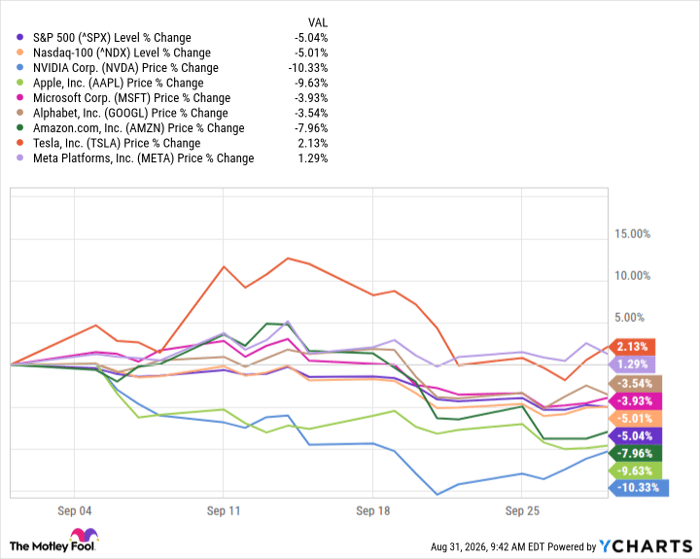
^SPX data by YCharts
In September 2023, both the S&P 500 and Nasdaq-100 indexes fell roughly 5%. While the performance of the Magnificent Seven was widely distributed, Nvidia, which is the clearest proxy for the AI revolution, dropped the most at 10%. The following two Septembers looked quite different. In 2024, the S&P 500 and Nasdaq-100 each rose around 2%. Meanwhile, in 2025, the S&P 500 gained 3.5% while the Nasdaq-100 advanced 5.4%.
While the September Effect did not vanish, it hasn't necessarily been a reliable wrecking ball for the AI boom. This mixed record over the last few years is an important detail to understand. AI companies are still growth stocks with high duration. This means these stocks can fall further and faster than average, even if the overall September anomaly is modest. This vulnerability was on display in 2023.
However, both 2024 and 2025 demonstrated that a supportive interest-rate environment, continued capital expenditures (capex), and compounding earnings can outweigh seasonality. While the last three years are not a large sample size, it can still serve as a reminder that the AI trade is not immune to the same September pressures that have long hit high-beta growth stocks.
Where should investors look beyond tech stocks in the month of September?
The best places to store capital during weaker periods are not mysterious. When investors rotate out of growth, they usually seek out mundane assets such as gold, short-duration Treasuries, and traditional defensive stock groups -- utilities, consumer staples, and parts of healthcare. According to research from Dorsey Wright, gold generated positive returns 58% of the time in September since 1987.
The reason is simple: These asset classes do not need a narrative about the next generative model release and tend to be less vulnerable when narratives around geopolitics or monetary policy change. When institutional investors trim winners and harvest losses, they tend to sell the assets that have rallied the most and are most liquid. That description perfectly fits megacap AI stocks after a multiyear run. Defensive cash-flow stocks, gold, and high-quality bonds are where capital gets deployed when the same sellers want to stay invested without adding unnecessary risk.
The investment takeaway here is pretty unglamorous. I would not liquidate a long-term AI or technology allocation simply because the calendar turned to September. Instead, I'd treat the month as a stress test of position size. In other words, if a small handful of semiconductor and platform stocks now dominate your portfolio in the way they dominate the S&P 500, a modest trim into momentum, paired with a balance in safe-haven assets, is a way to respect the historical odds without pretending to time the market.
At the end of the day, rebalancing your portfolio after a strong August is precisely the behavior that creates the September Effect in the first place. Doing it deliberately, rather than having it done to you, can make all the difference.
Should you buy stock in S&P 500 Index right now?
Before you buy stock in S&P 500 Index, consider this:
The Motley Fool Stock Advisor analyst team just identified what they believe are the 10 best stocks for investors to buy now… and S&P 500 Index wasn’t one of them. The 10 stocks that made the cut could produce monster returns in the coming years.
Consider when Netflix made this list on December 17, 2004... if you invested $1,000 at the time of our recommendation, you’d have $437,097!* Or when Nvidia made this list on April 15, 2005... if you invested $1,000 at the time of our recommendation, you’d have $1,355,077!*
Now, it’s worth noting Stock Advisor’s total average return is 978% — a market-crushing outperformance compared to 213% for the S&P 500. Don't miss the latest top 10 list, available with Stock Advisor, and join an investing community built by individual investors for individual investors.
See the 10 stocks »
*Stock Advisor returns as of September 1, 2026.
Adam Spatacco has positions in Alphabet, Amazon, Microsoft, Nvidia, and Tesla. The Motley Fool has positions in and recommends Alphabet, Amazon, Apple, Meta Platforms, Microsoft, Nvidia, and Tesla. The Motley Fool has a disclosure policy.
Recommended Articles


