




Palantir Billionaire Peter Thiel Just Bought This Magnificent Artificial Intelligence (AI) Stock Up 347,260% Since Its IPO
Key Points
Peter Thiel is a serial entrepreneur and venture capitalist who has made billions in the technology industry.
Today, Thiel manages capital through his own hedge fund.
Thiel is known as a contrarian who enjoys investing in monopoly businesses.
- These 10 stocks could mint the next wave of millionaires ›
Peter Thiel gained early fame for being a co-founder of PayPal alongside Elon Musk. After selling that company to eBay, Thiel used his newfound fortune to become a venture capitalist. One of his earliest multibaggers came from investing in Facebook (now Meta Platforms) in 2004. Thiel later co-founded Palantir Technologies, the data analytics firm that has become a cornerstone of government and enterprise intelligence work.
Today, the serial entrepreneur manages capital through a hedge fund called Thiel Macro. According to the fund's latest 13F disclosure, in the second quarter, it opened a new stake in Amazon (NASDAQ: AMZN) -- acquiring 495,000 shares valued at roughly $118 million. This represents about 28% of the hedge fund's portfolio. This suggests that despite the stock already having a generational rise behind it -- with a 347,260% return since its IPO in 1997 -- Thiel still sees upside in Amazon.
Missed Nvidia in 2009? This Rare Signal Is Flashing Again. In 2009, a "Double Down" signal flashed for a little-known chipmaker called Nvidia. For the first time in years, that same "Total Conviction" signal is flashing for a company 1/100th the size of Nvidia. Continue »
That purchase raises an interesting question, though. Why would a contrarian thinker who is famous for seeking out monopolies suddenly invest in a company that faces intense competition on every front?
Image source: Amazon.
Thiel has a preference for monopolies, but Amazon faces stiff competition
Thiel has long argued that "competition is for losers." In his view, lasting value accrues to companies that can escape competition and establish durable monopolies through proprietary technology, network effects, economies of scale, or brand moats. Amazon fails this test across all of its major businesses.
In e-commerce, the company competes with Walmart's massive physical and expanding digital footprint in the United States, among other rivals. Meanwhile, Amazon remains virtually absent from the Chinese market, which is primarily dominated by local players. In cloud computing, Amazon Web Services (AWS) still leads in market share, but it is contending daily with Microsoft Azure and Google Cloud Platform, both of which are gaining ground.
The digital advertising space pits Amazon against the entrenched duopoly of Meta and Alphabet, while its Prime streaming service faces Netflix, Disney, and a crowded field of ancillary providers. Far from enjoying monopoly rents, Amazon operates in saturated markets where customers can switch providers, and rivals can undercut it on pricing at the flip of a switch.
What might Thiel see in Amazon?
Given that Amazon is not a monopoly and its aggressive capital spending on artificial intelligence (AI) has driven free cash flow into the negative, what might appeal to him about the tech giant as an investment is not immediately clear. What Thiel might be looking at is Amazon's infrastructure scale, which is giving it a more subtle competitive advantage.
AWS is the world's largest cloud platform and generates the bulk of Amazon's operating profits. After years of uninspiring growth, AWS' revenue gains are accelerating again as generative AI workloads surge. At the same time, AWS is designing a full-stack AI ecosystem featuring its custom Trainium, Inferentia, and Graviton chips, and expanding its suite of managed services. In addition, the company's large equity stake in Anthropic gives Amazon lucrative exposure to one of the world's frontier large language models (LLMs) in a way that doesn't require it to bear the full research risk alone.
It might be that Thiel is betting that Amazon's ability to supply the entire AI stack -- compute, storage, networking, specialized silicon, and model hosting -- will create compounding advantages that pure-play software or chip designers and manufacturers cannot match at scale. When viewed through this lens, the current pressures on its free cash flow can be seen as just the temporary price of locking in this strategic position while demand still exceeds supply.
Is Amazon stock a good buy?
Amazon is a tough stock to value. The lumpiness of its e-commerce business, combined with emerging services on so many other fronts, makes the company's net income quite unpredictable. For this reason, I personally do not love using the price-to-earnings (P/E) ratio to gauge the value of Amazon stock.
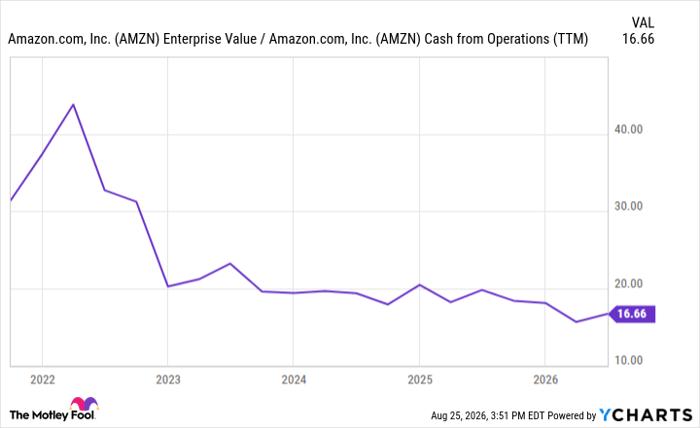
Instead, I prefer to look at the company on an enterprise-value-to-operating cash flow basis. Currently, Amazon's EV-to-OCF of 16.7 is near its lowest level since the start of the AI revolution. It's also notably under Amazon's P/E ratio of 21.
Fundamental Chart data by YCharts.
I see this disparity as quite meaningful for a company whose operating cash flow continues to expand even as its capex intensity accelerates. Against this backdrop, perhaps Thiel sees Amazon as a cheap way to own both the physical and software backbones of the AI boom.
While most investors focus on near-term free cash flow or competitive noise, Thiel appears focused on the multiyear optionality of an integrated ecosystem whose returns will continue materializing once ventures across new data centers and chips are fully utilized.
Amazon could be a reasonable buy for patient and disciplined investors who can tolerate ongoing elevated spending for a few more years. Ultimately, Amazon's combination of relative value and strategic positioning suggests Thiel could be early rather than reckless.
Don’t miss this second chance at a potentially lucrative opportunity
Ever feel like you missed the boat in buying the most successful stocks? Then you’ll want to hear this.
On rare occasions, our expert team of analysts issues a “Double Down” stock recommendation for companies that they think are about to pop. If you’re worried you’ve already missed your chance to invest, now is the best time to buy before it’s too late. And the numbers speak for themselves:
- Nvidia: if you invested $1,000 when we doubled down in 2009, you’d have $544,464!*
- Apple: if you invested $1,000 when we doubled down in 2008, you’d have $59,793!*
- Netflix: if you invested $1,000 when we doubled down in 2004, you’d have $439,308!*
Right now, we’re issuing “Double Down” alerts for three incredible companies, available when you join Stock Advisor, and there may not be another chance like this anytime soon.
See the 3 stocks »
*Stock Advisor returns as of August 27, 2026.
Adam Spatacco has positions in Alphabet, Amazon, Microsoft, and Palantir Technologies. The Motley Fool has positions in and recommends Alphabet, Amazon, Meta Platforms, Microsoft, Netflix, Palantir Technologies, PayPal, Walt Disney, and eBay. The Motley Fool recommends the following options: short September 2026 $47.50 calls on PayPal. The Motley Fool has a disclosure policy.
Recommended Articles


