




Kioxia Teams Up With SanDisk for Over $31 Billion Japan Expansion: Can They Catch Up With Samsung and SK Hynix?
TradingKey - On August 27, Asia-Pacific time, Kioxia Holdings and SanDisk (SNDK) jointly announced plans to invest over 5 trillion yen (equivalent to $31 billion) in Japan over a six-year period to expand memory chip production capacity.
The funds will be allocated to infrastructure construction and related technology upgrades at the Yokkaichi and Kitakami plants to meet memory demand driven by growth in AI and data-driven businesses.
Kioxia’s New Kitakami Plant Targets AI Data Center NAND Chips
As the centerpiece of this investment, Kioxia plans to construct a third fabrication plant (Fab3) at its Kitakami site in Iwate Prefecture, with a total investment budget of 1.8 trillion yen (including initial facility construction investment of over 1 trillion yen).
The project will be built jointly with SanDisk and dedicated to the mass production of the latest cutting-edge high-density 3D NAND flash memory chips, aiming to fully meet the surging demand for high-end storage driven by AI servers and cloud data centers.
This expansion plan has a prior foundation. In July of this year, Kioxia and SanDisk initiated mass production of 10th-generation 3D flash memory at the Kitakami plant's Fab2 (K2). The facility was completed in September 2025 and had previously mass-produced 8th-generation products, with both generations now being produced concurrently.
The smooth mass production at the K2 facility has validated the technological capabilities and capacity efficiency of the Kitakami site, providing foundational experience for the construction of the new plant. The two companies have partnered in the 3D flash memory field for over 25 years and extended their joint venture framework to December 2034 earlier this year.
Kioxia Expands Production to Catch Up With Samsung and SK Hynix Amid Memory Chip Supply-Demand Imbalance
The backdrop to Kioxia's major capacity expansion is a structural supply-demand imbalance in the global memory chip market. Expanding demand for memory and storage from data centers has driven up storage product prices, squeezing profit margins for downstream server manufacturers and end-device makers.
In response to this situation, South Korean rivals Samsung Electronics and SK Hynix (SKHY) have successively announced major expansion plans.
Kazuyoshi Saito, a senior analyst at IwaiCosmo Securities, believes Kioxia has likely secured favorable long-term contracts with customers for this expansion, which provides assurance for future growth and serves as "an extremely positive signal." Citi (C) analysts previously noted in a report that long-term agreements can smooth earnings volatility during NAND downcycles.
In addition, Kioxia and SanDisk will apply for government subsidies from Japan for the construction of the new plant. In recent years, Japan has vigorously supported domestic semiconductor manufacturing, providing large-scale financial support to companies such as TSMC (TSM), Sony Group (SONY), and Micron Technology (MU). Government subsidies lower the burden of capital expenditures, confirming that memory chip manufacturing is viewed as a strategic industry by Japan.
In terms of capacity allocation, the new plant in Kitakami, Iwate Prefecture, will focus on producing high-end NAND chips for data centers, while the Yokkaichi plant in Mie Prefecture will remain focused on chips for consumer electronics such as smartphones, creating a differentiated division of labor between the two production bases.
Data center chips and consumer electronics chips have different technical requirements; producing them separately reduces process switching costs and optimizes supply chain management.
What Risks Does This Capacity Expansion Face?
Although news of capacity expansion has boosted market confidence in Kioxia, the company still faces cyclical risks. The memory industry has historically experienced repeated cycles of aggressive investment during peak demand followed by oversupply. Whether capacity expansion translates into long-term value depends on the sustainability of AI memory demand and the stability of long-term contract customers.
For investors, this expansion plan is both a signal of growth and a test of their judgment on industry cycles. However, past expansion cycles in the memory industry have all been accompanied by price volatility, and whether history will repeat itself this time remains to be seen.
Can Kioxia Catch Up With Samsung and SK Hynix?
From the perspective of the current market landscape, it remains quite difficult for Kioxia to catch up with Samsung and SK Hynix in the short term.
According to the Q2 2026 memory market report released by Counterpoint Research on August 12, Samsung led the market in Q2 2026 with a shipment share of about 25%, SK Hynix accounted for about 22%, and Kioxia ranked fourth with about 14%. The market share gap between Kioxia and Samsung stands at around 11 percentage points.
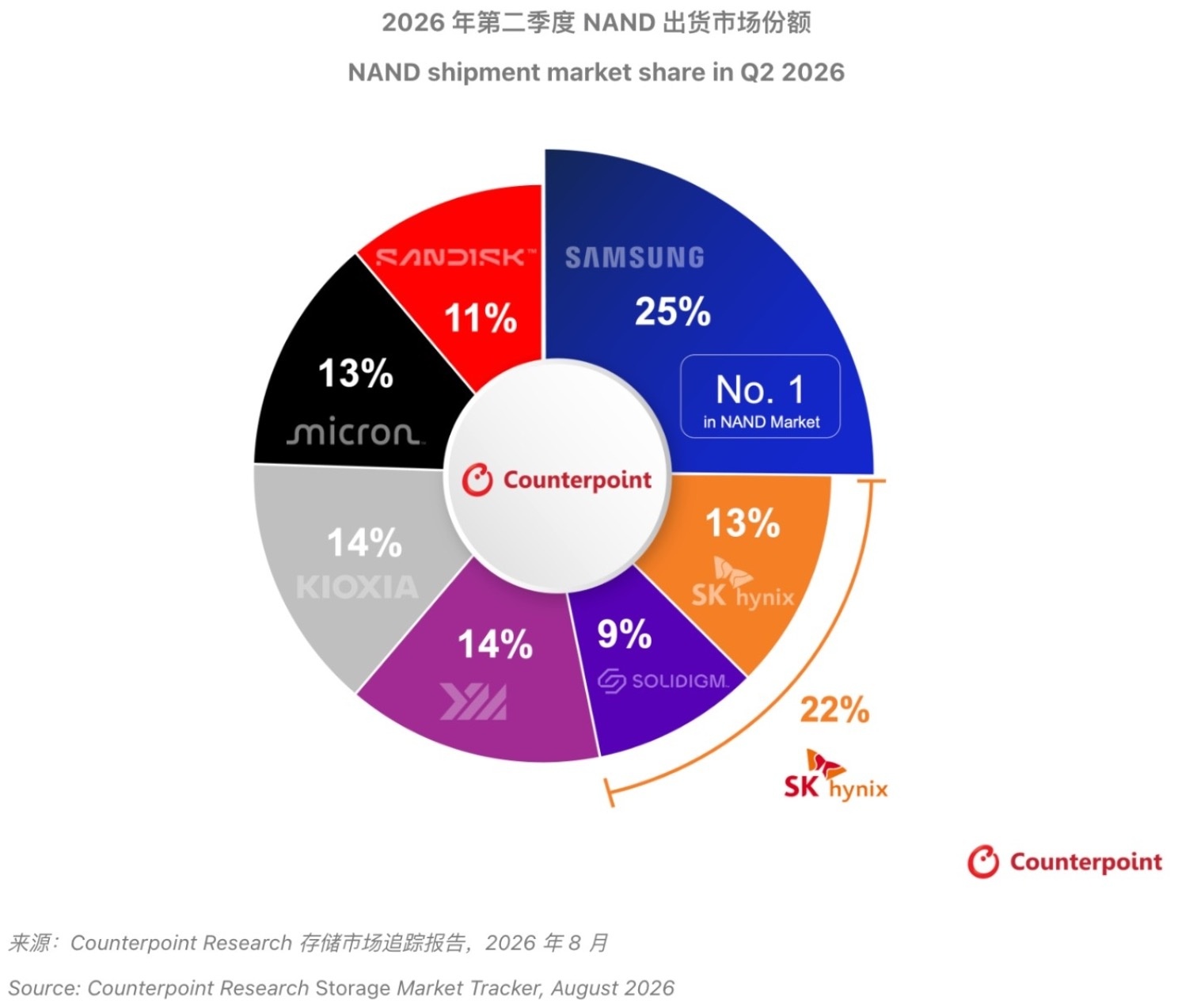
[Source: Counterpoint Research]
However, Kioxia has expressed its intention to catch up. Data centers represent the fastest-growing segment in the NAND market, but Kioxia lags behind its South Korean rivals in this area. The $31 billion expansion plan directly addresses this gap, with the new Kitakami plant dedicated to producing high-density 3D flash memory chips for AI data centers, establishing a differentiated division of labor from the consumer electronics focus of the Yokkaichi plant.
However, competitors are not standing still. Both South Korean companies are expanding capacity simultaneously, and Samsung has already begun mass production of data center storage drives for Nvidia's Vera Rubin platform this quarter, further consolidating its advantage in the enterprise market.
Overall, Kioxia's capacity expansion is a necessary step to narrow the market share gap with top rivals, but the likelihood of overtaking them in the short term remains low.
Recommended Articles


