




Did Alphabet Just Say Checkmate to Micron?
Key Points
Micron is a key memory supplier.
Memory capacity was a bottleneck in the AI supply chain.
- 10 stocks we like better than Micron Technology ›
Alphabet (NASDAQ: GOOG) (NASDAQ: GOOGL) just dropped a bombshell that is sending waves through the stock market, especially in the memory chip sector.
Before Alphabet's announcement, the assumption was that memory capacity for AI computing chips would be in a supply constraint for several years, leading to soaring memory prices.
Will AI create the world's first trillionaire? Our team just released a report on the one little-known company, called an "Indispensable Monopoly" providing the critical technology Nvidia and Intel both need. Continue »
However, Alphabet's latest breakthrough may have changed that notion, which has triggered a sell-off in Micron's (NASDAQ: MU) stock, one of the leading memory unit providers. The damage isn't just isolated to Micron; it has also affected Sandisk and SK Hynix, other leading memory providers.
But is this reaction warranted? Or is there a real issue here?

Image source: Getty Images.
TurboQuant is reducing the amount of memory needed for generative AI
Generative AI requires a ton of memory capacity. As models are trained on more and more information, accessing some of the training data or previous conversations requires a ton of memory capacity. Google refers to this as a "needle in a haystack," which is a perfect description of the challenge these models face. However, Google may have solved part of this issue with its TurboQuant algorithm. This algorithm reduces the amount of memory needed by generative AI models by six times, which logically triggered a collapse in memory stocks.
Since the paper was published on March 24, Micron's stock is down nearly 20%, matching the sell-off in its peer, Sandisk. The assumption is that the customers are going to need six times less memory than before, which would clear the memory bottleneck that AI hyperscalers are currently facing. Additionally, Google made this algorithm open-sourced, so everyone, including its competitors, has access to it. With every AI company needing potentially less memory and the ability to integrate this breakthrough overnight, there is a lot of fear in memory chip stocks.
However, I think that may be a bit too broad an assumption.
The Jevons Paradox may be at work here
One item that isn't discussed is how constrained AI models were before this breakthrough. Memory was a limiting factor, and with companies like Micron only being able to fulfill half to two-thirds of customer orders, there was no end in sight. Additionally, Micron projected the high-bandwidth memory market, the type primarily used for AI, would expand from $35 billion to $100 billion from 2025 to 2028 due to increased memory demand.
Just because AI companies can be more efficient with memory doesn't mean prices will automatically fall. The Jevons Paradox notes that when something becomes cheaper or more efficient, demand can actually rise due to it becoming more accessible. That could happen with memory chips, as demand may rise because AI is becoming better at utilizing them.
This would keep the status quo going for Micron, making the sell-off a potential buying opportunity. The market has been fairly bearish on Micron's stock since its latest earnings reports, and shares are down 30% since then, despite guiding for its revenue to rise to $33.5 billion, up from $23.9 billion in its latest quarter, and $13.6 billion the quarter before that.
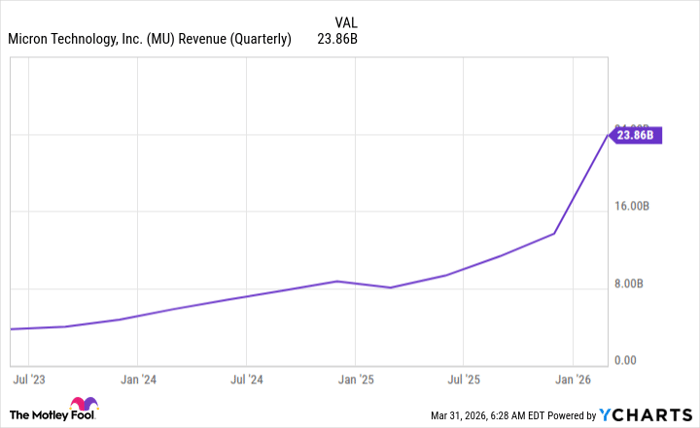
MU Revenue (Quarterly) data by YCharts
I think investors don't need to rush and buy Micron's stock right now, as the TurboQuant news is still being digested. Investors should keep an eye on consumer memory prices (by looking at RAM stick prices) and see if they fall. If they do, then Micron's stock could be facing falling product prices, which would give investors a reason to steer clear. If prices stay elevated, then that's an indication that there is still a large memory supply constraint, and the Jevons Paradox is real and active for memory demand.
Personally, I think the TurboQuant breakthrough is huge news. Still, AI companies are going to find a way to utilize all of the freed up memory capacity differently, leading to still-elevated memory chip demand, making Micron a smart buy now.
Should you buy stock in Micron Technology right now?
Before you buy stock in Micron Technology, consider this:
The Motley Fool Stock Advisor analyst team just identified what they believe are the 10 best stocks for investors to buy now… and Micron Technology wasn’t one of them. The 10 stocks that made the cut could produce monster returns in the coming years.
Consider when Netflix made this list on December 17, 2004... if you invested $1,000 at the time of our recommendation, you’d have $532,066!* Or when Nvidia made this list on April 15, 2005... if you invested $1,000 at the time of our recommendation, you’d have $1,087,496!*
Now, it’s worth noting Stock Advisor’s total average return is 926% — a market-crushing outperformance compared to 185% for the S&P 500. Don't miss the latest top 10 list, available with Stock Advisor, and join an investing community built by individual investors for individual investors.
See the 10 stocks »
*Stock Advisor returns as of April 4, 2026.
Keithen Drury has positions in Alphabet. The Motley Fool has positions in and recommends Alphabet and Micron Technology. The Motley Fool has a disclosure policy.
Recommended Articles


