




Nvidia's Blackwell and Rubin Chips Will Have $1 Trillion in Lifetime Sales. What Does That Mean for Nvidia's Stock?
Key Points
Nvidia expects huge growth over the next few years.
The market isn't pricing in any growth after 2026.
- 10 stocks we like better than Nvidia ›
Nvidia (NASDAQ: NVDA) has given investors some jaw-dropping projections over the past few years, and during the company's 2026 GTC event, CEO Jensen Huang gave investors another one to unpack.
Huang told investors that the management expects $1 trillion in lifetime sales for their current-generation Blackwell chips and next-generation Vera Rubin chips by the end of 2027. The market has basically ignored this commentary, as the stock has declined since the projection was given.
Will AI create the world's first trillionaire? Our team just released a report on the one little-known company, called an "Indispensable Monopoly" providing the critical technology Nvidia and Intel both need. Continue »
However, I think investors need to be taking this project a lot more seriously than the market is, as it could be signaling that Nvidia has far greater upside ahead.
Image source: The Motley Fool.
Huang just told investors that 2027's growth will be rapid
Another piece of context that investors need is Huang's projection from last year. During last year's event, he told investors that lifetime sales for these two units would total $500 billion by the end of 2026. This means that there is $500 billion in sales coming next year. While that increase could partially be attributed to greater 2026 demand, it's easier to assume that it's all coming next year.
But what does all of this mean for Nvidia's growth rates?
First, let's look at when Blackwell chips started being sold. The first primary sales of Blackwell chips began in the fourth quarter of fiscal year (FY) 2025 -- encompassing late 2024 to early 2025. Throughout FY 2026 (ended January 2026), Nvidia generated $216 billion in revenue. Not all of those sales came directly from Blackwell chips, but it's fair to assume a good number of them did. For FY 2027, Wall Street analysts expect $369 billion in revenue -- up 71% year over year. For FY 2028 (encompassing most of 2027), they expect $480 billion in sales.
That's just over $1 trillion in revenue when it's all added up. Still, the issue is that next year's sales don't crack $500 billion, even when Nvidia increased its sales projections by extending the calendar only one more year. I think this is a pretty clear-cut case of the market underprojecting the Nvidia growth thesis -- something it has done since the artificial intelligence (AI) race began in 2023.
If you look at AI hyperscaler spending, all the clues are there as well. Several companies are constructing AI data centers right now, and those can take years to build. Filling them with computing chips is usually the last piece that's done; that way, the owner can have the most advanced chips available at the time. With several data center projects being announced in 2025, it may not be until 2027 or 2028 that they are ready to purchase chips from Nvidia.
The market isn't pricing that in, and I think that's why investors need to be loading up on Nvidia's stock while it's still cheap.
The market is pricing in only one year's worth of growth
Nvidia's stock is currently trading for 35 times earnings and 20.6 times forward earnings.
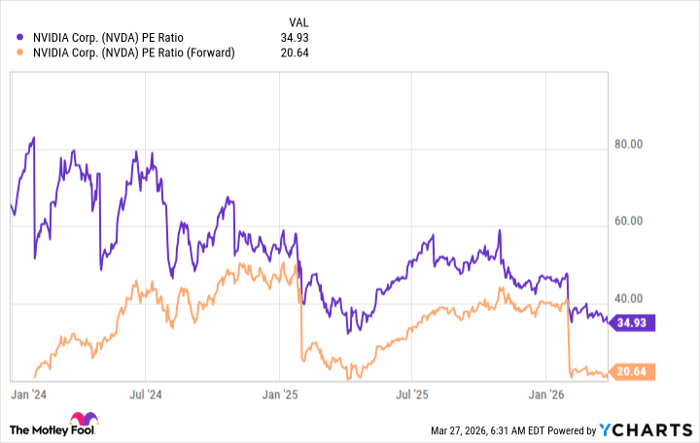
NVDA PE Ratio data by YCharts. PE Ratio = price-to-earnings ratio.
For reference, the S&P 500 is trading for only 23.8 times trailing earnings and 20.6 times forward earnings. This valuation is telling investors that the market expects 2026 to be a strong year, but after that, Nvidia is just a market-average stock.
However, it's clear that isn't true due to strong long-term growth projections from Nvidia, third-party sources, and component suppliers, such as Taiwan Semiconductor Manufacturing. The market is still a bit wary of all the AI spending going on, but the reality is that it's going to happen, and the best thing investors can do is invest in stocks like Nvidia that are set to make a fortune from the AI build-out. With Nvidia's cheap stock price, there are few stocks better to buy right now.
Should you buy stock in Nvidia right now?
Before you buy stock in Nvidia, consider this:
The Motley Fool Stock Advisor analyst team just identified what they believe are the 10 best stocks for investors to buy now… and Nvidia wasn’t one of them. The 10 stocks that made the cut could produce monster returns in the coming years.
Consider when Netflix made this list on December 17, 2004... if you invested $1,000 at the time of our recommendation, you’d have $515,294!* Or when Nvidia made this list on April 15, 2005... if you invested $1,000 at the time of our recommendation, you’d have $1,077,442!*
Now, it’s worth noting Stock Advisor’s total average return is 914% — a market-crushing outperformance compared to 184% for the S&P 500. Don't miss the latest top 10 list, available with Stock Advisor, and join an investing community built by individual investors for individual investors.
See the 10 stocks »
*Stock Advisor returns as of April 2, 2026.
Keithen Drury has positions in Nvidia and Taiwan Semiconductor Manufacturing. The Motley Fool has positions in and recommends Nvidia and Taiwan Semiconductor Manufacturing. The Motley Fool has a disclosure policy.
Recommended Articles


